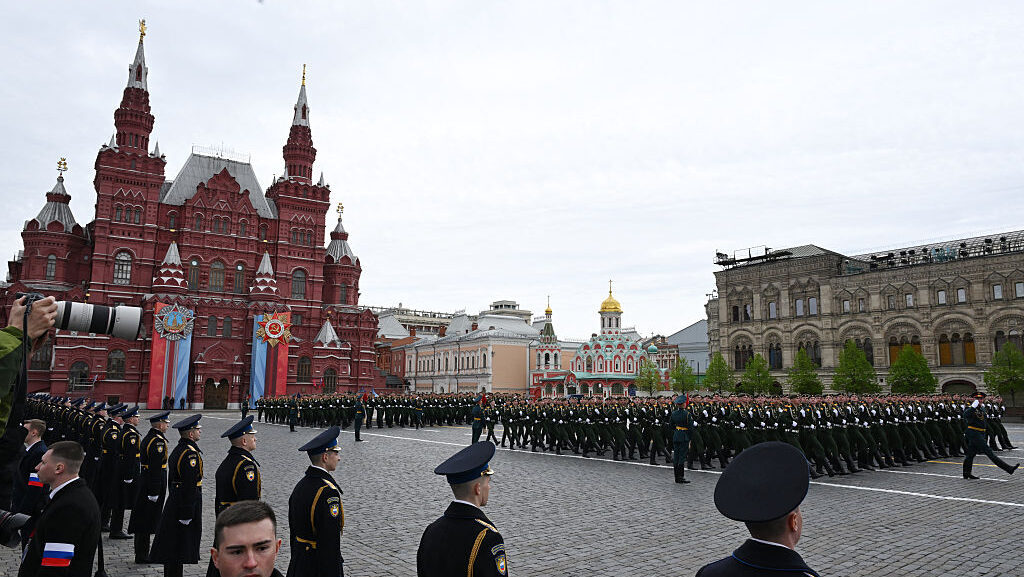
A Parade Built for Strength Looked Unusually Cautious
Russia’s Victory Day parade in Moscow is normally treated as an annual display of military confidence: heavy armor, new systems, disciplined ranks and a carefully staged message of national power. This year’s event on Red Square landed differently. According to analysts cited by Breaking Defense, the most notable feature of the May 9, 2026 parade was what was missing.
Moscow scaled back both equipment and personnel, and the reduction was widely interpreted by outside observers as more than a symbolic trim. Analysts said the subdued presentation reflected an underlying concern that even the center of Russian state pageantry is no longer insulated from the risks created by the war in Ukraine.
That matters because Victory Day is not just ceremonial. It is one of the Kremlin’s most visible opportunities to show domestic audiences, foreign governments and the defense community what the Russian military wants the world to believe about its readiness and staying power. A smaller, more tightly controlled event therefore carries political meaning well beyond parade choreography.
Analysts Read the Omissions as a Message
Breaking Defense reported that the usual accompaniment of high-end weapon systems and expansive power projection was absent. Rather than suggesting restraint from a position of comfort, several analysts said the decision pointed to persistent vulnerability. Timothy Ash of Chatham House described the event as showing “real vulnerability,” arguing that the caution on display reflected broader nervousness in Moscow about the sustainability of the war and the pressure on Russia’s economy.
Others drew a similar conclusion from the security environment around the event. Alexander Baunov of the Carnegie Russia Eurasia Center argued ahead of the parade that a military spectacle held furtively, with reduced public rehearsal and internet jamming aimed at limiting drone navigation risks, communicates fear rather than confidence. Natia Seskuria of the Royal United Services Institute likewise described the parade as subdued and said it signaled vulnerability rather than strength.
The central point in these assessments is not simply that Russia chose to show less hardware. It is that the state appeared to behave as though a showcase in its own capital required extraordinary caution. For analysts who track public military signaling, that shifts the parade’s meaning from a message of deterrence to a sign of defensive anxiety.
Ukraine’s Reach Is Shaping Russian Behavior
The analysts quoted by Breaking Defense tied the scaled-back event to the durability of Ukrainian resistance and, in particular, to Kyiv’s demonstrated ability to threaten targets beyond the immediate frontline. Ash argued that Ukraine has held the front and pushed back using technology, including deep-strike capabilities.
That interpretation suggests a broader change in the war’s strategic psychology. For much of the conflict, Russia has tried to project depth, mass and inevitability. A parade constrained by fear of possible attack complicates that image. Even without a strike occurring, the need to plan around one can alter the political effect of the event.
This does not by itself prove a decisive shift in battlefield momentum, and the parade is only one data point. But public rituals of power matter precisely because governments use them to manage perception. When the ritual is visibly narrowed for security reasons, outside observers are likely to treat that as evidence that the threat environment has become harder for the Kremlin to dismiss.
What the Display Did Not Show
Breaking Defense noted that last year’s parade included upgraded main battle tanks including the T-72B3M, T-80BVM and T-90M, while Janes reported that only one truly new land vehicle had appeared in 2025. Against that background, this year’s further reduction stood out. President Vladimir Putin told journalists that military equipment was not displayed in 2026 for security reasons.
That explanation is important because it acknowledges the same core issue the analysts highlighted: the event was shaped less by celebration than by risk management. When a state openly cites security concerns for limiting its most symbolic military parade, it invites scrutiny about what kinds of threats it now considers credible.
The larger question is whether this becomes a one-off adjustment or an enduring pattern. If future parades remain scaled back, analysts may treat 2026 as a marker of how far the war’s pressures have reached into Russian public life. If Moscow restores a fuller display, the Kremlin will likely try to recast this year as a temporary exception. For now, however, the takeaway from Red Square is unusually stark: a ceremony designed to communicate power instead prompted fresh discussion about fragility.
This article is based on reporting by Breaking Defense. Read the original article.
Originally published on breakingdefense.com