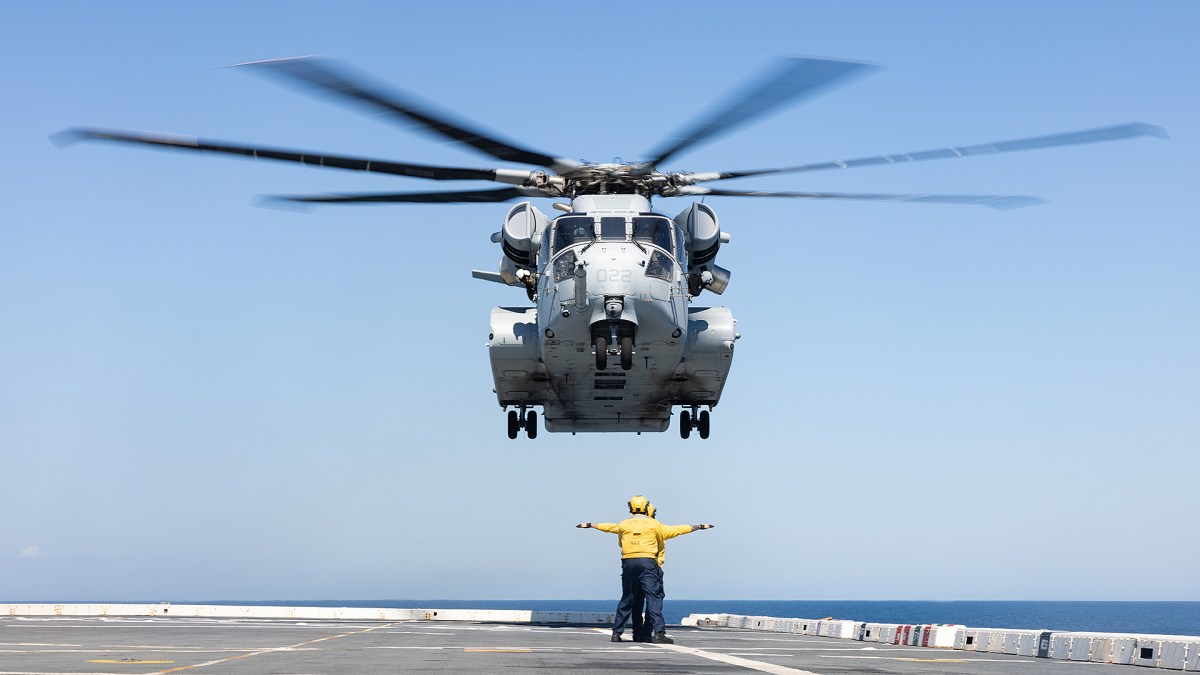
The Marine Corps is moving the CH-53K into a more operational phase
The U.S. Marine Corps is signaling a more confident turn in its long transition to the CH-53K King Stallion, with the heavy-lift helicopter now approaching its first operational deployment and a broader production ramp in the years ahead. Program officials said the aircraft’s planned trip to sea with the 26th Marine Expeditionary Unit is not just a milestone for the platform itself, but a marker that the Corps is beginning to treat the CH-53K as the center of its future heavy-lift fleet.
That shift matters because the CH-53K has long been framed as the successor to the aging CH-53E Super Stallion while also sitting alongside the MH-53E mission set. At the Modern Day Marine conference in Washington, D.C., Marine Corps program manager Col. Kate Fleeger described the legacy CH-53E and MH-53E fleets as still healthy and viable, but made clear that the institutional focus is now on the newer aircraft.
The message from the Corps is that the King Stallion is no longer merely a developmental promise. It is becoming an increasingly established fleet asset, backed by more squadrons, more training activity, and a clearer production path.
Where the aircraft stands now
According to the Marine Corps update, four squadrons currently have CH-53Ks in their inventory. Marine Heavy Helicopter Squadron 461, identified as the first fleet squadron, is now fully equipped with the aircraft. The training squadron, HMHT-302, has also received multiple CH-53Ks and is expected to remain a dual-type training unit during the transition from the older Echo model to the newer Kilo.
The helicopter is also present in the developmental test community at HX-21 in Patuxent River and with the operational test squadron VMX-1 in Yuma, Arizona. That distribution shows a program spanning fleet use, training, and test work at the same time, which is usually what a maturing platform looks like as it moves from introduction toward routine service.
The operational deployment piece is especially important. Going to sea with the 26th Marine Expeditionary Unit places the CH-53K in the expeditionary environment the Corps cares most about, where lift capacity, reliability, and supportability all matter under real-world conditions.
Production is still climbing
The Corps said deliveries are starting to ramp up, with the planned milestone of 16 aircraft annually now expected in Fiscal Year 2029. That date is also tied to the current plan for full-rate production. In practical terms, the update suggests the service sees enough progress to keep building toward a larger, steadier acquisition rhythm, even if the highest production tempo is still several years away.
That timeline underscores both progress and caution. The program is advancing, but it is not yet in the high-volume phase. For the Marines, that means continuing to operate the legacy fleet while carefully expanding the footprint of the CH-53K. For industry, it means the King Stallion remains in the proving-and-scaling stage rather than the fully normalized stage.
The Corps’ language nevertheless points to a program with more momentum than uncertainty. Fleeger described the CH-53K as “rocking and rolling across the board,” reflecting a tone that was notably more about execution than rescue.
A future mission may already be in view
One of the more consequential signals from the Marine Corps was its openness to developing a mine-countermeasures version of the CH-53K. That would position the aircraft as a possible replacement for the MH-53E in that mission area. No formal new variant was announced, but the willingness to discuss the idea indicates the platform may eventually be asked to cover more than heavy-lift transport alone.
If that happens, it would deepen the CH-53K’s role in Marine aviation and potentially reshape how the service thinks about mission consolidation around newer airframes. Even without a program of record yet, the fact that this possibility is being discussed publicly shows a growing level of confidence in the helicopter’s long-term utility.

Why this moment matters
The CH-53K has to do more than replace an older helicopter. It has to convince the Marine Corps that it can anchor future expeditionary logistics at scale. The latest update suggests that confidence is building through incremental but visible signs: more squadrons equipped, a clearer training pipeline, operational and developmental testing still active, a first deployment on the horizon, and a production ramp now pinned to a specific fiscal target.
That does not mean the transition is complete. The Corps is still relying on its CH-53E and MH-53E fleets, and full-rate production is not expected until Fiscal Year 2029. But the balance is shifting. The King Stallion is moving from promise to presence, and the Marine Corps now appears increasingly willing to plan around it rather than simply plan for it.
This article is based on reporting by twz.com. Read the original article.
Originally published on twz.com