Satellite imagery offers a rare look at a fast-moving test effort
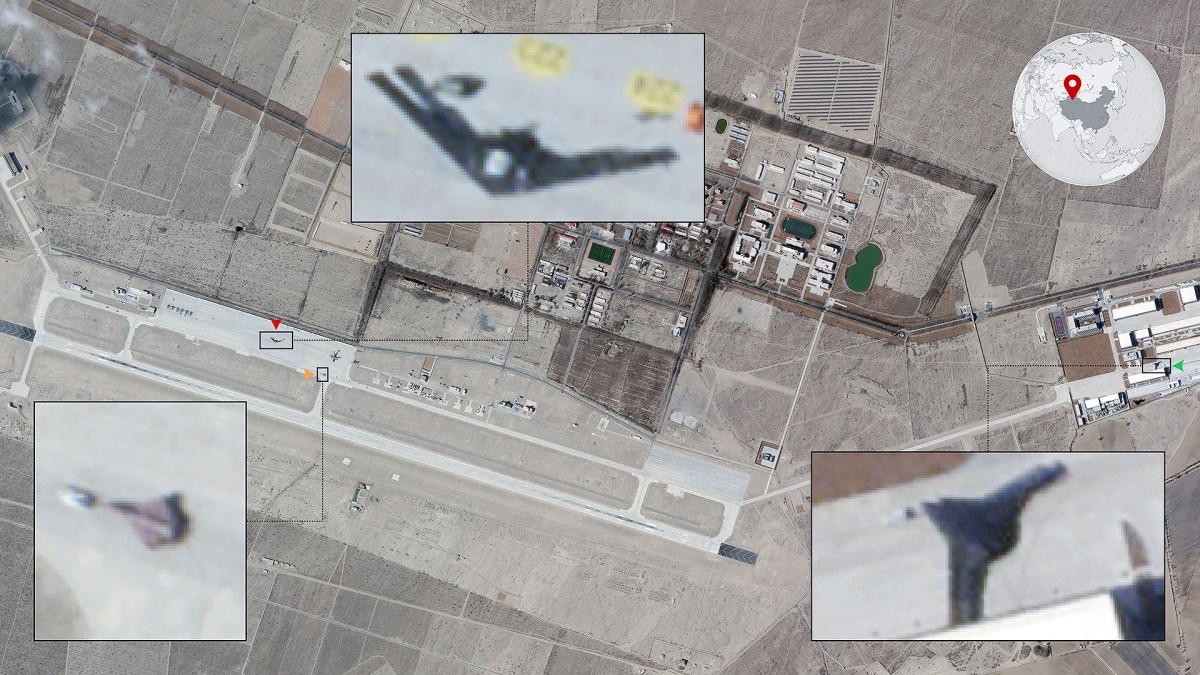
New satellite imagery is providing one of the clearest public snapshots yet of China’s advanced stealth drone work. Images dated March 26, 2026 show two very large flying-wing unmanned aircraft at the secretive Malan test base, a site long associated with leading-edge People’s Liberation Army unmanned aircraft development. The significance is not just that the aircraft exist. It is that both were seen outside their hangars at the same time, with one later observed taxiing toward the runway and apron area.
That matters because it points to a broader tempo of activity rather than a one-off appearance. Public reporting on highly classified test programs often advances through small visual clues, and in this case the imagery suggests a notable uptick in trials involving multiple large, stealth-oriented designs. For outside analysts, simultaneous visibility of both aircraft helps confirm that China is not working on a single experimental flying wing in isolation. It appears to be pushing more than one path in parallel.
Two distinct aircraft, two different operational possibilities
The larger of the two aircraft, sometimes dubbed the “Monster of Malan,” is described as having a wingspan of roughly 173 feet, putting it in the same general width class as the B-2 Spirit bomber. Details about its official designation and manufacturer remain unknown, but its size alone places it in a category well beyond small tactical drones. Aircraft of that scale imply long endurance, high payload potential, and strategic missions rather than localized battlefield use.
The second aircraft, a cranked-kite flying wing with an estimated 137-foot wingspan, appears smaller in span but may carry a different balance of weight, ceiling, and mission tradeoffs. Reporting tied to the imagery says this design is suited for intelligence, surveillance, and reconnaissance roles. That distinction is important. A dual-track test effort involving one extremely large flying wing and another shaped for a slightly different operating profile suggests China may be exploring a family of high-end unmanned systems rather than a single flagship platform.
Even within the limited facts available, the visible diversity of design tells a story. One aircraft seems optimized around maximum span and persistence. The other appears to reflect a different mission mix. Both remain stealthy flying-wing concepts, reinforcing the idea that low observability and endurance are central requirements.
Why Malan matters
Malan is not just another airfield. It has become closely associated with sensitive aerospace and unmanned aircraft work. When unusual vehicles appear there, the location adds weight to the interpretation. In this case, observers say the base has been on the leading edge of unmanned combat aircraft development. That makes the March imagery more consequential than a routine spotting at a conventional operating base.
The aircraft were first identified in archived imagery last year, but until now they had not been captured together outside their hangars, nor seen on the main apron in this way. That progression from hidden existence to more active movement is the real signal. Programs usually become more visible as testing grows more frequent, operational handling expands, and confidence in the airframe increases.
What the imagery does and does not prove
There is still much the public cannot know from satellite imagery alone. The images do not reveal propulsion details, onboard sensors, datalinks, weapons integration, or production plans. They do not prove service entry is near. They also do not answer whether either design is intended for reconnaissance, strike, electronic warfare, or some combination of roles.
But they do support several narrower conclusions. China has at least two very large stealthy flying-wing unmanned aircraft associated with a sensitive test location. Activity around those aircraft appears to be increasing. And the scale of the designs signals strategic ambition. For military planners in the United States and across Asia, even that limited set of facts is meaningful.
A broader shift in unmanned airpower
The larger implication is that China’s military aviation ecosystem is continuing to invest in long-range, survivable unmanned systems. Very large flying-wing aircraft could fit missions that benefit from persistence, reduced radar signature, and access to contested airspace. Whether used for surveillance, targeting support, strike, or other high-end tasks, such systems would align with a broader global push toward more autonomous and more survivable airpower.
The March 26 imagery does not settle what these aircraft will become. What it does is narrow the space for doubt. These are not isolated curiosities buried in rumor. They are real airframes at a known test base, and the visible rhythm of activity around them appears to be accelerating.
For now, that is enough to make Malan one of the more important places to watch in military aerospace. In an era when strategic competition increasingly turns on who can sense farther, survive longer, and operate with less risk to pilots, the appearance of two massive Chinese stealth flying wings on the apron at once is more than an interesting image. It is a marker of capability development that is becoming harder to hide.
This article is based on reporting by twz.com. Read the original article.
Originally published on twz.com