Boeing Braces for More Air Force One Overruns
Boeing expects additional cost growth on the long-delayed VC-25B program as it works to deliver the next Air Force One aircraft by 2028, according to the head of the company’s defense business. The statement is the clearest recent signal that one of the Pentagon’s most visible fixed-price aircraft programs remains financially painful even as it moves deeper into final assembly and certification work.
Speaking ahead of the Farnborough Airshow, Boeing defense chief Steve Parker said he expects further cost growth as the company completes wiring, structures and certification work. The company’s focus, he said, is on hitting the 2028 timeline. That framing matters because it suggests Boeing is still willing to absorb more near-term financial damage in order to stabilize the schedule on a high-profile presidential transport program that has already become a symbol of industrial complexity, contracting risk and program delay.
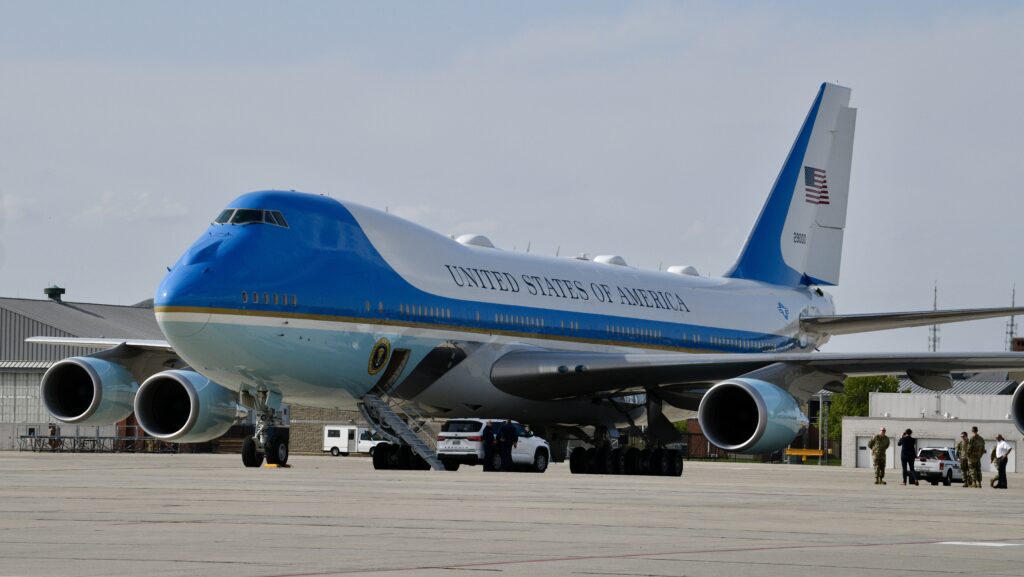
The VC-25B effort has been under pressure for years. The aircraft are intended to replace the current presidential airlifters, but the program has suffered technical setbacks, workforce challenges and repeated schedule slips. The source reporting notes that delivery was initially anticipated for 2024. It is now projected for mid-2028 for the first aircraft.
The Fixed-Price Contract Is Still the Central Issue
What makes the latest warning especially important is the commercial structure behind the program. Boeing is financially responsible for cost overruns under the firm, fixed-price agreement struck in 2018, which set a ceiling of $3.9 billion. In a normal cost-plus defense arrangement, some portion of overruns can be passed back to the government. Here, Boeing carries the overage itself.
That contract structure has already proved expensive. According to the source report, Boeing has taken about $2.8 billion in charges on the VC-25B program so far. Parker declined to comment on the timing of any additional charges because Boeing is in a quiet period ahead of its quarterly earnings report, but his remarks strongly indicate that the financial burden is not finished.
For defense contractors, fixed-price development programs can look attractive at award, especially when they offer prestige or strategic importance. But when requirements are complex, engineering changes accumulate, or certification work becomes more difficult than expected, the economics can deteriorate quickly. The Air Force One replacement program appears to embody those risks. It combines high-assurance communications, security, survivability and presidential transport requirements with the realities of modifying large commercial aircraft into uniquely specialized platforms.
That difficulty is visible in Parker’s own emphasis. His comments centered on finishing the wiring and structures and completing certification, all areas where late-stage complexity can drive both delay and rework. These are not cosmetic tasks. On a presidential aircraft, they sit close to the heart of safety, mission assurance and technical compliance.
Progress Is Real, but So Are the Remaining Risks
Boeing says all engineering on the VC-25B was completed last year and that aircraft modifications are now underway, with testing on the first aircraft intended to begin next year. That is meaningful progress. It suggests the program has moved beyond earlier phases where unresolved engineering work can create cascading uncertainty across the build.
Still, finishing engineering does not eliminate execution risk. Final integration is often where complex aerospace programs encounter some of their most expensive surprises. Systems that work on paper or in isolated subsystems still have to function together in a fully modified aircraft that satisfies every technical specification. Wiring, structural modifications and certification can all expose mismatches between design assumptions and real-world installation constraints.
Parker’s public message reflects that tension. On one hand, Boeing wants to reassure the Pentagon and political stakeholders that it is pressing forward and will not compromise on safety. On the other, it is preparing observers for additional financial pain. In effect, the company is saying the program is advancing, but not cheaply.
That distinction matters because schedule recovery in defense aviation is rarely free. Compressing work, maintaining specialized labor and resolving integration issues under time pressure can increase cost even when the calendar improves. Boeing appears to be signaling that the priority is no longer to protect margins on the contract. It is to get the aircraft finished and delivered.
A Program With Political and Strategic Visibility
The presidential airlift fleet is a uniquely visible part of the US military aviation portfolio. Delays therefore carry unusual political sensitivity. The reporting notes that, because of the slippage, President Donald Trump accepted a Boeing 747 from the Qatari royal family that is intended to be modified as a presidential transport aircraft ahead of VC-25B delivery. That aircraft, described as the VC-25B Bridge aircraft, was delivered in June.
The very existence of a bridge aircraft underscores how far the schedule has shifted. Interim solutions are usually a sign that an operational need cannot simply wait for the original acquisition timeline to recover. In this case, the gap between planned and actual delivery has become large enough to require a stopgap measure for one of the world’s most symbolically important air transport roles.
At the same time, the Air Force has continued to make adjustments within the program. The source report cites a December contract modification worth $15.5 million for communications equipment to be integrated into the aircraft, pushing the cumulative deal value to just over $4.3 billion. The Air Force said at the time that the added work would be accomplished within the current program schedule. That means Boeing’s newly signaled cost growth is emerging even as the target date remains officially mid-2028.
For the Pentagon and for Boeing investors, this creates a familiar but difficult equation. The government still needs the aircraft. Boeing still needs to execute. But each additional charge reinforces the lesson that prestige programs do not guarantee profitable ones, especially when fixed-price terms meet highly customized aerospace integration.
What the Latest Warning Tells Us
The immediate news is straightforward: Boeing expects more cost overruns on Air Force One and is prioritizing 2028 delivery. The broader implication is more consequential. The program remains a case study in how demanding military modification work can strain even the largest defense contractors when schedule, certification and unique requirements collide inside a fixed-price contract.
It also highlights the gap between engineering milestones and true program stability. Completing engineering and entering modification work are important achievements, but they do not automatically erase the possibility of late-stage complications. Parker’s comments suggest Boeing is now operating in that difficult last stretch where the program looks more mature on paper but may still generate expensive surprises in practice.
For industry watchers, the VC-25B remains worth following not only because of its political visibility, but because it says something broader about aerospace execution. Programs with legacy airframes, bespoke mission systems and uncompromising standards can remain vulnerable long after their designs appear settled. Boeing’s latest warning is therefore not just about Air Force One. It is also about the enduring cost of complexity in defense aviation.
This article is based on reporting by Breaking Defense. Read the original article.
Originally published on breakingdefense.com