Argentina retires a legacy fighter fleet
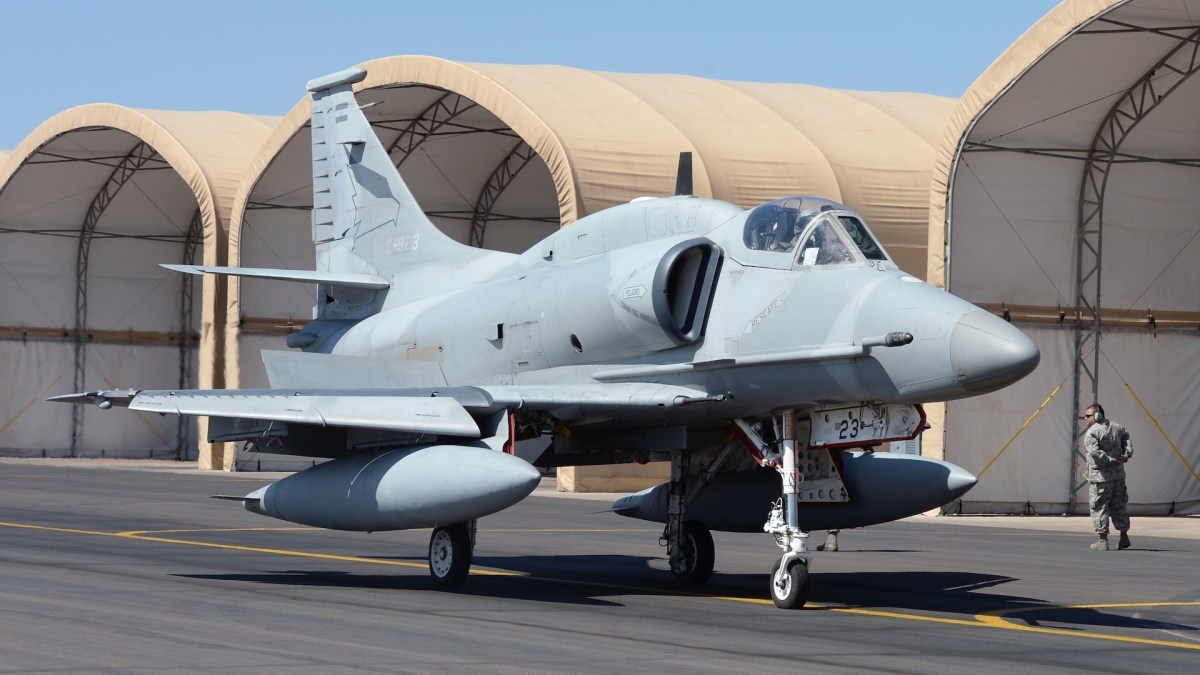
Argentina has formally withdrawn its remaining A-4AR and OA-4AR Fightinghawks, ending roughly six decades of service for the Skyhawk family in the country. The Argentine Air Force announced the definitive decommissioning of the fleet at Villa Reynolds Air Base in San Luis province, home to the last local A-4 unit, the 5th Air Brigade.
The move closes the book on one of the longest-running Skyhawk stories anywhere in the world. Argentina was the first export operator of the A-4, and the type remained part of its inventory long after many other users had moved on. In its final Argentine form, the Fightinghawk was a uniquely national variant created through a major modernization effort built around former U.S. Marine Corps A-4M and OA-4M aircraft taken from storage.
Why the fleet is being retired now
According to the Argentine Air Force, the decision was tied to “operational efficiency and economic sustainability.” The service also pointed to the growing burden of maintaining and sustaining an aging jet fleet. Those pressures have become increasingly difficult to manage, and the economics of keeping the aircraft flying no longer aligned with the broader modernization path the service is now pursuing.
The retirement coincides with the arrival of Argentina’s first F-16s, making the timing especially significant. Rather than simply trimming an old fleet, the air force is using the moment to shift to a new fighter system that it says will help overhaul national capabilities. That makes the Fightinghawk’s exit more than a ceremonial farewell: it is part of a structural transition in how Argentina intends to equip its combat aviation arm.
A long second life for the A-4
The aircraft leaving service were not standard legacy Skyhawks. Argentina’s A-4AR and OA-4AR Fightinghawks emerged from a Lockheed Martin-led modernization program applied to ex-U.S. Marine Corps airframes. That effort gave the country a refreshed but still fundamentally older platform, one that extended service life and relevance but could not eliminate the underlying age of the design.
For years, the Fightinghawk provided Argentina with an affordable way to preserve a fighter capability despite tight constraints. The type remained familiar, relatively compact, and operationally useful, but every additional year in service increased the challenge of sustainment. Aging aircraft tend to demand more maintenance hours, more parts support, and more careful fleet management, and the Argentine Air Force indicated that these pressures had become central to the retirement decision.
The meaning of the F-16 transition
The introduction of the F-16 gives Argentina a very different path forward. While the supplied source material does not detail the full structure of the new fleet, it makes clear that F-16 familiarization flights are already underway and that the aircraft is now being presented as the service’s new fighter. In institutional terms, that marks a notable reset.
The replacement is also symbolically important. Retiring a venerable platform is one thing; replacing it with a widely used fourth-generation fighter is another. The shift suggests that the Argentine Air Force is trying to move away from prolonged stopgap sustainment and toward a more contemporary baseline for air defense and fighter operations.
That does not mean the transition will be effortless. Any fleet change of this kind brings training, logistics, maintenance, and doctrine implications. Pilots, technicians, and planners all have to adapt. But the source material shows that the service is already framing the F-16 as part of its commitment to integrated aerospace defense, underscoring that this is intended to be an operational change, not just a procurement headline.
An inflection point for Argentine airpower
The end of the Fightinghawk fleet is the kind of milestone that compresses history into a single decision. Argentina kept the A-4 relevant through modernization and persistence, but even a successful life-extension strategy eventually reaches its limit. The service has now acknowledged that keeping the jets in operation no longer makes enough practical or economic sense.
For observers of Latin American airpower, the retirement is notable because it pairs an emotionally resonant goodbye with a more consequential question about what comes next. The A-4 was familiar, proven, and deeply tied to Argentine service history. The F-16 represents a different ambition: a move toward renewed capability and a more sustainable future fighter structure.
What is clear from the announcement is that Argentina has made its choice. The Skyhawk chapter is over, and the air force is using that ending to define the start of a new one.
This article is based on reporting by twz.com. Read the original article.
Originally published on twz.com