Histidine Draws New Attention in Cancer Research
Cancer medicine has spent years looking for biomarkers that can do more than describe disease after it is already visible. The most useful markers help physicians sort risk earlier, understand how tumors behave, and tailor treatment choices with greater precision. A new analysis published in Nature Medicine puts the amino acid histidine into that conversation, describing it as a readily measurable and potentially modifiable metabolic biomarker for cancer risk stratification and treatment optimization.
That combination matters. A biomarker that is both easy to measure and, in principle, open to intervention is more attractive than one that only serves as a passive signal. The article frames histidine as a candidate that could connect metabolic profiling with more practical clinical decisions. At the same time, it makes clear that translating this kind of association into real-world oncology tools remains difficult.
Why Histidine Matters
Histidine is an amino acid, meaning it sits inside the larger metabolic systems that help cells grow, divide, repair themselves, and respond to stress. Because cancer is deeply tied to altered metabolism, researchers have long studied whether specific metabolites can reveal who is at greater risk, which tumors may behave more aggressively, or which therapies may work better in particular patients.
The significance of histidine in this context is not simply that it can be detected. Many molecules can be measured. What makes the finding notable is the suggestion that histidine may be useful for risk stratification and treatment optimization, two areas where oncology still needs better tools. Risk stratification can help determine who may need closer surveillance or earlier intervention. Treatment optimization can, in principle, help clinicians make more informed choices about how to sequence or adjust therapies.
The analysis also points to histidine as potentially modifiable. That is an important distinction because a measurable marker becomes more clinically valuable if it also reflects a pathway that can be influenced through treatment, metabolism-focused interventions, or broader supportive care strategies. Even so, potential modifiability is not the same as proven therapeutic leverage.

From Data Signal to Clinical Tool
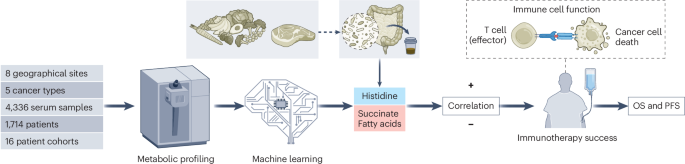
The article highlights a wider trend in cancer research: the growing use of machine learning and metabolic profiling to identify patterns that traditional clinical observation may miss. In that framework, histidine becomes part of a larger effort to mine complex biological data for signals that correlate with cancer risk and response.
This is where excitement often collides with reality. A biomarker may look promising in datasets and still fail to become a dependable clinical instrument. Associations can weaken when tested across broader populations. Measurements that seem straightforward in a controlled research setting can become harder to standardize across hospitals, labs, and patient groups. And even strong correlations do not automatically reveal whether changing the marker itself will change outcomes.
The Nature Medicine piece emphasizes exactly that tension. Histidine may be a useful metabolic readout, but turning that observation into an intervention pathway will require a much higher level of evidence. Researchers need to show not only that histidine tracks with cancer-related risk or treatment dynamics, but also how robustly it performs across tumor types, demographics, care settings, and time.
What Clinicians and Researchers Will Need Next
For histidine to move beyond a promising concept, several questions will need clearer answers. First, the field will have to establish where histidine performs best. It may prove more informative in some cancers than others, or in some phases of treatment rather than at diagnosis. Second, investigators will need to determine whether histidine adds meaningful value beyond existing biomarkers and clinical indicators.
That is a high bar. Oncology already uses a mix of imaging, pathology, genomic testing, and blood-based measures. Any new biomarker must improve decision-making enough to justify cost, workflow changes, and potential patient anxiety. A marker that is interesting biologically but redundant clinically will struggle to gain traction.
Third, if histidine is to be treated as modifiable in a medically useful way, the causal chain must become clearer. Researchers will need to understand whether histidine itself is influencing disease biology, whether it is serving as a downstream indicator of other metabolic changes, or whether it reflects broader environmental or microbiome-linked processes. That distinction affects whether clinicians could eventually intervene on the pathway with confidence.

Why This Development Still Matters Now
Despite those caveats, the emergence of histidine as a candidate biomarker is notable because it reflects where cancer medicine is heading. The field is moving toward a more integrated view of disease, one that combines metabolism, immune response, tumor behavior, and computational analysis instead of relying on a single genetic or anatomical explanation.
That shift could be especially important in areas where cancer care still depends on coarse categories. Patients with the same diagnosis often respond very differently to the same treatment. Better metabolic signals could help explain part of that variation and improve how therapy is selected or monitored.
The work also reinforces a pragmatic truth about precision medicine: the most valuable advances are not always the most technologically dramatic. Sometimes the real gain comes from identifying a measurable biological feature that can be incorporated into everyday practice if validation holds up. Histidine now appears to be one of the metabolites worth watching in that regard.
The Bottom Line
The new Nature Medicine analysis does not present histidine as a finished clinical answer. It presents it as a compelling lead. Histidine appears measurable, relevant to cancer-associated metabolism, and potentially useful for sorting risk and improving treatment decisions. But it also sits at the start of a translation problem that is common in modern biomedical research: converting a biologically persuasive association into a reliable clinical tool.
For now, the significance is twofold. First, the cancer biomarker pipeline may have gained a credible new metabolic candidate. Second, the article is a reminder that the path from discovery to practice depends not just on what can be measured, but on what can be validated, standardized, and acted upon in patient care.
This article is based on reporting by Nature Medicine. Read the original article.

Originally published on nature.com