A pathology model trained to reason in clinical language
A new paper in Nature Medicine describes a pathology foundation model designed to work at the level of entire slides while also aligning its outputs with the kinds of question-and-answer reasoning used in clinical practice. The system, called PRISM2, was trained on 2.3 million whole-slide images and 14 million clinical question-answer pairs derived from 700,000 pathology reports, according to the study published July 31.
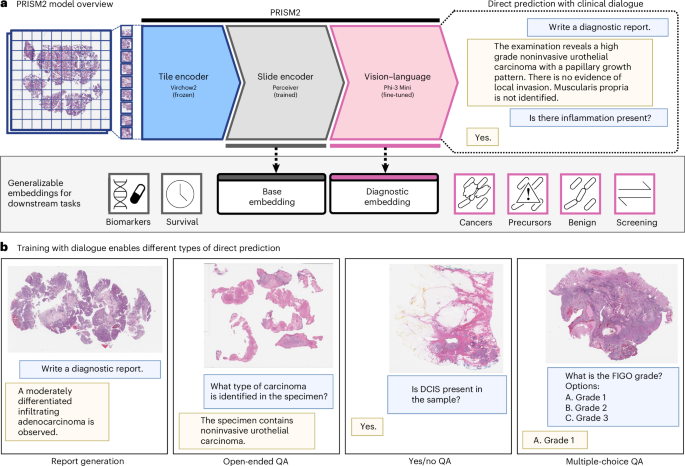
The researchers present PRISM2 as a step beyond earlier computational pathology models that focused mainly on encoding image patches. In their framing, those earlier systems helped drive rapid progress in the field, but their direct clinical utility remained limited. PRISM2 is intended to address that gap by connecting histomorphology, meaning what appears in tissue images, with diagnostic reasoning expressed through language supervision.
That pairing matters because pathology is not only a visual recognition task. In practice, clinicians interpret whole-slide findings, connect them to disease patterns, and answer specific diagnostic questions. The authors argue that this kind of dialogue-style supervision provides a scalable and clinically grounded training signal for generalizable representations.
What the model was trained on
According to the abstract, the model’s multimodal training combined slide-level pathology data with large-scale textual supervision. The image side included 2.3 million whole-slide images. The language side included 14 million question-answer pairs generated from 700,000 pathology reports. The study says this clinical dialogue supervision lets PRISM2 align visual tissue patterns with diagnostic reasoning rather than only with labels.
The result, the authors write, is a model that supports two different modes of use. One is prompt-based inference, where the model can answer task-specific prompts directly. The other is as a source of transferable embeddings that can be used in downstream tasks such as classification, biomarker work, and survival analysis.
That dual-use design is important for pathology workflows because the field spans both narrowly defined clinical products and research settings where teams may want a reusable representation layer instead of a single-purpose classifier.

How PRISM2 performed in the paper
The paper reports that, with prompt-based inference, PRISM2 achieved or exceeded the balanced accuracy of clinical-grade products calibrated for cancer detection in the prostate, breast, and breast lymph node, with statistical significance reported at P < 0.05. That is one of the clearest practical claims in the study because it places the model against systems built for clinical-grade detection rather than only against research baselines.
The authors also report that PRISM2 embeddings never statistically underperformed previous foundation models across comprehensive diagnostic, biomarker, and survival benchmarks when evaluated with linear probing, again at P < 0.05. In other words, across the benchmark set described in the abstract, the model consistently matched or bettered prior foundation-model representation quality rather than trading performance in one domain for gains in another.
A third result points to fine-tuning efficiency. The study says task-specific fine-tuning on survival prediction outperformed training from scratch on the same large survival dataset. That suggests the pretraining procedure is not only producing broad-purpose features, but also creating a strong base for specialized follow-on tasks.
Why the paper stands out
The scale of the training corpus is one reason this study is likely to draw attention. Another is the way it frames language as a bridge between visual pathology data and clinical practice. Many foundation-model efforts in medicine have focused on scale, but this paper argues that scale alone is not enough if the supervision signal does not reflect how pathology decisions are actually made and communicated.
By emphasizing clinical dialogue, the researchers are effectively trying to make the model more useful for prompt-based tasks and more interpretable in workflow terms, even though the abstract does not claim full explainability or independent clinical deployment. The study instead presents a model that is grounded in diagnostic reasoning and can transfer across several categories of pathology tasks.
That distinction matters in a field where whole-slide imaging produces extremely large and information-dense inputs. A model that can reason at slide level, rather than only through local patches, may be better positioned to capture broader structural context, tissue relationships, and disease patterns that matter in diagnosis and prognosis.

Where this could matter next
Within the bounds of the paper’s abstract, PRISM2 appears aimed at a wide middle ground between research tooling and clinically relevant model development. The reported evaluations span cancer detection, diagnostic benchmarks, biomarker benchmarks, and survival benchmarks, which suggests the authors are positioning the system as a general pathology representation model rather than a narrowly tuned product.
That does not mean the paper claims immediate routine use in hospitals. The abstract focuses on comparative performance, representation quality, and fine-tuning benefits. But the work is notable because it argues for a specific recipe for the next generation of pathology AI: train on very large slide datasets, supervise with clinically meaningful language, and evaluate across both direct prompting and downstream adaptation.
If that recipe proves robust beyond the benchmarks described in the paper, it could influence how future pathology models are built, especially for applications that need to connect visual evidence with question-driven medical reasoning.
Key points from the study
- PRISM2 was trained on 2.3 million whole-slide images.
- The language supervision used 14 million question-answer pairs derived from 700,000 pathology reports.
- The model supports prompt-based inference and transferable embeddings for downstream tasks.
- The paper reports performance at or above clinical-grade cancer detection products for prostate, breast, and breast lymph node tasks.
- The study says PRISM2 embeddings never statistically underperformed previous foundation models across the benchmark categories tested.
The broader significance is less about a single benchmark win than about the training strategy itself. PRISM2 is presented as evidence that language-supervised pretraining can connect human diagnostic reasoning to foundation-model performance in pathology. In a sector looking for systems that generalize across tasks without losing clinical relevance, that is a meaningful shift.
This article is based on reporting by Nature Medicine. Read the original article.
Originally published on nature.com