A Record Outbreak With No Licensed Countermeasures
The Democratic Republic of the Congo is confronting its seventeenth Ebola outbreak, and the figures in a new Nature Medicine correspondence are stark. As of 11 August 2026, the national response had logged 4,566 confirmed cases and 2,128 confirmed deaths, a case-fatality ratio of 46.6 percent. In the preceding 24-hour window, 118 new confirmed infections and 67 deaths were recorded — the highest daily confirmed case count of the entire outbreak.
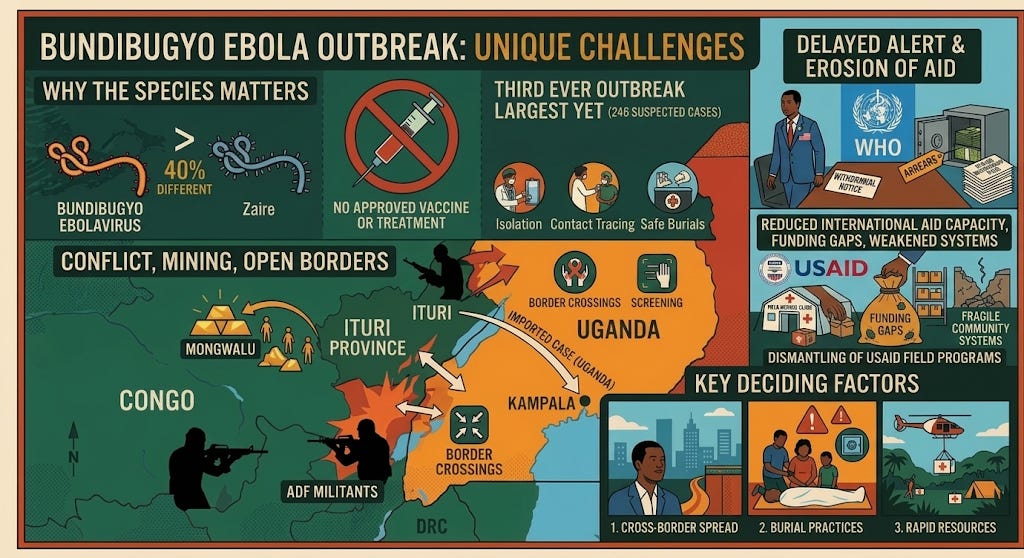
What makes this emergency different is its cause: Bundibugyo virus (BDBV). Unlike Zaire ebolavirus, for which licensed vaccines and therapeutics exist, BDBV has no approved vaccine or specific treatment. That absence shifts the burden of control onto older, labor-intensive tools — rapid detection, isolation, infection prevention and control, supportive care, contact tracing and community engagement. The authors, a team of DRC-based researchers led by Justin Kambale Kahingi and Roland Muhindo Muyisa, argue that the outbreak exposes a gap between how well the response can see transmission and how quickly it can stop it.
The Surveillance Paradox: Reach Is Not Effectiveness
By conventional dashboard standards, the DRC response is performing at high volume. During the reporting period, 324 suspected cases were validated, and 99.7 percent of them were investigated. Contact tracing reached 17,085 of 20,728 listed contacts, producing national follow-up coverage of 82.4 percent.
Those figures are often read as evidence of a functioning response. The correspondence pushes back on that interpretation. Investigated alerts and followed contacts describe the reach of surveillance, not whether surveillance happened fast enough to prevent secondary transmission. A contact visited after they have already infected others still counts toward coverage while contributing nothing to containment. The same applies to a suspected case that is eventually tested and isolated after days of unmonitored exposure.
- 4,566 confirmed cases and 2,128 confirmed deaths as of 11 August 2026
- 46.6% case-fatality ratio
- 118 new confirmed cases and 67 deaths in the preceding 24 hours
- 99.7% of 324 validated suspected cases investigated
- 82.4% follow-up coverage, with 17,085 of 20,728 contacts reached
The authors' central claim is that coverage metrics can create a false sense of security. They measure the health system's effort, but not the interval that matters most: the time between detecting a signal and intervening on it.

Why BDBV Raises the Stakes
For Zaire ebolavirus outbreaks, vaccination and therapeutics can blunt transmission even when surveillance is imperfect — ring vaccination can protect contacts, and treatments improve survival. BDBV offers no such backstop. Without a licensed vaccine or specific therapeutic, every hour between an alert and an isolation decision is an hour in which the virus can move through households, health facilities and communities.
That reality elevates the basic pillars of outbreak control. The correspondence identifies rapid detection, isolation, infection prevention and control, supportive care and community engagement as the central interventions available. Each depends on speed and trust as much as on raw capacity. Supportive care does not just treat individuals; it keeps patients inside the formal system, where transmission can be managed. Community engagement does not merely communicate risk; it determines whether people report symptoms early or avoid facilities until they are severely ill.
The Response Interval as the Unit of Performance
The authors propose a conceptual shift: the key measure of outbreak performance should be the interval between detection and intervention, not the proportion of alerts or contacts processed. Surveillance has value only when an alert can be rapidly translated into a sequence of actions — investigation, laboratory confirmation, isolation, appropriate care, contact tracing and sustained follow-up.
A Temporal Chain Where Delays Compound
These steps form a chain in time. A delay at any link creates opportunities for onward transmission, and the effects multiply rather than merely add. Slow laboratory confirmation keeps a probable case in the community. Late isolation exposes caregivers and health workers. Incomplete contact follow-up allows new chains to begin unnoticed.
- Alert to investigation: How long between a reported signal and a field team's arrival?
- Investigation to sample: How quickly are specimens collected and transported?
- Sample to confirmation: What is the laboratory turnaround time?
- Confirmation to isolation: How many hours pass before a confirmed patient is separated from susceptible contacts?
- Contact listing to follow-up: Are contacts seen before or after their incubation window closes?
None of these intervals appears in a traditional coverage dashboard. Yet together they determine whether a response reduces transmission or simply documents it.
Better Metrics for a Harder Virus
If coverage is not effectiveness, what should decision-makers track? The correspondence's logic points toward time-based indicators: median days from alert to investigation, from sample collection to laboratory result, from confirmation to isolation, and from contact identification to first visit. Pairing those intervals with outcome measures — secondary infections among known contacts, infections among health workers, and time to containment — would give a clearer picture of whether the response is closing the gap.
Such metrics also make bottlenecks visible. If investigation is fast but laboratory confirmation lags, the fix is diagnostic logistics. If confirmation is prompt but isolation is delayed, the constraint may be bed capacity, transport or community acceptance. Coverage figures alone cannot distinguish among these failures.
Humanitarian and Health-System Realities
The correspondence stresses that this outbreak is unfolding in a difficult humanitarian and health-system context, which compounds every interval. Security concerns, population movement, weak infrastructure and competing health needs can slow field teams, disrupt supply chains and erode community trust. Under those conditions, a response that looks adequate on paper may still be too slow where it counts.
Community engagement becomes especially consequential when no vaccine exists. Without a biomedical shortcut, people must be persuaded to report symptoms, accept isolation, share contact information and support survivors — work that requires consistent communication and local leadership, not just external case-finding.

Closing the Interval
The DRC's seventeenth outbreak is not a story of failed detection. It is a story of detection outpacing action. The response has investigated nearly every validated suspected case and reached most listed contacts, yet cases and deaths continue to climb, including the outbreak's largest single-day tally. The authors argue that this paradox will persist as long as success is defined by how many alerts and contacts are covered rather than by how quickly each one becomes protection.
For Bundibugyo virus, with no licensed vaccine or therapeutic to fall back on, speed is not one component of the strategy — it is the strategy. Measuring the detection-to-intervention interval, and treating every hour of delay as a transmission risk, may be the most practical way to convert surveillance capacity into real outbreak control.
This article is based on reporting by Nature Medicine. Read the original article.
Originally published on nature.com