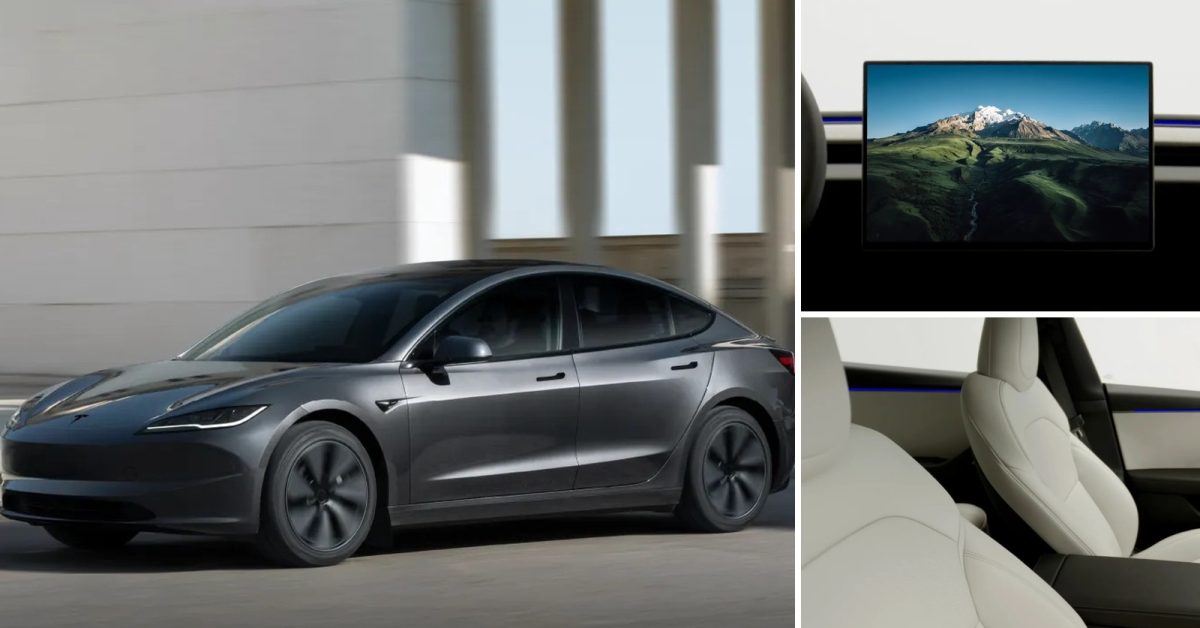
Tesla Rebuilds the China-Market Model 3
Tesla's Chinese business is refreshing every Model 3 it sells, combining a larger 16-inch touchscreen with a new light gray interior option and the activation of AC power export at up to 2.2 kW. The changes, reported by Electrek's Fred Lambert, are not confined to a single trim level or a limited-run edition — they extend across the entire Model 3 lineup Tesla offers in China.
At the same time, the same package is not being extended to buyers in the United States. That leaves American customers with a meaningfully different vehicle from the one now heading to showrooms in the world's largest electric-vehicle market, and it sharpens a question that has followed Tesla for years: why does the company's most capable hardware so often debut outside its home market first?
What Exactly Is Changing
Three distinct updates make up the refresh, and each one touches a different part of the ownership experience — the interface, the cabin, and the way the car interacts with the world outside its own battery pack.
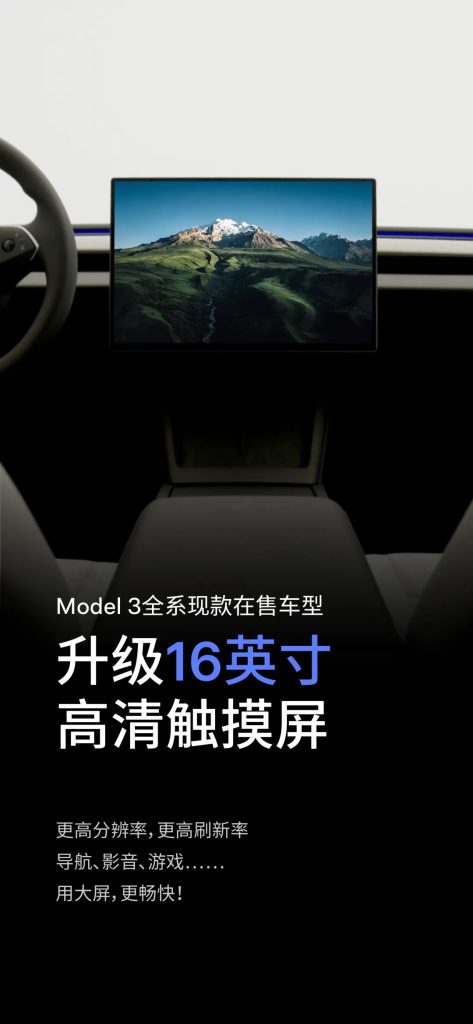
A 16-Inch Central Touchscreen
The headline change is the display. Tesla China is fitting every Model 3 it sells with a 16-inch touchscreen, a step up in size from what the vehicle previously carried. In Tesla's design language, the center screen is not merely an infotainment panel — it is the primary control surface for the car, housing climate settings, navigation, media, driving visualizations and vehicle configuration. A larger panel means more room for split-screen layouts, larger map rendering and more legible controls, particularly for functions that drivers interact with while the car is in motion.
A bigger screen is also a competitive signal. Cabin technology has become one of the most visible battlegrounds in the Chinese EV market, where buyers compare display size, interface responsiveness and software polish as readily as they compare range figures. Upgrading the standard screen across the range is a way of keeping a volume model visually current without a full platform change.
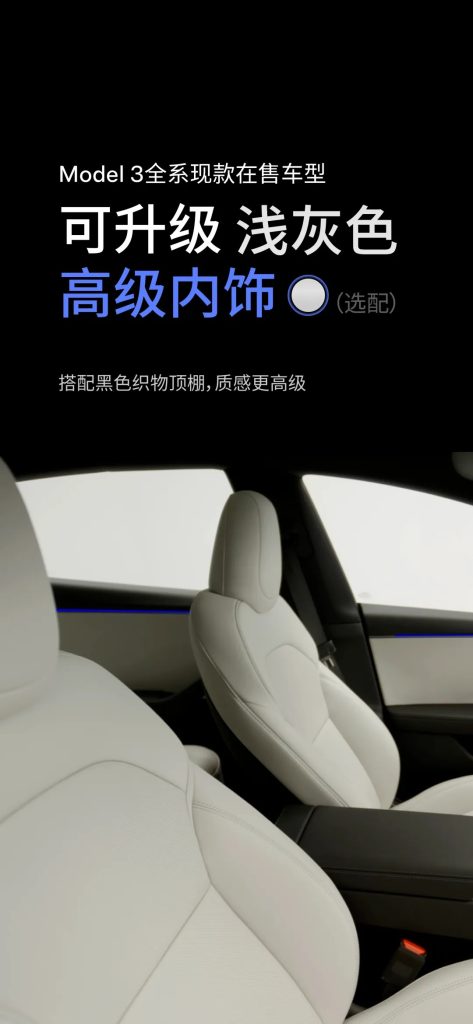
A Light Gray Cabin Option
Tesla is also adding a new light gray interior choice to the Model 3 lineup in China. Interior color palettes tend to be a small detail in spec sheets but a significant one at the point of sale: they give buyers a way to differentiate a car that otherwise looks identical to thousands of others on the road, and they let a manufacturer refresh a model's perceived freshness without altering sheet metal.
Offering a light gray alternative also broadens the aesthetic range of a cabin that has traditionally been defined by a small number of finishes. For Tesla, which builds at very high volumes from a narrow configuration set, adding a new option is a comparatively low-cost way to widen appeal.
Up to 2.2 kW of AC Power Export
The most consequential item on the list is the activation of AC power export, commonly known as vehicle-to-load or V2L, at up to 2.2 kW across the entire Model 3 range in China. In practical terms, that turns the car into a large mobile power outlet: the traction battery can supply alternating current to external devices rather than only accepting charge from the grid.
A 2.2 kW ceiling is enough to run a wide assortment of everyday equipment — power tools, camping appliances, lighting, small kitchen devices, or electronics at a worksite or outdoor event. It also gives the vehicle a role during grid interruptions, allowing a charged car to serve as a backup supply for selected loads.
Why Power Export Changes the Value Proposition
V2L sits at the intersection of transportation and energy, and that is precisely why it matters. An electric vehicle already carries one of the largest batteries a household owns. Enabling power export means that capacity is no longer stranded when the car is parked — it becomes usable infrastructure that travels with the owner.
For manufacturers, the feature is a differentiator that does not depend on range or charging speed, two metrics where improvements are increasingly expensive. For buyers, it reframes the purchase: the car is not only a means of movement but a portable energy source. And for the broader grid, vehicles capable of exporting power are part of a growing conversation about distributed energy resources and how parked cars might eventually support homes, businesses and utilities.
The report does not specify whether Tesla is delivering the capability through a software update, a hardware revision or a combination of the two, nor whether existing China-market cars can be upgraded retroactively.
The American Gap
The detail that will draw the most attention outside China is what is not happening. The upgraded screen, the new interior option and the power-export capability are described as China-market changes, and US buyers are left out of the package.
That asymmetry is not unprecedented for Tesla, which operates regional product strategies shaped by local competition, supply chains and regulatory conditions. China's EV market is the most crowded and fastest-moving in the world, with domestic manufacturers pushing cabin technology and feature content aggressively. Matching that pace may require Tesla to concentrate its newest hardware where the competitive pressure is highest.
For US customers, the practical result is a widening feature gap within the same model name. Two cars badged as a Model 3 may increasingly differ in screen size, cabin choices and energy capability depending on which side of the Pacific they were delivered to.
Questions the Announcement Leaves Open
Several important details remain unanswered. It is not yet clear what the changes mean for pricing in China, whether the larger display is standard on every configuration or tied to specific variants, or how quickly the updated cars reach customers. It is also unclear whether the US lineup will receive any of the three updates later, and if so, on what timeline.
There is no word either on whether V2L output will be expandable, whether it requires additional accessories to connect external devices, or how the feature will be presented within Tesla's software interface. Those are the kinds of specifics that typically emerge as vehicles reach customers and independent testing begins.
The Wider Pattern
Seen together, the three changes describe a company treating a volume model as a living product rather than a fixed specification. A larger screen refreshes the interface, a new interior color refreshes the cabin, and power export adds a capability that did not previously exist. None of the three requires a new platform, yet each changes how the car is experienced day to day.
The story also illustrates how electric vehicles are drifting away from the traditional automotive feature set. Battery capacity is becoming a general-purpose resource, and the software and hardware that govern how that energy flows in and out of the car are turning into competitive territory in their own right.

Key Takeaways
- Tesla China is upgrading every Model 3 it sells with a 16-inch touchscreen, a change from the display previously fitted to the vehicle.
- A new light gray interior option joins the lineup, widening the available cabin finishes.
- AC power export, or V2L, is being enabled at up to 2.2 kW across the entire Model 3 range in China, letting the car supply external devices.
- None of the three updates are being offered to US buyers, creating a feature gap between the same model in two markets.
- Tesla has not disclosed pricing, availability timing, or whether the power-export capability can be added to existing cars.
The refresh reinforces a pattern worth watching: in the electric era, a car's most interesting upgrades are increasingly about energy and software rather than engines and transmissions — and where those upgrades land first says a great deal about where a manufacturer believes the competition is hardest.
This article is based on reporting by Electrek. Read the original article.
Originally published on electrek.co