Coal’s decline in Poland is real and rapid
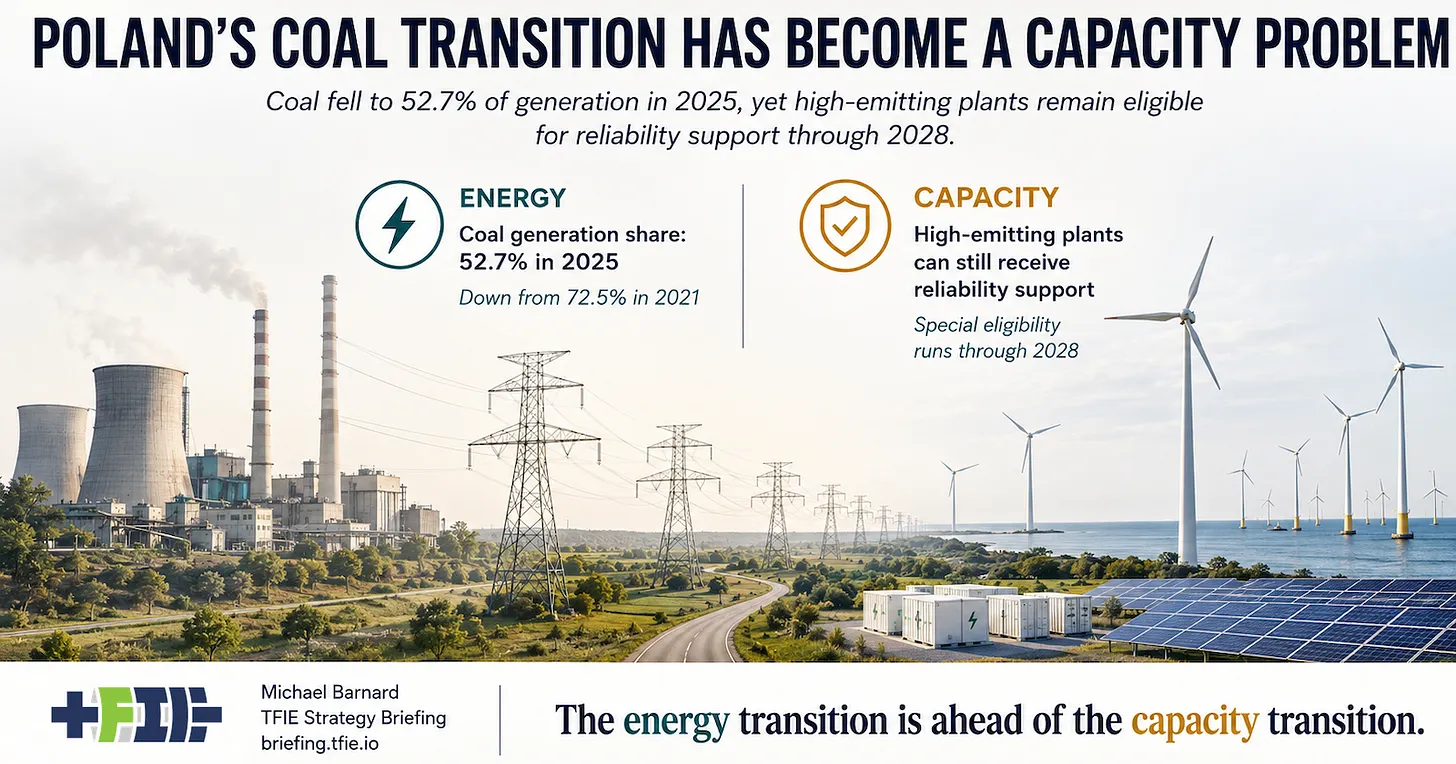
Poland’s electricity mix is changing faster than many outside observers may assume. Coal, long the dominant source of Polish power, supplied 72.5% of electricity in 2021. By 2025, that share had fallen to 52.7%, while renewables reached 31.4%, according to the analysis published August 30 by CleanTechnica. In five separate months, coal provided less than half of generation, and in June renewables produced more electricity than coal across a full month for the first time.
Those figures matter because Poland has often been treated as one of Europe’s most coal-dependent holdouts. The new picture is more dynamic. The country is still heavily reliant on coal, but the direction of change is unmistakable. Wind and solar are taking a larger role, curtailment is appearing as a real system issue, and the debate is shifting from whether the transition is happening to what form it is taking and how the grid remains reliable while it unfolds.
The replacement is not coal-for-renewables alone
The most important correction to the simple transition story is that gas is also rising. The CleanTechnica analysis notes that in both 2024 and 2025, gas posted the largest increase in generation share. In 2025, Poland produced 24.4 terawatt-hours from gas, compared with 23.8 terawatt-hours from onshore wind and 20.3 terawatt-hours from solar.
That means Poland’s decarbonization is not a neat one-for-one exchange in which renewables directly displace coal with no intermediate support. Instead, the current system is evolving into a mix where renewables grow quickly, gas expands as a balancing and replacement source, and coal’s role in annual generation shrinks faster than its role in reliability planning.
This is a familiar pattern in power-system transitions, but in Poland it is especially visible because the country began from such a coal-heavy baseline. As a result, headline declines in coal generation can coexist with policies that continue to support coal plants. That apparent contradiction is central to understanding the present moment.

Energy and capacity are no longer the same question
The analysis draws a sharp distinction between energy and capacity. Energy is about how many megawatt-hours or terawatt-hours are produced over time. Capacity is about whether enough dependable megawatts are available during the most difficult hours, such as periods of high demand, weak wind, no solar output, constrained imports, or multiple system stresses at once.
That distinction helps explain why coal plants can become less important as everyday generators while still being paid to remain available. A coal unit that runs fewer hours each year may be steadily losing its place in the energy mix, but system planners may still see it as insurance against scarcity during challenging conditions.
Poland’s transition, in that sense, has moved faster on energy than on firm replacement capacity. Renewables are pushing coal down the dispatch order, but the system has not yet fully replaced all the reliability services and backup functions coal once provided by default.
Why Poland is still paying for coal capacity
This tension is visible in the country’s capacity market. A supplementary auction held in September 2025 for the 2026 delivery year contracted 7.58 gigawatts of capacity obligations. High-emitting plants above 550 kilograms of carbon dioxide per megawatt-hour were allowed to participate under a special derogation. Similar auctions are planned for 2027 and 2028, with the European exemption set to expire at the end of 2028.
From a policy perspective, that means Poland is simultaneously accelerating its clean-energy shift and preserving a temporary role for high-emitting coal assets in reliability planning. The policy is not necessarily incoherent. It reflects a judgment that the grid still needs dependable fallback capacity even as cleaner sources expand quickly.
Still, this approach carries real costs. Paying to keep coal plants available can slow the economics of cleaner flexible alternatives if the market signal is not managed carefully. It can also prolong emissions from assets that are increasingly uncompetitive in regular energy production. The challenge for policymakers is to treat coal’s residual role as a bridge rather than a default.

Success is creating new operational problems
Poland’s renewable progress is now creating second-order system issues associated with transition success. In 2025, the country curtailed 1.4 terawatt-hours of renewable generation, double the 2024 level, according to the analysis. That suggests clean output is growing fast enough that grid flexibility, network constraints, storage, interconnections, and dispatch rules are becoming more important.
Curtailment is often a sign that the next phase of transition cannot rely on simply adding more generation. Once wind and solar reach higher penetration, system value increasingly comes from the ability to move, store, and balance electricity when it is needed. Poland appears to be entering that phase.
This is why the country’s “coal problem” has changed. The old problem was heavy dependence on coal energy. The newer problem is how to retire coal capacity responsibly while building enough alternatives to preserve reliability and absorb larger volumes of renewable output.
The next phase will be judged by flexibility
Poland’s power sector now sits in an in-between stage that many grids will recognize. Coal is losing market share. Renewables are no longer marginal. Gas is filling part of the gap. Capacity mechanisms are still compensating high-emitting plants to stay on call. Meanwhile, curtailment signals that the grid must become more flexible, not just cleaner.
What happens next will matter beyond Poland. The country offers a case study in how quickly a coal-heavy system can change once renewable growth accelerates, but also how stubborn the reliability question can remain. The end of the European exemption in 2028 is likely to become a key deadline, forcing a clearer answer to whether Poland can replace coal’s backup role with cleaner capacity, stronger networks, better market design, and more flexible resources.
For now, the evidence points in two directions at once. Poland is moving away from coal faster than its reputation suggests. But it is also discovering that replacing coal generation is easier than replacing coal’s system role. The transition is real. So is the engineering challenge that comes after it.
This article is based on reporting by CleanTechnica. Read the original article.
Originally published on cleantechnica.com




