AI infrastructure is making grid forecasting harder and more urgent
U.S. electricity planners already knew data centers were becoming a major new source of demand. BloombergNEF’s latest numbers suggest the challenge may be growing faster than many models can comfortably handle. In a new assessment, the research firm says U.S. data center power demand could reach 207 gigawatts by 2033 under a scenario based on expected AI chip deliveries.
Even its more conservative base case is large. BloombergNEF now projects about 118 gigawatts of U.S. data center demand in 2030 and 194 gigawatts by 2035. Those figures represent substantial upward revisions from the firm’s previous outlook published in December: 52% higher for 2030 and 83% higher for 2035.
The numbers matter because they frame one of the central infrastructure questions of the AI buildout: not simply how many models will be trained or deployed, but whether the physical electric system can support the data centers being proposed. If current project pipelines, chip delivery expectations, and site sizes continue to scale up, utilities, grid operators, regulators, and developers may all be working from forecasts that quickly become outdated.
Two scenarios, one widening uncertainty gap
BloombergNEF’s updated outlook highlights how uncertain the upper bound has become. The firm describes two scenarios for U.S. data center electricity demand by 2030 that differ by 42 gigawatts. Analysts noted that the gap alone is more than four times the peak load of New York City. By 2033, that spread grows to 63 gigawatts.
That is not a small modeling disagreement. It is evidence that forecasting demand from AI-linked infrastructure has become structurally harder. Project announcements are expanding in both number and size, while actual buildout depends on power availability, construction speed, interconnection timelines, financing, and how efficiently future data centers are designed and operated.
BloombergNEF says it underestimated installed U.S. data center capacity in 2025. Installed capacity topped 47 gigawatts by the end of last year, 16% higher than the firm’s forecast. That miss helps explain why the firm has revised its outlook so sharply upward. The issue is no longer whether data center demand is rising quickly. It is how much higher real-world deployment may run relative to the models used to plan for it.

Why the forecast moved so much
According to BloombergNEF Senior Associate Nathalie Limandibhratha, the market changed materially over the past year. The firm added about 100 gigawatts of project capacity to its U.S. tracking during that period. Growth is not just about more developers entering the market. It is also about the size of the projects now being proposed.
A year ago, a one-gigawatt data center project was considered large. Now BloombergNEF says its pipeline includes more than 70 projects at one gigawatt or larger, with some proposals reaching multiple gigawatts and going as high as 10 gigawatts. Projects of that scale can transform local transmission planning, water considerations, land use debates, and utility procurement strategies. They also make national forecasting more volatile, because a relatively small number of very large projects can dramatically shift aggregate demand expectations.
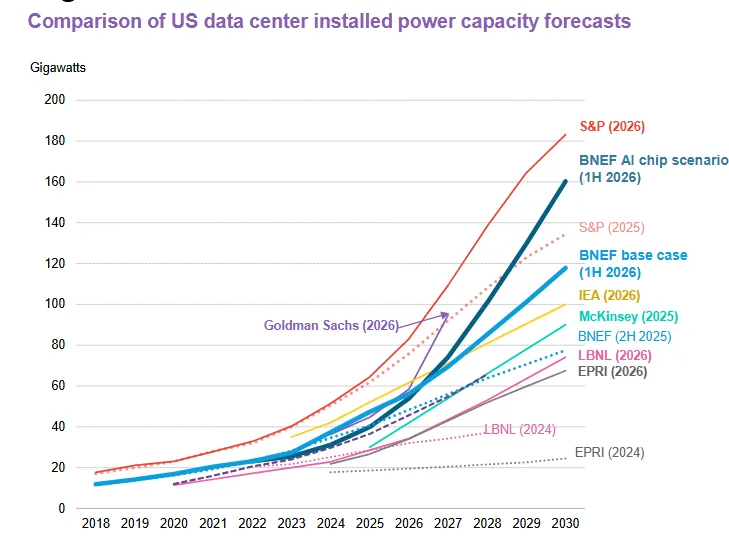
The firm’s second scenario, based on expected AI chip deliveries, is especially important because it ties demand growth to the hardware pipeline rather than only to announced project development. That approach reflects a hard reality of the AI economy: chip availability can be a more practical near-term constraint than developer ambition. If advanced chips arrive in the volumes expected, the electrical load needed to house and run them may follow.
What this means for the power sector
Utilities and grid planners are already facing difficult tradeoffs. Large loads can create opportunities for new revenue and justify investment, but they can also intensify interconnection backlogs and raise questions about who pays for new transmission, substations, and generation. As demand forecasts move upward, the risk of underbuilding infrastructure rises. So does the risk of overcommitting to projects that may not all materialize on schedule.
The scale in BloombergNEF’s update suggests that conventional planning assumptions may need revision. A pipeline containing dozens of gigawatt-scale data centers is unlike the historical pattern of incremental commercial load growth. These are concentrated, fast-moving, capital-intensive projects that can reshape regional load maps in only a few years.
For policymakers, the report is also a reminder that AI policy is now inseparable from energy policy. Debates about domestic compute capacity, industrial competitiveness, and digital infrastructure increasingly run into transmission constraints, generation adequacy, and local permitting realities. If the U.S. wants to host a larger share of future AI training and inference workloads, the electric system becomes part of the competitive stack.

The planning problem is bigger than one forecast
BloombergNEF’s revised outlook should not be read as a precise prediction that every proposed project will be built on time and fully energized. The more useful takeaway is that demand uncertainty itself has become a planning variable. A 42-gigawatt difference between 2030 scenarios is large enough to affect utility strategies, regulator expectations, and market narratives around generation buildout.
It also suggests that analysts may need multiple forecasting methods to understand where the sector is headed. Pipeline-based estimates capture what developers are trying to build. Chip-based models capture what the hardware supply chain may enable. Neither is perfect on its own, but together they show why confidence intervals are widening rather than narrowing.
That is the defining message in BloombergNEF’s new report. Data center demand is not simply growing; it is becoming harder to bound. The AI buildout is pushing the U.S. power sector into a planning environment where project scale, timing, and concentration can all move faster than legacy forecasting tools were designed to handle. Whether actual demand lands closer to the base case or the higher chip-linked scenario, the direction is clear: grid planning for the next decade will have to account for a much larger and more uncertain data center footprint than many observers assumed just months ago.
This article is based on reporting by Utility Dive. Read the original article.
Originally published on utilitydive.com




