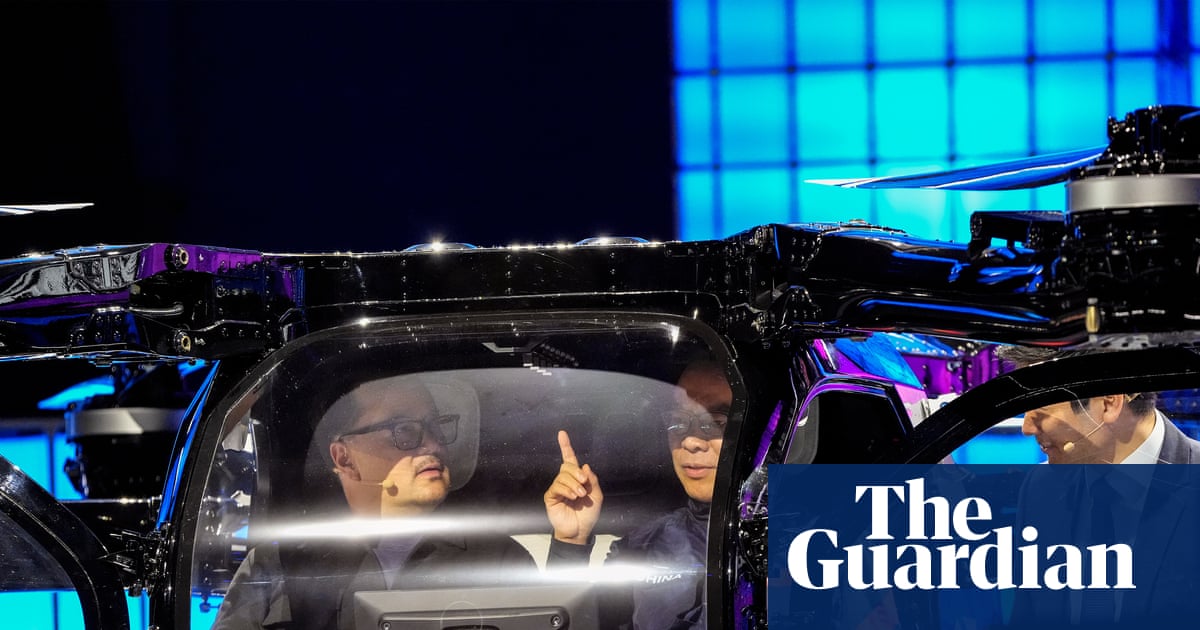
XPeng outlines a 2027 path for a low-altitude vehicle
People could begin taking trips in XPeng’s so-called flying car in China as early as next summer, according to the company’s chief executive. The two-seat, low-altitude vehicle is expected to be ready for recreational users in rural areas and for emergency services in the second half of 2027, Deli Zhao said.
The vehicle is better understood as a small, helicopter-style drone than as a conventional car. It has no wheels, according to the report, and uses six battery-powered, drone-like propellers to lift itself. Its cockpit is about the size of a Fiat 500, while the package sold to customers includes a six-wheel van roughly the size of a Ford Transit.
That van is more than a transport accessory. Zhao said the flying vehicle unfolds from its rear, an arrangement he compared to Transformers. The result is a modular system designed to move the aircraft by road before it is deployed for low-altitude flight.
Limited use and a high initial price
XPeng’s vehicle is priced at $300,000, Zhao said. The early market is therefore not framed as everyday personal commuting. Instead, the company is targeting people interested in activities such as diving, surfing, off-roading and flying, alongside potential emergency-service uses in rural locations.
The vehicle has been approved by China’s civil aviation authorities for limited use, the report says. That approval is an important distinction from broad public availability: the company’s plan concerns restricted operations, not an unrestricted new form of urban transportation.
Zhao said XPeng has spent 10 years developing flying vehicles, including trials of flying motorbikes at its Guangzhou base. A prototype of the latest aircraft was displayed at the Web Summit in Lisbon, where it drew crowds, and it was also demonstrated in Dubai last month.
Autopilot and manual operation
The aircraft can be flown with a simple joystick, according to Zhao. It can also travel autonomously to a programmed destination. Zhao, who is a trained pilot, said he could teach someone to fly it in five minutes.
Those claims describe an ambitious attempt to simplify aircraft operation, but they should not be read as a description of unrestricted access or a statement about the operational rules that will govern each flight. The supplied report says the vehicle has been cleared for limited use, and it does not provide details on the training, routes, airspace procedures or service rules that would apply when the proposed 2027 deployment begins.
XPeng says the vehicle can cruise as high as one kilometre above the ground. The report notes that this remains well below the operating altitude of an unpressurized light aircraft such as a Cessna. The intended operating space is therefore low altitude, consistent with the company’s description of rural recreation and emergency response rather than normal airline travel.
Competition over what counts as flying
The announcement arrives amid competition between the United States and China in electric-vehicle and drone technology. Zhao contrasted XPeng’s vehicle with a flying Tesla prototype shown by Elon Musk last month. He argued that Tesla’s concept was “really hopping or jumping and not really flying,” while XPeng’s vehicle is designed to cruise.
That comparison illustrates the unsettled nature of the category. The term “flying car” can describe very different machines: road-capable vehicles, drone-like passenger aircraft, vehicles that make short powered hops, or systems that combine a road transport platform with a detachable aircraft. XPeng’s product belongs to the last of those categories. The flight unit has no wheels, while its accompanying van carries it to the point of use.
For prospective customers, that distinction may be as important as the headline promise of flight. The aircraft is not presented as something that drives along city streets before taking off. It is a battery-powered, six-propeller vehicle transported in a larger road vehicle and deployed in suitable low-altitude settings.

From prototype to service
XPeng’s timeline puts the proposed first uses in the second half of 2027. If that schedule holds, recreational use in rural areas and emergency-service applications would be the company’s opening cases. Zhao said nobody had been injured or hurt using the vehicle so far.
The report does not identify how many aircraft will be available, which emergency organizations might use them or where the initial operations would occur. It also does not state whether the $300,000 price will change as production develops. Those questions will determine whether the system remains a specialist product for enthusiasts and demonstration programs or grows into a broader low-altitude service.
What XPeng has provided is a concrete description of the machine and a target window for limited use in China. The product combines a two-seat autonomous-capable aircraft, a six-wheel carrier van and a narrowly defined initial market. Its prospects now rest on turning a high-profile prototype and limited approval into repeatable operations under the constraints of low-altitude aviation.
This article is based on reporting by The Guardian. Read the original article.
Originally published on theguardian.com