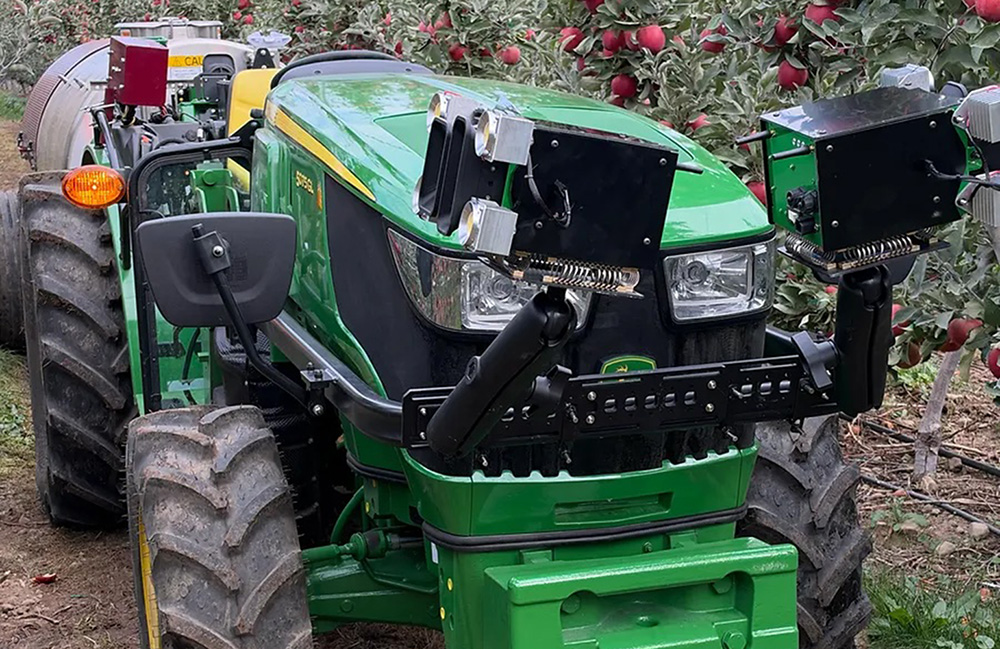
John Deere has acquired Orchard AI, a San Francisco company whose systems use vehicle-mounted cameras and artificial intelligence to assess individual trees, vines and plants across high-value crop farms. The deal adds plant-level crop data and a crop-management software platform to Deere’s broader precision-agriculture technology portfolio.
Orchard AI’s approach is built around capturing large numbers of images as a vehicle moves through a farm. Its system analyzes hundreds of images for each tree, giving growers information about crop conditions rather than relying only on broad field-level observations. According to the company description, the resulting data can include yield estimates, fruit counts, fruit size and color measurements, and canopy information.
From imagery to decisions in the orchard
The acquisition centers on the practical value of more detailed agricultural data. Fruit and nut growers must make decisions throughout a growing season, often across orchards where conditions can differ substantially from one block, row or plant to the next. A platform that identifies variation at that scale could help operators see where attention is needed and make choices with a more specific understanding of their crop.
Orchard AI also offers FruitScope, software intended to help growers visualize and use the data its imaging systems collect. Deere said it plans to combine those plant-level insights with its own equipment, precision-agriculture technology and farm expertise. The stated aim is to connect an understanding of what crops need with machinery that can carry out work in the field.
That combination is central to the promise of precision agriculture. Sensing and analysis are useful, but the operational benefit depends on whether a farm can translate an observation into timely action. Deere’s equipment footprint gives the company a route to link crop intelligence with the machines growers already use, while Orchard AI supplies a more granular source of information about crop status.

A portfolio built through technology acquisitions
The Orchard AI deal is another step in Deere’s longer-running effort to build advanced technology into its agricultural business. The company acquired Blue River Technology in 2017 for $305 million. Blue River developed computer-vision and machine-learning technology used in agricultural sprayers to identify weeds and selectively apply herbicides.
Deere later acquired Bear Flag Robotics for $250 million. Bear Flag worked on retrofitting autonomy stacks to agricultural equipment, extending Deere’s interest beyond crop sensing toward the automation of work in the field. Orchard AI adds a different but complementary layer: detailed intelligence about the condition and expected output of individual plants.
Together, those acquisitions illustrate how agricultural technology is being assembled as a set of connected capabilities. Cameras and machine learning can distinguish crop conditions. Software can make the resulting data usable for farm managers. Equipment can execute work with greater precision. Autonomy can eventually change how consistently or efficiently those actions are performed. None of those components alone resolves every challenge on a farm, but their integration is becoming a major competitive focus for equipment makers.
Why plant-level data matters
High-value crops make the economics of detailed measurement particularly compelling. Estimating yield, counting fruit and monitoring quality characteristics can influence labor planning, harvest preparation and decisions made during the season. Better visibility into fruit size, color and canopy measurements may also help growers understand variation that would be difficult to detect through manual sampling alone.
The source material does not specify how Deere will package Orchard AI’s products, when integration will occur or what commercial terms were involved in the acquisition. It does, however, make clear that Deere views the deal as a way to help growers make more informed decisions over the course of the season and obtain more value from the technology they already rely on.
For Orchard AI, joining Deere could expand the reach of its crop-intelligence mission. Chief executive Charlie Wu said the company was founded to give growers the information needed to farm more profitably and sustainably, and that becoming part of Deere would help accelerate that goal. Deere Farm Systems Innovation director Tim Marquis said the acquisition creates an opportunity to connect crop-level intelligence with technology and equipment able to act in the field.
The next question is execution
The significance of the deal will depend on how well those capabilities are integrated into daily farm operations. Growers need data that is reliable, understandable and available when a decision must be made. They also need workflows that do not add unnecessary complexity during already demanding periods of the season.
Deere’s acquisition signals that imagery-based, AI-assisted crop assessment is becoming an increasingly important part of the precision-agriculture stack. Rather than treating agricultural equipment and crop analytics as separate categories, the company is pursuing a model in which crop observations can inform the work of connected farm machinery. Orchard AI gives Deere a new source of detailed plant-level information as it continues building that model.
This article is based on reporting by The Robot Report. Read the original article.
Originally published on therobotreport.com