The Raptor Gap in Toyota's Lineup
For years, enthusiasts and Toyota loyalists have watched the Ford F-150 Raptor dominate the performance truck conversation without a serious Japanese rival. The Raptor's combination of long-travel suspension, aggressive off-road capability, and high-output powertrain established a segment that RAM has challenged with the TRX—a vehicle with a supercharged Hellcat V8—but that Toyota, despite its dominance in global truck sales, has left uncontested.
That is about to change. Toyota's forthcoming TRD Hammer has been the subject of speculation for months. A Tundra with extreme off-road capability, 37-inch tires, and serious power was known to be in development. What was not confirmed was the powertrain choice: would Toyota follow RAM with a massive V8, or would it take a different route? The Mint 400 provided the answer.
The Mint 400 Validation Run
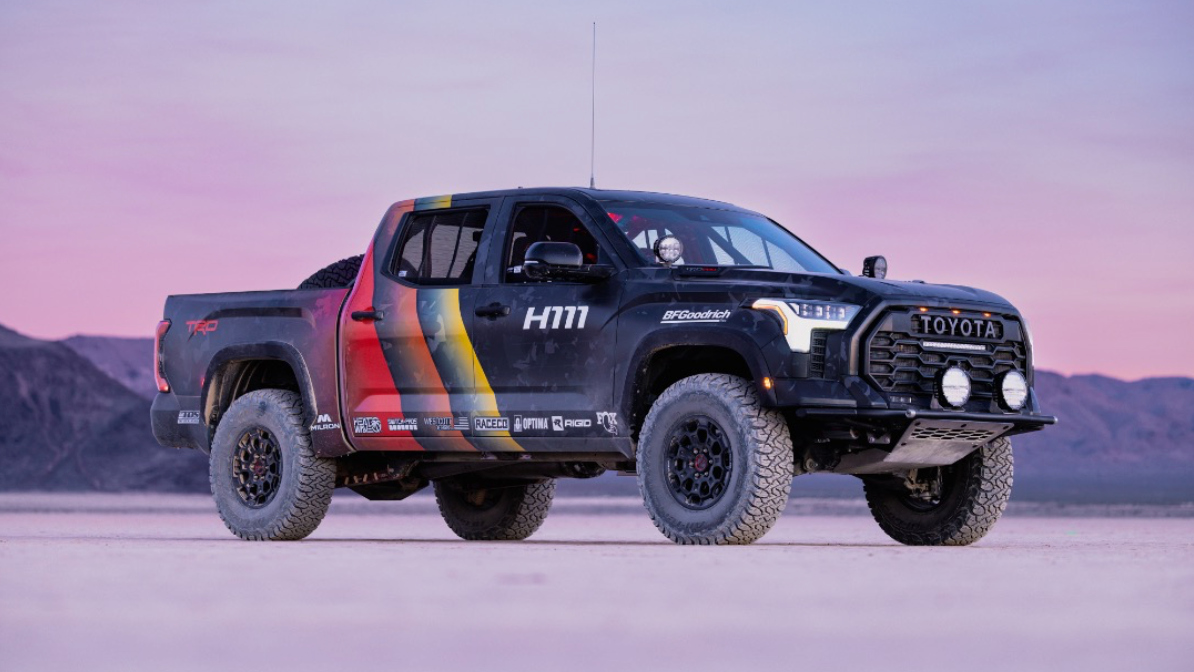
The Mint 400 is one of the most demanding off-road races in North America—a brutal desert course outside Las Vegas used by manufacturers for public validation testing for decades. Ford ran early Raptor development trucks at Baja races during that vehicle's development. Toyota has now done the same, entering a disguised Tundra on 37-inch BFGoodrich KO3 tires in the 2026 running of the race.
The truck won its class. And its official race entry documentation lists the powertrain as Toyota's hybrid V6—the i-Force Max system that produces 437 horsepower and 583 pound-feet of torque in its current Tundra configuration.
This is not confirmation from Toyota's press department; the company has not officially announced the TRD Hammer. But winning a major desert race on the intended production powertrain, in a thinly disguised production-intent vehicle, is the clearest possible signal that the development program has cleared its validation milestones and that the hybrid V6 is the chosen path.
Why Hybrid Instead of V8
The decision to build the TRD Hammer around a modified hybrid V6 rather than a large-displacement V8 reflects several converging factors. Regulatory pressure makes a V8-powered performance truck a harder business case than it was five years ago. But the performance math also supports the hybrid approach. Electric torque delivery is instantaneous in a way that no combustion engine can match. The i-Force Max system's electric motor contributes peak torque from zero RPM, filling in the power band exactly where a turbocharged V6 tends to have a gap—the mid-range, where response feels slightly removed from driver input. For off-road driving in particular, where throttle modulation on technical terrain is critical, the predictable and immediate torque delivery of a hybrid system is a genuine capability advantage.
The 437 horsepower figure in current Tundra trim already matches the standard F-150 Raptor's 450 horsepower closely. A modified version of the system—which sources close to the project indicate is in the works—could comfortably reach 480 to 510 horsepower without radical engineering changes. That number would be competitive with the Raptor and would exceed the RAM 1500 RHO, which produces 540 horsepower with a naturally aspirated V8.
What 37-Inch Tires Mean for Capability
The TRD Hammer's 37-inch tires are not cosmetic. Tire size is one of the most fundamental determinants of off-road capability: larger diameter tires roll over obstacles more easily, provide more ground clearance, carry more sidewall volume for air-down performance on sand and rocks, and offer a wider contact patch on soft terrain. Moving from the TRD Pro's 33-inch tires to 37s represents a step change in genuine off-road ability rather than a cosmetic upgrade.
Running 37-inch tires on a production truck also requires significant engineering changes: the suspension geometry must be revised to accommodate the larger wheel package, the wheel arches need flaring, and the differential and axle components may need strengthening to handle the increased leverage loads. Toyota's willingness to make these changes signals a commitment to genuine off-road performance rather than image-focused modification.
Timing and Positioning
Toyota has not confirmed a production date for the TRD Hammer, but the Mint 400 win suggests the development program is well advanced. The truck is expected to debut as a 2027 model year vehicle, with production beginning in late 2026. Pricing is anticipated to position it against the standard Raptor rather than the V8-powered Raptor R, reflecting the powertrain choice and the market segment Toyota is targeting. When it arrives, the TRD Hammer will be the first credible Japanese challenger to the Raptor's decade-long dominance of the performance truck segment.
This article is based on reporting by The Drive. Read the original article.
Originally published on thedrive.com