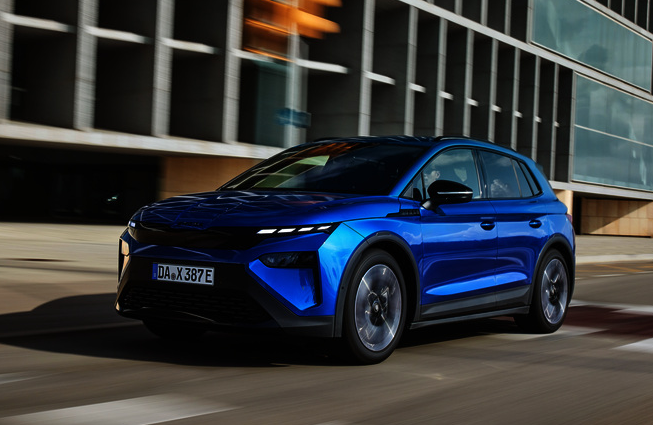
Skoda is arguing for a two-track transition
Skoda says its strategy of continuing to invest in combustion-engine vehicles while expanding its battery-electric lineup is paying off in Europe. According to the company figures cited in new reporting, the automaker delivered 174,900 battery-electric vehicles in 2025 while maintaining an operating margin of 8.3 percent, a combination it is using to support the case for a dual ICE-EV strategy rather than an all-at-once pivot.
The numbers are notable because Europe’s auto market has put manufacturers under pressure to scale electric offerings without destroying profitability. Many companies have found that aggressive EV expansion can collide with cost, pricing, and demand realities. Skoda’s message is that there is still room for a more balanced model: grow electric volumes, but keep internal combustion products in the portfolio long enough to support margin stability and market coverage.
EV growth led by the Elroq
In the reporting, the company’s battery-electric momentum was led by the Elroq, which was said to record 94,165 registrations in 2025, making it Europe’s second-best-selling full-electric car behind the Tesla Model Y according to Dataforce. That gives Skoda a concrete proof point that its EV program is not merely defensive. It is producing scale in a fiercely competitive market.
What makes the result more significant is the context. European automakers are navigating regulatory pressure, uneven charging buildout, intense Chinese competition, and consumers whose willingness to shift fully to battery-electric vehicles still varies by segment and country. In that environment, preserving an earnings buffer while expanding EV volumes can be strategically valuable.
Why a dual strategy appeals right now
Skoda chief executive Klaus Zellmer credits continued investment in combustion engines alongside the EV rollout. That approach reflects a view shared by several manufacturers: the transition will be large, but it will not be perfectly synchronized across markets, price bands, and customer groups. Maintaining ICE products can therefore fund the transition, protect share where charging or affordability remains a hurdle, and reduce the risk of overcommitting to one demand curve.
The strategy also speaks to execution discipline. Automakers do not only need compelling EVs. They need factory planning, supplier alignment, brand positioning, and launch timing that do not destabilize the rest of the business. A dual-track model gives management more options while the market remains mixed.
That does not mean the strategy is permanently superior. The longer-term direction of Europe’s industry still points toward electrification. But the Skoda case suggests that in the medium term, companies may be rewarded for managing the transition pragmatically rather than treating every combustion investment as stranded by definition.
A broader lesson for the European car market
Skoda’s results support a larger industry argument: success in electrification may depend as much on transition management as on technological commitment. Delivering nearly 175,000 battery-electric vehicles while holding an 8.3 percent operating margin offers a narrative many rivals would like to claim.
It also complicates simplistic debates about whether manufacturers are moving too slowly or too quickly. The better question may be whether they are matching product strategy to actual market conditions. Skoda appears to be betting that disciplined overlap between ICE and EV portfolios can outperform more rigid approaches, at least for now.
If the company continues to pair strong EV registrations with healthy margins, its model could become a more influential example across Europe. The underlying message is not that electrification should be delayed. It is that the route to it can still include profitable combustion models, provided they are used to support rather than resist the shift.
This article is based on reporting by Automotive News. Read the original article.
Originally published on autonews.com