Honda pivots after a bruising year
Honda is changing course in a major way. After reporting its first annual loss since going public in 1957, the Japanese automaker says it will abandon its 2040 combustion-free goal and instead push harder into hybrids, with 15 new hybrid models planned through 2030. The shift marks a significant retreat from a more aggressive electrification strategy and highlights how uneven the transition away from internal combustion remains for large global carmakers.
According to the report, Honda posted an operating loss of 414.3 billion yen for the fiscal year ended March 31, reversing the previous year’s operating profit of 1.21 trillion yen. It also recorded a net loss of 423.9 billion yen. Chief executive Toshihiro Mibe attributed the reversal largely to the company’s EV strategy, with EV-related write-downs and impairments totaling 1.58 trillion yen.
What Honda is changing
The company’s immediate answer is not to walk away from electrification entirely, but to rebalance around gasoline-electric vehicles that may be easier to sell profitably in current market conditions. Mibe said Honda will introduce 15 new hybrids by 2030. Some will be updates to existing nameplates, while others will be entirely new products.
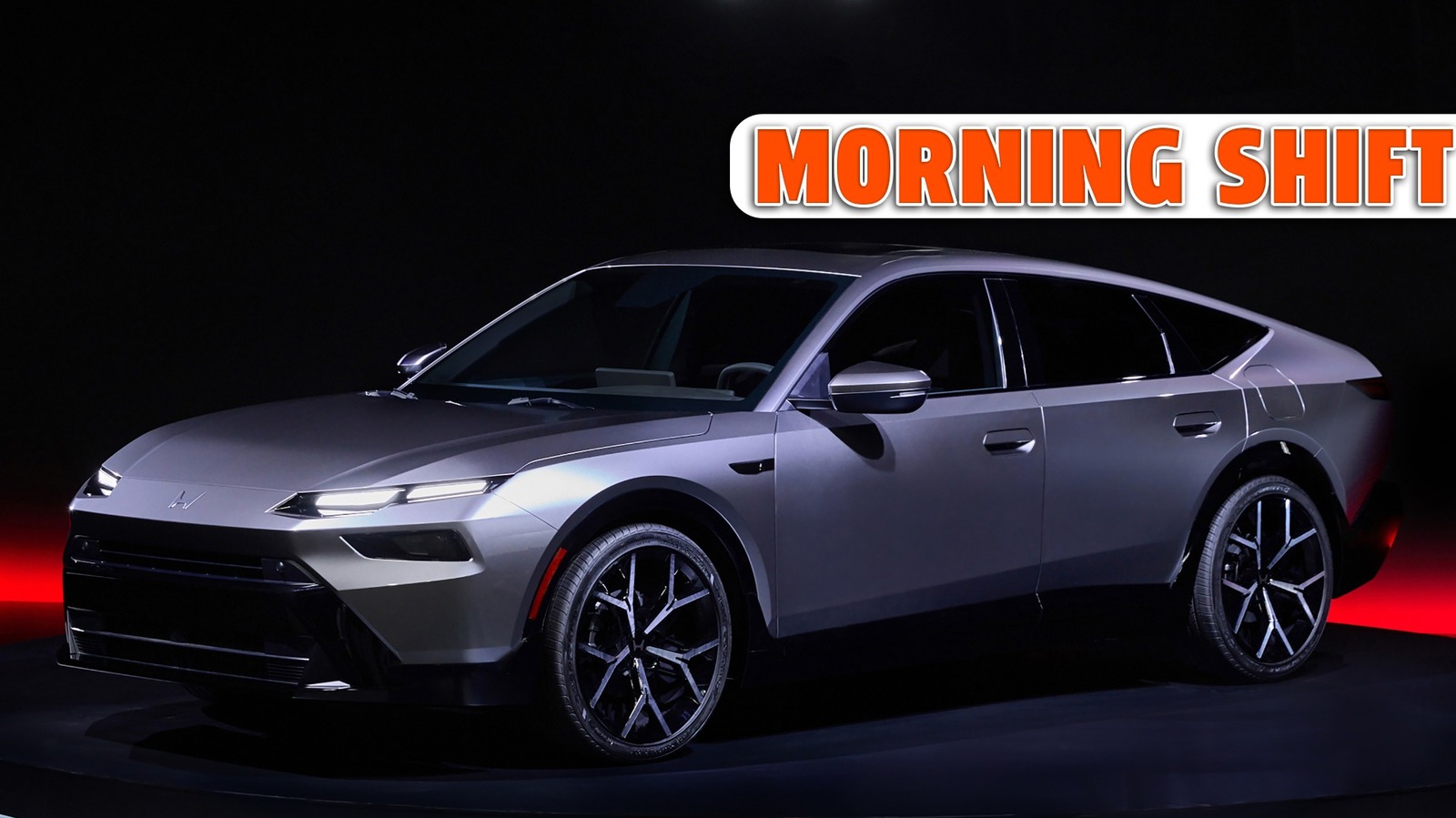
Honda also previewed two hybrid concepts at the press conference described in the report: a silver liftback sedan with Accord-like cues and a red compact crossover that appears intended to signal the next generation of the Acura RDX. Both are said to be headed for market within the next two years.
Why hybrids look safer than a pure EV push
The report presents Honda’s earlier EV bet as premature and financially costly. Hybrids offer a middle path. They allow automakers to cut fuel use and emissions relative to conventional internal-combustion vehicles while avoiding some of the infrastructure, demand, and cost challenges that have complicated all-electric rollouts in many markets.
For Honda, the pivot is also tied to industrial and geopolitical pressures. The company says it will raise local procurement of hybrid drivetrain components in the United States to 64 percent by 2028 and to more than 90 percent by the end of the decade, up from 16 percent today. That suggests Honda is not only rethinking product mix but also using hybrids to improve margins and reduce exposure to tariffs and cross-border supply disruption.
The financial signal to the industry
Honda’s loss is large enough to resonate beyond one company. The group was already under pressure to show that its electrification strategy could translate into durable profits, and the scale of the impairments indicates how expensive strategic misreads can become when automakers commit capital ahead of market demand.
That does not necessarily mean EVs are losing relevance. It does mean the path will be less linear than some targets implied. Honda’s reversal on its 2040 combustion-free ambition shows that hard deadlines can be revised when cost structures, consumer uptake, or product timing fail to line up. For the broader industry, the message is that transition planning now has to account for multi-technology portfolios rather than a simple handoff from combustion to battery electric vehicles.
What this means for product strategy
Repurposing pieces of Honda’s next-generation 0 Series EV architectures and components for hybrid vehicles is one of the more notable details in the report. It suggests the company is trying to salvage strategic value from EV investments even as it changes course. Rather than treating the write-downs as a complete reset, Honda appears to be extracting usable engineering work and applying it to vehicles that may reach stronger demand in the near term.
That approach could help compress development cycles and spread sunk costs across a broader lineup. It also signals that the boundary between EV and hybrid programs may become more porous as automakers search for flexibility.
A pragmatic but costly reset
Honda’s new plan is fundamentally a risk-management strategy. Hybrids are meant to stabilize the business, reduce supply-chain vulnerability, and rebuild profitability after a year defined by EV-related losses. But the reset comes at the cost of credibility around long-range decarbonization targets. Dropping a 2040 combustion-free goal is not a minor adjustment; it is a statement that the previous roadmap no longer fits the company’s view of the market.
Whether the shift proves durable will depend on consumer demand, policy support, and how quickly battery-electric economics improve. For now, Honda has made a clear choice. It is stepping back from an aggressive end-state promise and placing a large bet on hybrids as the practical bridge between today’s market and whatever comes next.
This article is based on reporting by Jalopnik. Read the original article.
Originally published on jalopnik.com