Ford returns to the Nürburgring with a serious statement
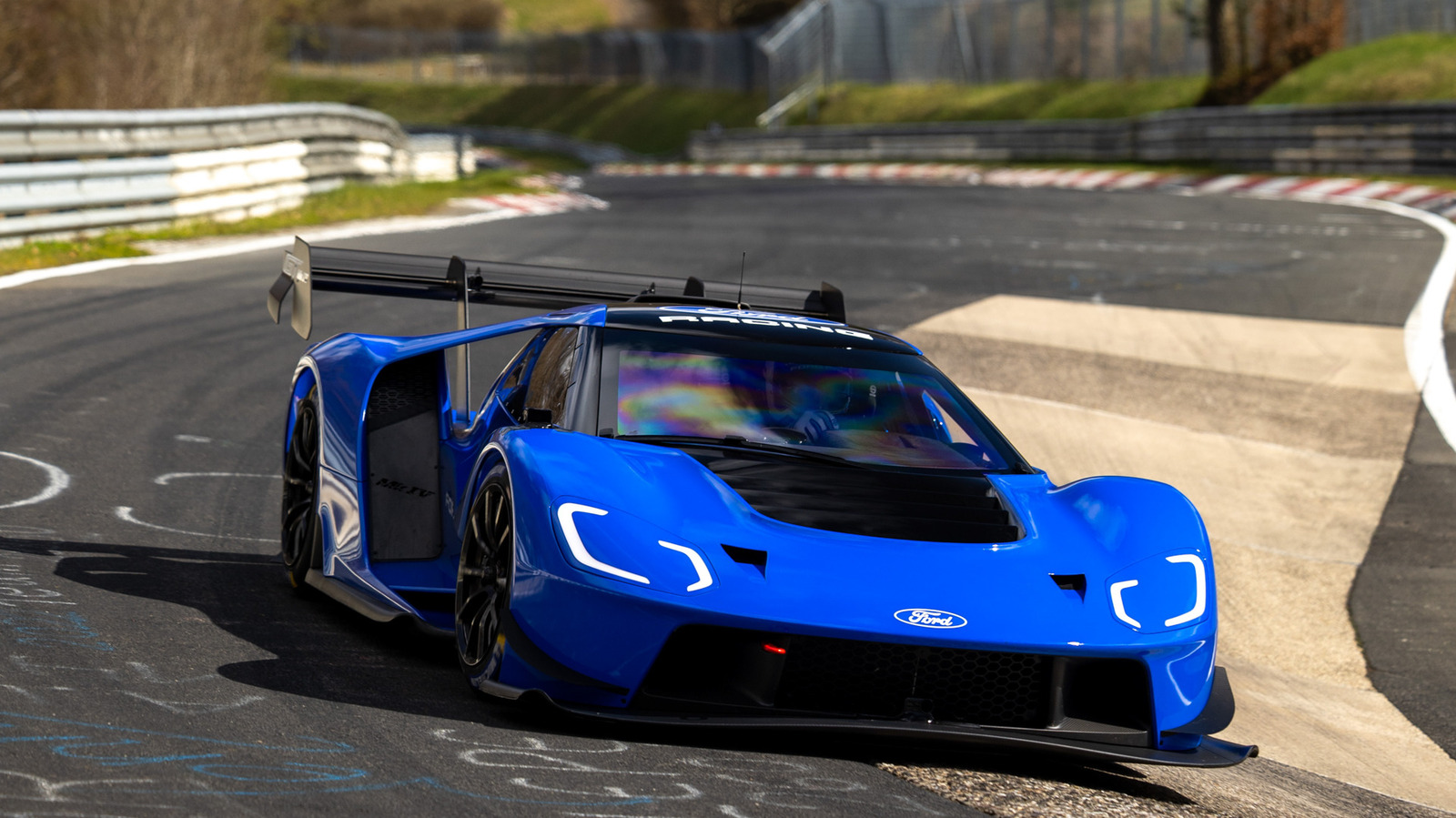
The Ford GT Mk IV is now the fastest American car ever to lap the Nürburgring, after posting a 6:15.977 time at the German circuit. According to the supplied source text, that puts the car not only at the top of the American field but third fastest overall among all vehicles to run the track, trailing only the Volkswagen ID.R and the Porsche 919 Hybrid Evo.
That ranking matters because Nürburgring lap times still carry symbolic weight in performance engineering. The circuit is long, technically punishing, and globally recognized as a benchmark for chassis balance, aerodynamic efficiency, braking stability, and sustained speed. A quick lap there does not settle every debate about what makes a great car, but it remains one of the clearest public demonstrations of what a machine can do under demanding conditions.
A track-only machine built for exactly this job
The GT Mk IV was never meant to be a conventional halo car. The source text describes it as a non-road-legal machine built solely for track driving. Ford developed it with Multimatic, the Canadian racing supplier known in performance circles for its advanced suspension systems. The car also carries a longer wheelbase than the roadgoing GT, a full carbon-fiber body, a very large rear wing, extensive hood venting, and a dedicated racing gearbox. Power comes from an 800-horsepower twin-turbo EcoBoost V6.
Taken together, those choices explain why the car is so fast. Nothing in the package is meant to preserve everyday usability. This is a machine engineered around lap-time extraction. The extended wheelbase and aerodynamics are there to improve stability and grip. The carbon body cuts mass while enabling aggressive surface design. The gearbox serves circuit work rather than city traffic. Even the fact that the car is not street legal is central to the story: Ford was free to pursue performance without the compromises required of production road cars.
The significance of the 6:15.977 lap
The time itself is startling. A 6:15.977 lap makes the GT Mk IV the quickest American entry ever around the Nürburgring, and the supplied source text notes that it also beats the Xiaomi SU7 Ultra Prototype by seven seconds. That gap is notable given the recent attention around high-output electric prototypes and the assumption that electrification would dominate these record lists.
The record was set by Ford factory driver Frédéric Vervisch, a two-time 24 Hours of Nürburgring winner. Driver capability always matters at this level, but the lap also validates Ford’s decision to push the modern GT architecture to its most extreme form rather than leave the model’s story anchored in its original road-car launch years ago.
There is another distinction that makes the result even more interesting. While the GT Mk IV is not the fastest road-legal car to lap the circuit, the source text says it is the fastest purely internal-combustion car ever to do so. In a period when electric and hybrid performance records increasingly dominate the conversation, that gives Ford’s run an additional historical angle.
What the record does and does not mean
It is important to separate categories. Because the GT Mk IV is not road legal, it cannot claim the street-car crown. That remains with the Mercedes-AMG One, according to the supplied material. Likewise, the absolute fastest Nürburgring times are still held by more specialized machines, including the unrestricted Porsche 919 Hybrid Evo. So this is not a universal “fastest car ever” headline.
But that limitation does not weaken the achievement much. If anything, it clarifies what Ford has actually accomplished. The company took a customer car program, aimed it squarely at circuit performance, and produced a lap that places it among the quickest vehicles ever to run one of the world’s hardest tracks. For American performance branding, that is valuable. For engineering credibility, it is even more so.

A signal about where performance prestige still lives
The Nürburgring remains one of the few places where a manufacturer can make a claim that resonates with both hardcore enthusiasts and the broader performance market. In that sense, the GT Mk IV lap is about more than one track day. It is a statement about technical ambition. Ford is showing that it can still build a machine capable of competing at the sharp end of global performance, even if the product is limited, costly, and inaccessible to most buyers.
The supplied source text notes that only 67 examples were set to be built, each priced at $1.7 million. That scarcity makes the GT Mk IV an elite object rather than a mass-market benchmark. Yet these projects are not designed to drive unit volume. They exist to establish capability, shape brand identity, and create a reference point for what the engineering team can achieve when the restraints come off.
An American record with wider relevance
There is a temptation to dismiss track-only specials as vanity projects. Sometimes that is fair. But records still matter because they capture where current engineering limits sit. The GT Mk IV’s Nürburgring run says something concrete about aerodynamics, combustion performance, thermal management, and chassis tuning at the highest level of contemporary internal-combustion design.
For Ford, that is a meaningful outcome. For the industry, it is a reminder that even in an era increasingly shaped by electric and hybrid experimentation, there is still room for breathtaking performance from a focused combustion machine. The GT Mk IV may not be practical, democratic, or road legal. It is something else instead: a clear measure of what happens when a manufacturer builds a car for one purpose and executes it well enough to rewrite the American record book.
This article is based on reporting by Jalopnik. Read the original article.
Originally published on jalopnik.com