China’s EV giant is finding growth outside China
BYD’s domestic momentum has weakened, but its international business is moving the other way. In a roundup published by The Drive, the Chinese electric-vehicle maker was reported to have logged its eighth straight month of overall sales decline at home, including an April in which deliveries were 16 percent lower than a year earlier. At the same time, exports jumped 71 percent last month.
The contrast is striking because it shows two realities coexisting inside the same company. In China, BYD is running into cooling demand. Outside China, it is benefiting from a market environment made more favorable by rising fuel prices. The Drive tied that export surge to the war in Iran, which has pushed oil prices higher and made electric vehicles more attractive to cost-conscious buyers abroad.
For a company of BYD’s scale, that matters immediately. When the home market softens, export strength can serve as both revenue support and strategic proof that the company’s global ambitions are not merely aspirational. It also highlights a broader theme in the auto industry: the economics of EV adoption are highly sensitive to fuel costs, and geopolitical shocks can accelerate demand in places where consumers are already weighing a switch.
Higher fuel prices are changing the sales equation
Electric-vehicle demand is often discussed in terms of policy support, charging infrastructure, or model availability. Fuel prices deserve equal attention. When oil rises sharply, the ownership case for electric vehicles becomes easier to understand in purely economic terms. Consumers who may have been undecided can suddenly see a faster payoff in avoiding gasoline or diesel costs.
That is the dynamic reflected in BYD’s export performance. The Drive’s summary does not claim that every global market is surging for the same reason, but it does connect the rise in exports to the oil shock linked to the conflict in Iran. In practical terms, that means macro events far outside the auto sector are now shaping which manufacturers gain momentum and where.
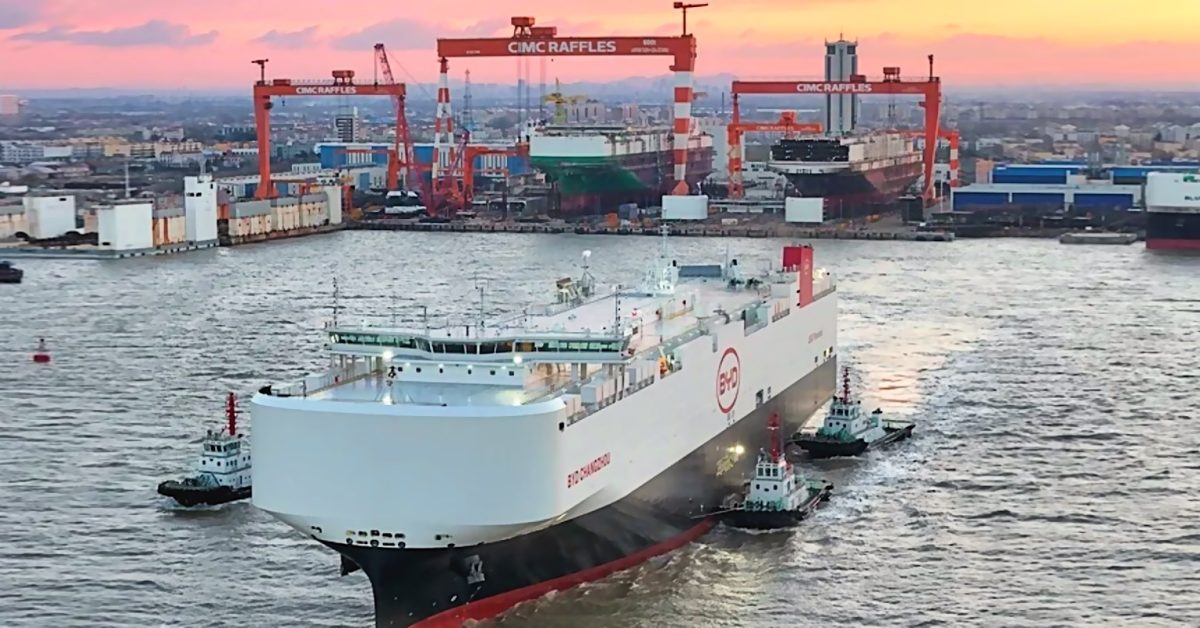
BYD is well placed to benefit because it already has the manufacturing scale and international product pipeline to respond when overseas demand strengthens. Export growth of 71 percent in a single month is not a minor fluctuation. It suggests the company is successfully shifting more volume into markets where conditions are turning in its favor.

Domestic weakness still matters
None of that erases the warning signs at home. Eight straight months of overall sales decline and a 16 percent year-over-year delivery drop in April are meaningful figures for any automaker, especially one that has become emblematic of China’s EV strength. They suggest that BYD cannot rely on domestic demand alone to sustain its pace.
The home-market slowdown also raises questions about competition, market saturation, and how quickly Chinese EV demand can keep expanding after several years of extraordinary growth. Even the strongest players eventually face the challenge of defending share in a crowded field.
That is one reason export performance matters beyond the headline. It is not just a growth story. It is a hedge. If China becomes less able to absorb increasing output, foreign markets become critical to keeping factories busy and maintaining scale advantages.
The global EV race is becoming more geopolitical
BYD’s April split between domestic softness and export strength illustrates how geopolitical conditions increasingly shape transportation markets. An energy shock caused by conflict can improve EV economics. Trade policy can influence which brands can enter which countries. Industrial strategy determines where cars are built and what incentives buyers receive. The result is an industry that is global in structure but deeply exposed to local political events.
For BYD, this creates both opportunity and risk. Rising oil prices can boost demand for its vehicles abroad, but geopolitical tension can also complicate logistics, regulation, and market access. The company’s international expansion therefore depends not only on product competitiveness but on its ability to navigate a fragmented global environment.
Still, the export figure shows that the company has meaningful traction outside China. That is strategically important for a manufacturer sometimes portrayed mainly through the lens of its domestic dominance. Export growth at this pace indicates BYD is becoming harder to frame as only a China story.

An early sign of where EV demand may move next
The most important lesson from this update is that EV demand can re-accelerate under pressure from traditional energy markets. When fuel becomes more expensive, the savings argument for electrification gets stronger without any new technological breakthrough. That can quickly reshape buyer behavior.
BYD’s April performance is therefore useful not just as a company update but as a market signal. It suggests that some of the next big changes in transportation adoption may come not only from battery improvements or policy support, but from volatility in oil itself. Manufacturers that are globally positioned and able to move volume across markets stand to benefit first.
For now, BYD is living both sides of the story at once: a difficult period in its home market and a powerful expansion abroad. That combination may define the next phase of the EV business more broadly, as automakers learn that the path to growth is no longer tied to any single country.
Why this story matters
- BYD’s domestic sales have continued to decline, but exports surged 71 percent last month.
- The export boost was linked in the source summary to higher fuel prices tied to the war in Iran.
- The split shows how geopolitics and energy prices are increasingly shaping EV demand.
This article is based on reporting by The Drive. Read the original article.
Originally published on thedrive.com