An unnecessary engine project can still be deeply instructive
In transportation engineering, not every meaningful build begins with a practical business case. Some begin with a question so strange that answering it becomes a technical demonstration in its own right. That is what makes Garage 54’s latest project interesting: the team has converted a Subaru boxer-four engine into an inline-four, according to the supplied source text.
There is no indication that the conversion solves a market problem or opens a new manufacturing path. But it does expose the structural logic of engine architecture in a way few conventional projects can. By taking a boxer layout, literally cutting it apart, and reassembling its cylinder banks side by side, the builders turned a familiar Subaru hallmark into the industry’s most common four-cylinder format.
How the conversion was done
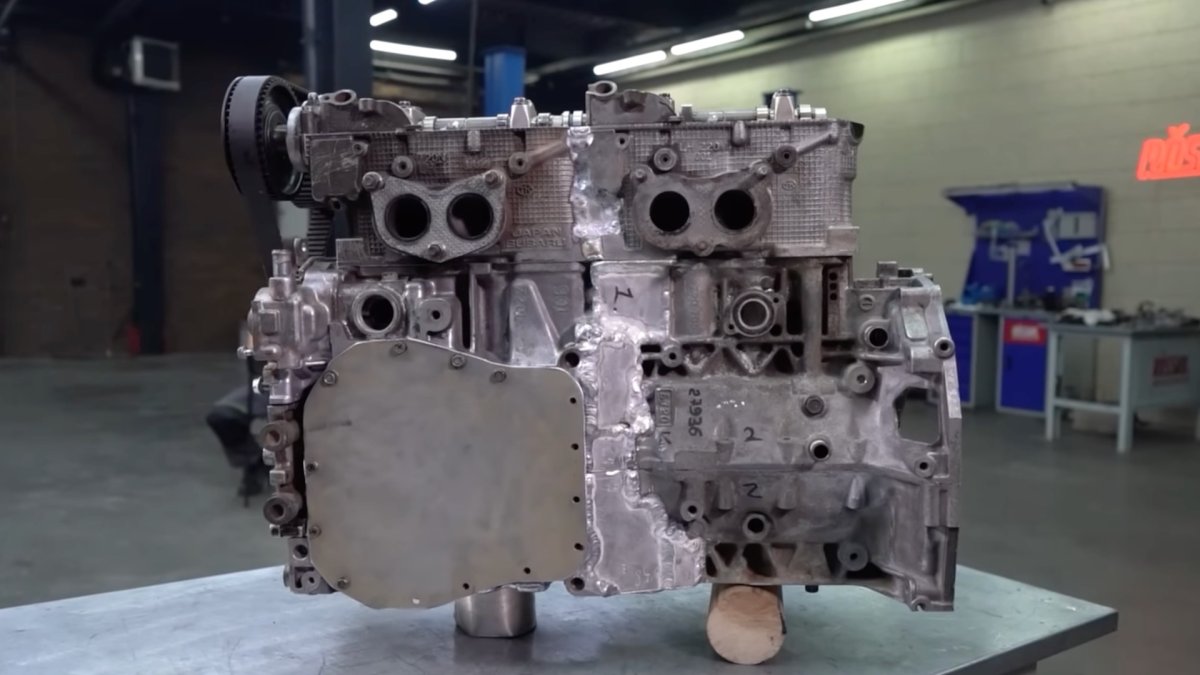
The source text says the project began by cutting the boxer engine in half and placing the two cylinder banks vertically side by side. Because the water pump is attached to one bank from the factory, that bank became the front of the new engine. The change in geometry then produced an unexpected parts crossover: a timing belt from a Toyota 1JZ reportedly fit perfectly.
Length immediately became one of the major problems. Moving from a horizontally opposed layout to a stitched-together inline format effectively doubled the engine’s length, so a second engine was sourced to provide additional crankcase material, which was welded to the first. The same logic extended to the cylinder heads, which were built from a pair of stock heads welded together.
The rotating assembly required equally improvised solutions. The camshafts were made by welding two factory cams end to end while preserving timing orientation. The crankshaft was created from two factory cranks joined with custom-fabricated tabs. In a normal engineering program, those steps would raise obvious concerns about balance, durability, lubrication, and manufacturing tolerance. But as a proof-of-concept exercise, they show just how many interdependent systems define an engine beyond cylinder count alone.
Why the build matters to transportation enthusiasts
The project’s value lies partly in its irrationality. Most production engineering aims to reduce complexity, cost, and failure points. Garage 54 moved in the opposite direction, which makes the invisible assumptions of mass-produced engines easier to see. Oiling, packaging, crank support, head integration, and timing all become visible constraints once a familiar architecture is forced into an alien form.
The source text notes that the resulting inline-four currently has two oil pans on either side because of the cut-and-stitch design. Intake, exhaust, plumbing, and pulley work still remain for a future stage, but the engine has been fully assembled and turns. That alone is presented as a significant achievement, and fairly so. Getting a heavily modified engine to rotate cleanly after such invasive structural changes is not trivial.
Transportation coverage often prioritizes products that are new, profitable, or close to market. Projects like this instead highlight the culture of mechanical experimentation that still thrives outside corporate R&D. They are reminders that transportation technology is also sustained by tinkerers, machinists, and builders willing to explore the limits of what can physically be made, even when the answer has no immediate commercial use.
A spectacle with real educational value
Subaru enthusiasts may see the project as sacrilege; others will see it as comedy. It is both, but it is also a kind of public engineering lesson. By forcing a boxer engine into an inline-four shape, the builders turned an abstract design distinction into something tactile and obvious. You can see what each architecture demands because the project has to solve those demands manually.
That does not make the engine practical. It makes it revealing. In an automotive world increasingly defined by software, electrification, and sealed systems, there remains a strong audience for transparent mechanical experimentation. This build belongs to that tradition: impractical, difficult, and strangely clarifying.
This article is based on reporting by The Drive. Read the original article.
Originally published on thedrive.com