An aging three-row still has one clear strength
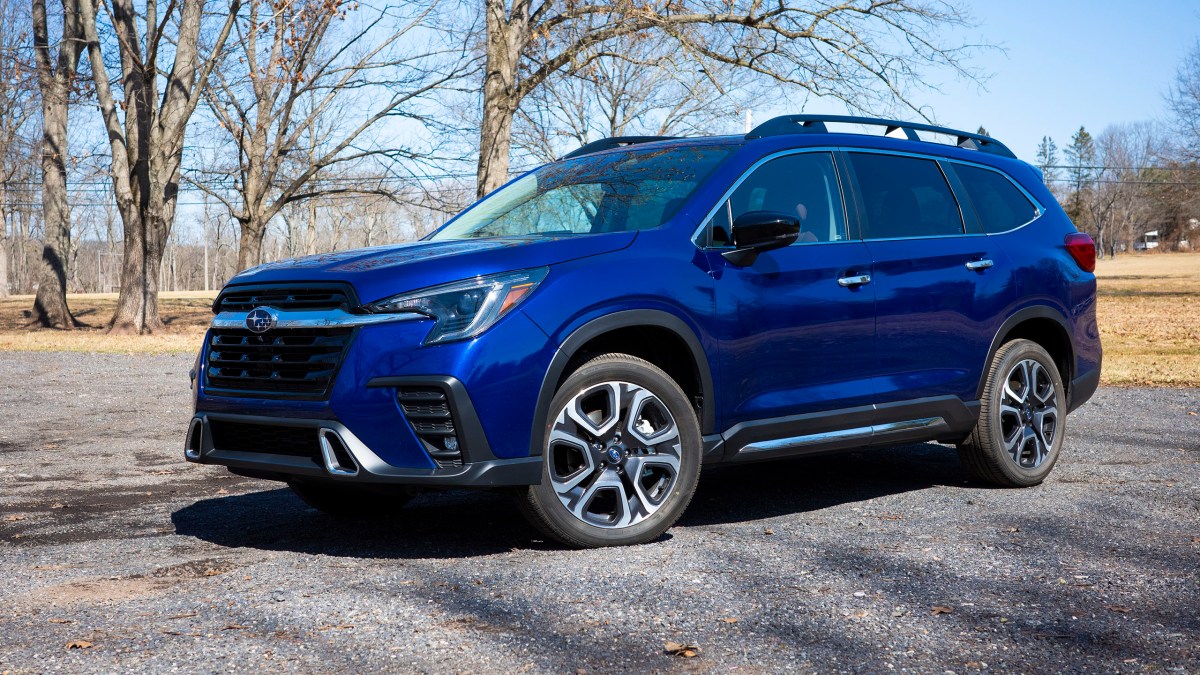
The 2026 Subaru Ascent arrives as a familiar kind of product: a practical family SUV that has stayed on the market long enough for its strengths and weaknesses to become equally obvious. In the review that informs this piece, comfort remains the model’s defining virtue. Nearly everything else now reads as the product of an older phase in the segment.
That contrast is what makes the Ascent interesting in 2026. It is not being positioned as the class leader on technology, design, or driving character. Instead, it survives on a narrower proposition: roomy, easygoing transportation with standard all-wheel drive and a usable baseline feature set.
There is still an audience for that. The question is whether the market has moved far enough that comfort alone is no longer enough to offset age elsewhere.
What Subaru is still getting right
Every 2026 Ascent comes with a turbocharged 2.4-liter flat-four producing 260 horsepower and 277 pound-feet of torque, paired with a continuously variable transmission and all-wheel drive. Three rows of seating are standard across the lineup, and buyers can choose a second-row bench or captain’s chairs depending on trim.
Those fundamentals still matter in the family-SUV market. Subaru also equips the Ascent with a standard cold-weather package, heated front seats, driver power adjustment, adaptive cruise control, steering-responsive headlights, power-folding mirrors, and a 5,000-pound towing capacity. On paper, that creates a solid utility case, especially for buyers who value traction and year-round usability.
The base 2026 Ascent starts at $42,245 including destination, while the reviewed Onyx Edition Touring came to $52,615. That places the vehicle in a price range where buyers are increasingly sensitive not just to comfort and space, but to the total feel of the cabin and interface.
Where the age shows most clearly
According to the review, the Ascent’s biggest problem is not one catastrophic flaw. It is cumulative age. The exterior and interior both resemble products from the previous decade, the vehicle is noisy, and the infotainment system was described as the most frustrating the reviewer had sampled in recent memory.
That point is especially damaging because infotainment has become a core part of how modern buyers evaluate daily usability. A family vehicle does not need to be flashy, but it does need to reduce friction. If the screen, controls, and interface routinely irritate the driver, comfort elsewhere can only compensate so far.
The review also notes that the Ascent does not stand out in comparison tests and is not the three-row SUV most buyers should choose. That is a blunt assessment, but it captures where the model sits today: competent in the basics, outclassed in the broader competition.
Why it still leaves an impression
Even with those criticisms, the review’s most telling line may be emotional rather than technical. Despite the dated design and weak infotainment, the reviewer was still a little sad to see the vehicle go. That suggests Subaru has managed to preserve something many newer vehicles struggle to deliver consistently: ease.
Comfort is easy to underrate in a market saturated with feature comparisons. But for households spending long hours commuting, hauling children, or taking road trips, a vehicle that feels relaxed can still create loyalty. The Ascent appears to benefit from exactly that dynamic.
This does not erase the model’s competitive problems. It does explain why an aging SUV can continue to find buyers after the market has moved on in other respects. There is a difference between being outdated and being unpleasant. The Ascent seems to be the former far more than the latter.
A sign Subaru likely needs a replacement
The review ultimately lands on an unavoidable conclusion: Subaru should probably replace the Ascent soon. That is less a criticism of the original concept than a recognition of how quickly expectations have risen in three-row crossovers. Screens, interfaces, cabin design, refinement, and powertrain behavior now shape the segment as much as room and comfort do.
In that context, the 2026 Ascent looks like a vehicle stretching beyond its natural cycle. It still does enough right to remain likable, but not enough to define the category. Buyers who prioritize comfort above nearly everything else may still find something to appreciate. Most others will likely see a model whose replacement is overdue.
That is the real takeaway. The Ascent is not a disaster. It is a time capsule with decent seats, solid standard hardware, and a shrinking margin for forgiveness.
This article is based on reporting by The Drive. Read the original article.
Originally published on thedrive.com