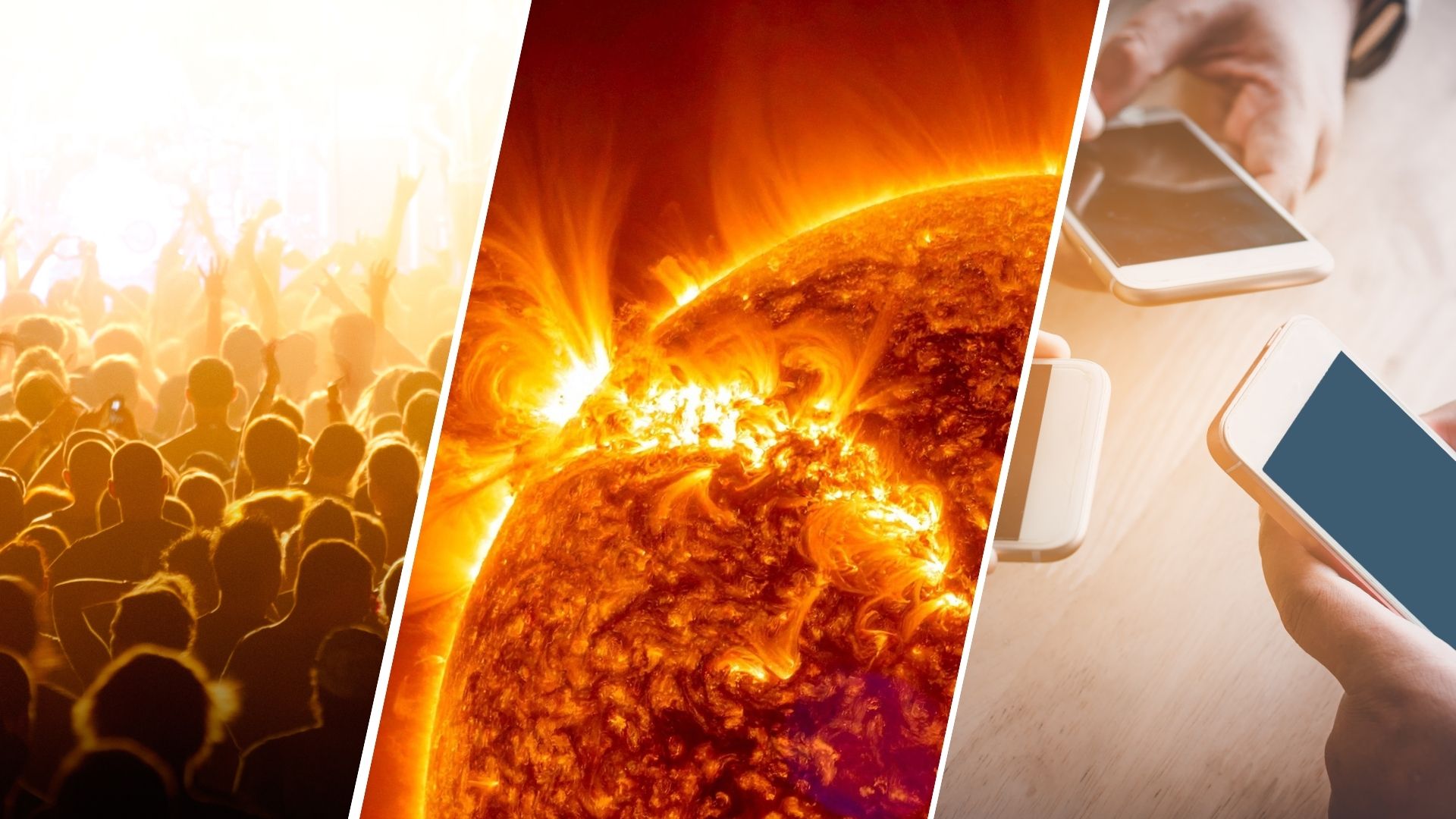
Space weather planning is shifting from hardware failure to social fallout
Extreme solar storms have long been discussed in terms of infrastructure. Scientists and policymakers worry about disrupted satellites, damaged power grids, communications outages, and heightened risks for aircrew and astronauts. But a new warning highlighted by Space.com argues that the real-world consequences of a worst-case event could extend well beyond broken systems. The social response itself may become part of the emergency.
The report referenced by Space.com says a severe space weather event could contribute to panic buying, public unrest, conspiracy theories, and other forms of destabilized behavior. That framing marks an important change in how extreme solar risk is being discussed. The threat is no longer only that the Sun can interfere with critical technologies. It is also that societies deeply dependent on those technologies may react in unpredictable and sometimes disruptive ways when those systems fail.
That is a plausible concern because modern life is tightly coupled to digital infrastructure. A storm that disrupts navigation, power, communications, and satellite services would not unfold in a vacuum. It would affect supply chains, finance, travel, emergency communications, and public trust all at once. In such an environment, rumors can spread as quickly as official guidance, and scarcity behavior can emerge before people fully understand what has happened.
A rare event with cascading consequences
Space.com notes that space weather covers the influence of solar activity on Earth and the near-Earth environment. Solar flares, coronal mass ejections, and solar energetic particles can all affect technology and human operations. Smaller impacts are already common enough that satellite operators regularly adjust to them. Larger impacts are much rarer, which is part of the challenge. Low-frequency disasters are difficult to socialize and hard to rehearse, even when experts take them seriously.
The article points to the fourth edition of the UK Science and Technology Facilities Council’s summary of worst-case space weather scenarios, released in January 2026. The takeaway is not that social breakdown is inevitable. It is that planners need to account for the human layer of technological disruption. When networks fail, people do not simply wait calmly for systems to come back online. They fill information gaps, hoard what looks scarce, and respond to visible uncertainty in ways that can amplify the original disruption.
This idea should sound familiar because it mirrors lessons from other crises. Natural disasters, cyberattacks, and pandemics have repeatedly shown that public behavior is not a side issue. It is a core variable in resilience. The difference with space weather is that the trigger is external, poorly understood by most people, and likely to create confusion across multiple sectors simultaneously.
Misinformation may be one of the biggest force multipliers
One of the most striking elements in the warning is the emphasis on conspiracy theories and extreme belief responses. In an era of fragmented media and rapid rumor circulation, a large disruption with an invisible cosmic cause could become fertile ground for false explanations. If communications infrastructure is degraded while fear rises, reliable information may travel more slowly than speculation.
That has practical consequences. Public compliance with emergency instructions depends partly on trust and comprehension. If people believe a blackout is evidence of sabotage, a cover-up, or a broader political plot, authorities could face not only a technical recovery challenge but a legitimacy challenge. The same applies to panic buying. Empty shelves are not just a sign of supply trouble; they can become a visual accelerant that convinces more people to stockpile.
The report’s value, then, is not in predicting exactly how the public would respond. It is in forcing institutions to treat behavior as part of the hazard model. Emergency management for space weather may need stronger communication plans, better public education, and more realistic assumptions about how quickly social systems can fray when technical systems go dark.
The next step is preparedness that treats society as infrastructure too
There is a tendency to imagine resilience as hardware hardening alone: tougher grids, more redundant satellites, more robust forecasting. Those matter. But the warning covered by Space.com suggests they are not sufficient. A technologically advanced society can still become brittle if people lack trusted information and clear expectations during a cascading outage.
The most useful lesson is therefore broad. Severe solar storms are not only an astrophysics or engineering problem. They are a systems problem that spans energy, communications, governance, and public psychology. Planning for them means preparing institutions to manage uncertainty as much as to repair equipment.
If that sounds expansive, it is because the modern risk landscape is expansive. The more a society depends on seamless digital coordination, the more any disruption becomes both technical and social. Worst-case solar storm planning is finally catching up to that reality.
This article is based on reporting by Space.com. Read the original article.

Originally published on space.com