A lucky archival find gave astronomers an unusually clear look at a comet’s surface
Comets are usually at their most visible when they swing closer to the Sun, but that is also when they become hardest to study in detail. Solar heating releases gases and dust that form a coma around the nucleus, wrapping the body of the comet in a hazy envelope. That makes the object brighter, but it also hides the solid surface researchers want to examine.
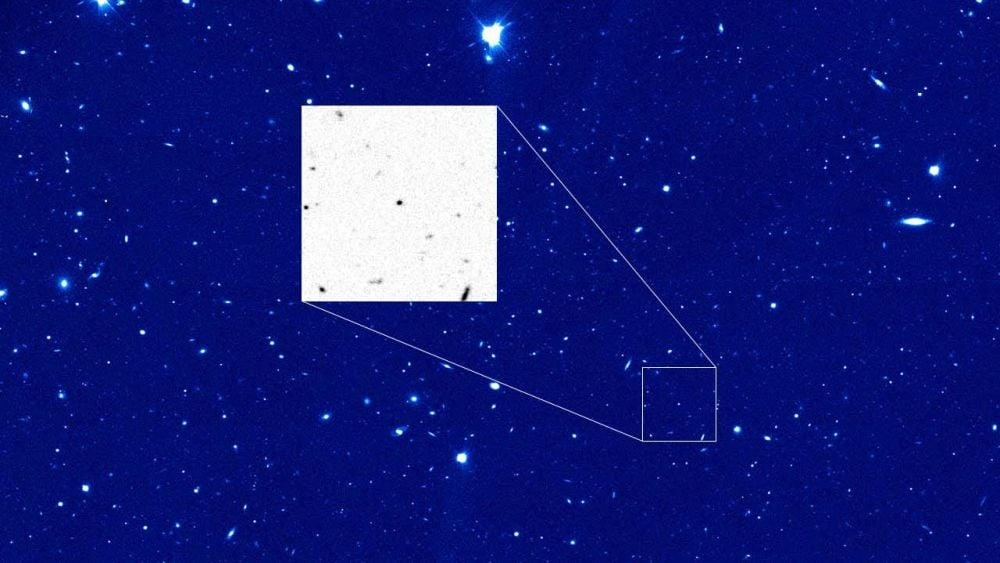
A team of Japanese researchers found a way around that problem by looking backward instead of forward. While searching the Subaru Telescope archive, they uncovered images of comet 28P/Neujmin taken from almost exactly the right geometry for detailed study. The result, described in a paper published in Publications of the Astronomical Society of Japan, offered a rare opportunity to examine a so-called naked comet, one that shows little to no coma at large distances from the Sun.
The object in question, comet 28P/Neujmin, orbits the Sun roughly every 18 years and is about 21 kilometers across. That alone makes it notable, but the more important feature is that when it is far from the Sun, it can appear nearly free of the usual cloud of escaping material. According to the researchers, observations at a heliocentric distance beyond 10 astronomical units effectively minimized contamination from a coma, allowing them to focus on the nucleus itself.
Why “naked” comets matter
Most comet studies have to work around the same basic limitation: the more active the comet, the less direct the view of its surface. For scientists trying to understand composition, texture, reflectivity, and how a comet’s surface scatters light, that is a major obstacle. A naked comet offers a cleaner laboratory. Instead of mostly studying the material blown off the body, astronomers can gather clues about the body itself.
That matters because comets preserve material from the early Solar System. They are not just dramatic sky objects; they are remnants of planetary formation. Any improvement in how well researchers can observe a nucleus can help refine ideas about how small bodies formed, evolved, and weathered over time.
Comet 28P/Neujmin is especially useful for that kind of work because it belongs to the Jupiter-family comets, a group that is dynamically important and relatively accessible to observation. At roughly 21 kilometers in size, it is also one of the larger members of that class mentioned in the source material, which gives astronomers a substantial target when conditions are right.

The archive was the instrument as much as the telescope
The discovery also highlights a broader shift in how astronomy advances. The Subaru Telescope, operated by the National Astronomical Observatory of Japan on Mauna Kea in Hawaii, has been collecting deep-sky data since its completion in 1998. Over the years, its 8.2-meter mirror and wide-field instruments have built a massive image archive. Those stored observations are more than historical records; they are a scientific resource that can yield new findings long after the original observing campaign ended.
In this case, researchers were not simply reviewing old comet imagery for completeness. They were searching for previously unnoticed images of a specific target and found a dataset that turned out to be unusually well suited to their question. That kind of “photo-bombing” event, where a wanted object appears in archival observations made for other purposes, is one of the quiet advantages of modern survey-scale astronomy. A telescope can answer questions that had not yet been asked when the exposure was first taken.
The source text indicates that the archived image came from Subaru’s imaging system and that the viewing angle was close to ideal for studying the comet. For planetary scientists, geometry matters. Light scattering changes with phase angle, and those changes can reveal physical properties of a surface, including roughness and particle behavior. The team’s paper focuses on the opposition effect of comet 28P/Neujmin, a brightness behavior seen when an object is observed at nearly zero phase angle.
What researchers can learn from the light
The opposition effect is a technical concept, but its importance is straightforward: surfaces can brighten sharply when the Sun, the object, and the observer line up in a favorable way. Measuring that change can help scientists infer how the surface is structured at small scales. For a comet nucleus, that can provide information difficult to obtain through more conventional observations.
Because the comet was observed far from the Sun, where coma contamination was minimized, the team could treat the signal more confidently as a property of the nucleus rather than an artifact of surrounding gas and dust. That does not solve every observational challenge, but it improves the quality of the interpretation. For a field where direct spacecraft encounters are rare and expensive, well-timed telescope observations remain one of the best tools available.
The article from Universe Today frames the observation as a fortunate catch, and that is accurate in one sense. But it is also a case study in deliberate scientific reuse. The luck came from the archival image existing at the right angle. The discovery came from knowing what to search for and why it mattered.

A reminder that astronomy’s back catalog still holds discoveries
Large observatories are often discussed in terms of future missions, new instruments, and upcoming observation windows. This result is a reminder that the scientific life of a telescope extends well beyond the night an image is captured. Archives can function as dormant observatories, waiting for new methods, new questions, or new target lists to unlock them.
For comet science, that is particularly valuable. The best observing opportunities can be infrequent, and many comets change dramatically depending on where they are in their orbit. A usable archival image taken under unusually favorable conditions can become scientifically important years later.
In the case of 28P/Neujmin, researchers gained a rare look at a cometary nucleus without the usual veil. That makes the object more than an observational curiosity. It becomes a cleaner test case for understanding how comet surfaces behave, how they reflect light, and how much information astronomers can extract from remote observations alone.
The broader lesson is equally significant. As astronomy generates larger and larger stores of data, discovery increasingly depends not only on building more powerful instruments but also on revisiting what those instruments have already seen. Sometimes the next useful observation is not waiting in the future. It is already sitting in the archive.
This article is based on reporting by Universe Today. Read the original article.
Originally published on universetoday.com