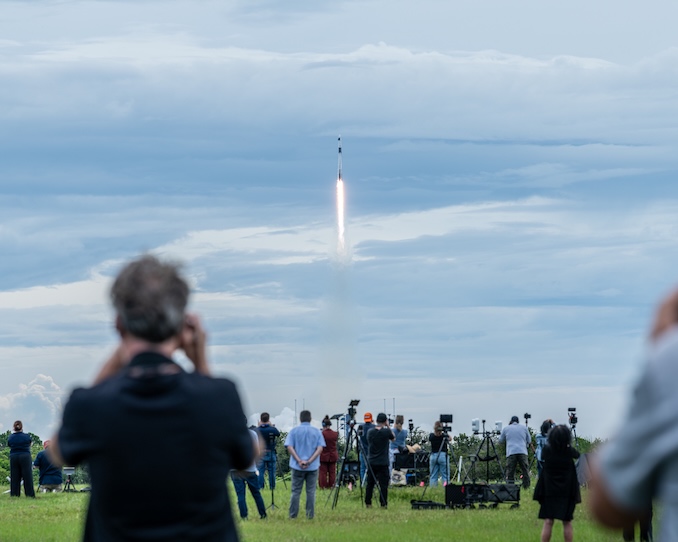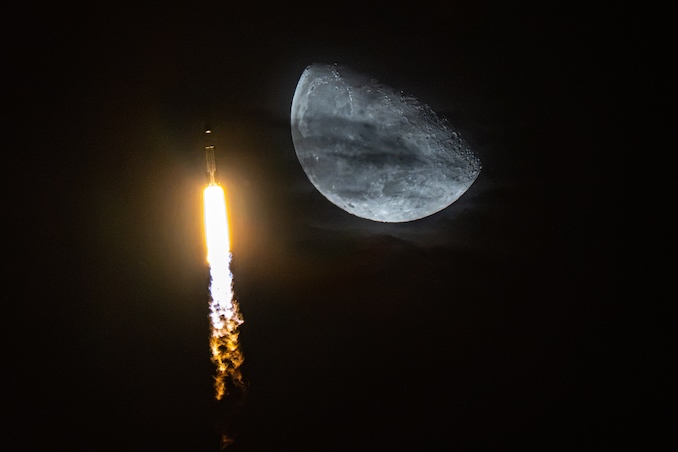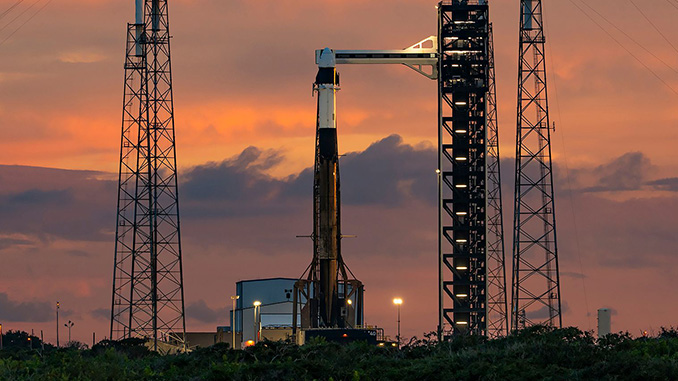
NASA and SpaceX are preparing to send a Cargo Dragon spacecraft to the International Space Station on the CRS-35 commercial resupply mission, carrying 6,300 pounds of cargo that includes the final pair of ISS Roll-Out Solar Arrays.
Liftoff aboard a Falcon 9 rocket from Space Launch Complex 40 at Cape Canaveral Space Force Station is scheduled for 6:33 a.m. EDT on October 13. The mission is SpaceX’s 35th resupply flight to the orbiting laboratory under NASA’s Commercial Resupply Services contract.
Power upgrade for an aging station
The two solar arrays are stowed in the unpressurized trunk of Dragon spacecraft C211. They are the final pair of ISS Roll-Out Solar Arrays, known as iROSAs, planned to augment the station’s power generation.
The station’s existing solar power system has supported operations for years, and the new arrays are intended to add generating capacity as the orbital complex continues to host crew activities, science work and visiting spacecraft. Sending the final pair is therefore a notable infrastructure milestone within the resupply mission.
Dragon C211 is making its fourth cargo flight. Its previous ISS resupply missions were CRS-26, CRS-29 and CRS-33. If the launch and flight proceed as planned, the spacecraft is scheduled to dock with the zenith port of the Harmony module on October 15 at about 11 a.m. EDT.

Cargo includes maintenance and research hardware
CRS-35 will also transport equipment intended for station maintenance and utilization. NASA Low Earth Orbit Program deputy manager Bill Spetch said the cargo includes a dose pump for the station toilet, pre-treat quality sensors, and a robot microcontical tool for maintenance and utilization work involving external replacement units and impairments.
The Dragon trunk will additionally carry a clamshell apparatus for a failed Canadarm2 joint removed during a June 30 spacewalk. Returning or handling failed station hardware is part of the practical work of maintaining a long-running orbital facility: equipment must be replaced, investigated and managed alongside the flow of new supplies and experiments.
The mission’s pressurized cargo includes several scientific investigations. According to NASA’s mission description, the experiments include work on manufacturing artificial retinas, examining how microgravity affects the growth of 3D heart-tissue models, studying glass made with non-traditional elements, and investigating links between inflammation and neurodegenerative diseases.
These experiments share the limited space and launch capacity of a routine cargo mission with items that keep the station operational. That combination illustrates the station’s dual role as both a research platform and an actively maintained spacecraft.
Falcon 9 and Dragon flight plan
SpaceX plans to use Falcon 9 first-stage booster B1096 for the launch. The flight would be the booster’s eighth after missions including NASA’s IMAP, CRS-34, NROL-77, NROL-95, GPS III-9, Kuiper Falcon 01 and Starlink 6-87.
Following liftoff, the rocket is expected to fly on a northeasterly trajectory. Dragon C211 will then begin its journey to the station, where the Harmony zenith docking port became available after the Crew Dragon Freedom returned NASA’s SpaceX Crew-12 astronauts to Earth on October 8.
Once docked, Cargo Dragon is expected to remain attached to the ISS for about a month. That window gives station crews time to unload supplies and research payloads and conduct the work associated with the arriving hardware.
A resupply mission with a broader purpose
The CRS-35 launch is not only a delivery flight. It supports ongoing upgrades to the ISS power system, carries hardware tied to a recent spacewalk, and brings research that ranges from artificial-retina manufacturing to 3D heart-tissue models.
For the space station, continued operations depend on this kind of coordinated logistics. A single Dragon flight can carry replacement and maintenance tools, scientific investigations and large external hardware that cannot fit inside the pressurized cabin. In this case, the mission will also complete the planned delivery of the final pair of roll-out solar arrays.
Weather, launch operations and spacecraft readiness can still affect the schedule. But with Dragon C211 at the pad and Falcon 9 booster B1096 assigned, NASA and SpaceX are positioned for another commercial cargo mission to the ISS—and for a significant final step in its solar-array upgrade effort.
This article is based on reporting by Spaceflight Now. Read the original article.
Originally published on spaceflightnow.com