NASA is preparing to launch the next SpaceX Cargo Dragon mission to the International Space Station, a flight known as SpX-35 that is expected to carry the final set of ISS Roll Out Solar Arrays, or iROSAs. The hardware is intended to augment the orbiting laboratory’s electrical supply as its original solar arrays continue to age after more than two decades in space.
The delivery is a practical milestone in the continuing modernization of the International Space Station. The station remains a working research outpost, but its power system has had to operate through years of exposure to the space environment. The new arrays are designed to add generation capacity over the station’s existing solar arrays rather than replace the original wings outright.
A power upgrade for an aging laboratory
The International Space Station depends on solar power to support its life-support systems, communications, research equipment, computers, thermal-control hardware, and the many other systems needed to sustain a permanent human presence in low Earth orbit. Its solar arrays convert sunlight into electricity, while batteries store power for periods when the station passes through Earth’s shadow.
The original arrays have been exposed to the orbital environment for more than 20 years. Over time, such exposure can reduce performance. Adding new solar capacity is therefore an infrastructure project as much as a cargo delivery. It helps preserve the power margin available to the station and supports the broad set of activities carried out by international crews.
Six iROSAs have already been installed on the station. The SpX-35 payload is expected to deliver the last set in the series, completing the upgrade described in the mission preview. Once deployed, the arrays will augment the existing solar-array system, increasing the electrical supply available to the ISS without requiring the removal of the older hardware.
Why the arrays are deployed over existing hardware
The ISS Roll Out Solar Arrays use a compact, flexible design suited to delivery in a cargo spacecraft and installation in orbit. Their role is not to recreate the station’s electrical architecture from scratch. Instead, they are mounted in a way that allows new generation hardware to work alongside the original arrays.
That approach reflects the reality of operating a complex orbital platform that has remained continuously inhabited for decades. Replacing major station systems is not comparable to servicing equipment on the ground. Hardware must be launched, installed by astronauts or robotic systems, and integrated without interrupting essential operations. Building additional capacity into the existing power system provides a way to extend its useful capability while minimizing disruptive changes.
The upgrade also demonstrates why cargo missions are central to the station’s operations. Cargo flights do not only deliver food, supplies, and scientific experiments. They can also carry the components needed to maintain and improve the outpost itself. Solar-array hardware is especially consequential because it underpins the electrical capacity on which every other onboard activity depends.
Part of a busy week in human spaceflight
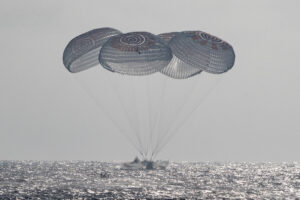
The planned cargo launch follows the return of the Crew-12 mission, whose members spent almost eight months in space. NASA astronauts Jessica Meir and Jack Hathaway, European Space Agency astronaut Sophie Adenot, and Roscosmos cosmonaut Andrey Fedyaev splashed down on October 8 after 237 days in space, including 235 days aboard the ISS.
The mission had been extended by several weeks after an oxidizer leak on the SpaceX Crew Dragon Grace had to be addressed before the Crew-13 launch. After Crew-12’s departure, the station returned to its usual complement of seven people. The current crew includes NASA astronauts Jessica Watkins, Luke Delaney, and Anil Menon; Canadian Space Agency astronaut Josh Kutryk; and Roscosmos cosmonauts Sergey Teteryatnikov, Pyotr Dubrov, and Anna Kikina.
Crew-12’s mission also included multiple spacewalks. Meir completed four during the flight, bringing her career total to seven. Adenot completed three, including one with Meir. Such operations underline the combination of routine science, crew rotation, maintenance, and upgrade work that keeps the ISS functioning.


Preparing for the station’s next phase
The final iROSA delivery arrives as the ISS continues to serve as a platform for research and international cooperation while agencies and companies also plan for future activity in low Earth orbit. Maintaining reliable power is a prerequisite for both the station’s current work and its ability to support new equipment and experiments.
The solar upgrade is also a reminder that the station is not a static artifact. Its modules, systems, crews, and cargo flows must be continuously managed. The laboratory’s longevity depends on decisions made years after its initial assembly, including targeted improvements to systems that remain vital but are exposed to the harsh conditions of orbit.
For NASA and its partners, this kind of maintenance mission has strategic value beyond the individual flight. It preserves a working destination for astronauts, science teams, and commercial and international partners. It also sustains operational experience in the demanding tasks of rendezvous, cargo transfer, robotic operations, and on-orbit assembly.
What comes next
The key near-term event is the launch and arrival of the Cargo Dragon mission, followed by the installation and deployment of the final array set. The source material identifies the iROSAs as the last units planned for the current augmentation effort. Their installation would complete a multi-delivery effort to strengthen the station’s power system.
That does not end the wider work of operating the ISS. Crews will continue conducting research, performing maintenance, and supporting visiting spacecraft. But completing the iROSA campaign would close an important chapter in the station’s modernization: giving an aging but still active orbital laboratory an added source of the electricity it needs to keep working.
This article is based on reporting by spacepolicyonline.com. Read the original article.

Originally published on spacepolicyonline.com