SpaceX pushes another 24 Starlink satellites into orbit from California
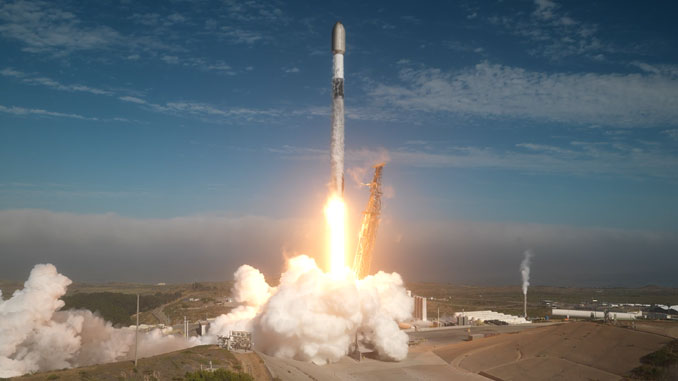
SpaceX carried out another high-cadence Starlink mission on July 25, launching 24 Starlink V2 Mini satellites aboard a Falcon 9 rocket from Vandenberg Space Force Base in California. The mission, identified as Starlink 17-51, lifted off at 8:51 a.m. PDT, or 15:51 UTC, from Space Launch Complex 4E and added another batch of spacecraft to the company’s growing broadband network in low Earth orbit.
According to mission coverage from Spaceflight Now, the rocket departed on a southerly track toward a 97-degree inclination orbit, a geometry commonly used for launches from California that target high-inclination paths. After stage separation, the Falcon 9 first stage completed its return flight and landed on the droneship Of Course I Still Love You, which was positioned roughly 380 miles downrange in the Pacific Ocean.
The launch continued a pattern that has become central to SpaceX’s current operating model: frequent, highly repeatable missions that rely on reusable boosters and tightly managed launch infrastructure. In this case, the first stage booster, designated B1100, flew for the eighth time. Spaceflight Now reported that the booster had previously supported the NROL-105 mission for the U.S. government’s reconnaissance satellite agency as well as six earlier Starlink flights.
Just over an hour after liftoff, SpaceX confirmed successful deployment of the 24 satellites into an initial orbit measured at approximately 168 by 160 miles. While that orbit is only the starting point for the satellites’ operational climb, it marks the core success criterion for the launch itself: safe delivery of payload, booster recovery, and clean execution of a mission profile SpaceX now performs with unusual regularity.
Why this mission matters beyond the launch itself
On the surface, another Starlink flight can seem routine. That perception is partly a measure of how normalized SpaceX has made orbital launches that would once have dominated the news cycle on their own. But the significance lies in the accumulation. Every additional batch of Starlink satellites expands network capacity, refreshes spacecraft already in orbit, and helps SpaceX maintain the dense deployment tempo needed for a global communications business built in space.
The July 25 mission also illustrates how important Vandenberg has become to that strategy. Spaceflight Now described Starlink 17-51 as the seventh of eight planned Falcon 9 launches in July from the California base. By comparison, the outlet said four Falcon 9 missions had flown from Cape Canaveral’s Space Launch Complex 40 during the same month, with one more planned. That balance shows how heavily SpaceX is currently leaning on its West Coast infrastructure.
The shift is notable because Florida has long been the company’s most visible launch hub. Yet recent operational priorities appear to be redistributing the load. Spaceflight Now reported that Vandenberg has become a workhorse facility as SpaceX focuses on Starship preparations in Florida. That does not mean Falcon 9 activity on the East Coast is slowing to insignificance, but it does suggest California is carrying a larger share of the orbital cadence than many casual observers might expect.
For the Starlink program, that matters in practical ways. Launch location shapes orbital options, scheduling flexibility, and the ability to move satellites into different shells of the constellation. A reliable California cadence gives SpaceX another lever for keeping deployment rates high while balancing demands across sites, vehicles, and mission types.
Reusable hardware remains central to the business case
Booster reuse is now so common in Falcon 9 operations that it can fade into the background, but it remains one of the most consequential parts of the story. The eighth flight of booster B1100 is another example of the company extracting repeated value from expensive launch hardware. Reuse does not remove the technical complexity of launch, recovery, refurbishment, and recertification, but it changes the economics and cadence of access to orbit in ways few competitors have matched.
The successful droneship landing also reinforces how mature this recovery architecture has become. Recovering the first stage at sea allows SpaceX to support missions whose performance requirements make return-to-launch-site landings less practical. In other words, booster recovery is not an add-on spectacle; it is part of the operational design that makes missions like this sustainable at scale.
That sustainability matters because Starlink is not a one-time deployment. It is a continuously evolving network that depends on adding satellites, replacing older spacecraft, and managing a large orbital fleet. The launch system behind it must therefore function less like a bespoke exploration program and more like logistics infrastructure. Falcon 9, at least for now, fills that role.
A familiar mission with strategic weight
There were no dramatic anomalies in the July 25 launch, and that is precisely the point. SpaceX’s advantage is increasingly tied to dependable repetition. A mission that lifts off on time, places 24 satellites into orbit, lands its booster, and clears the pad for the next flight is not merely another launch; it is evidence of an industrial rhythm that few space companies have demonstrated.
Starlink 17-51 will not be remembered as a singular milestone in the way a debut mission or record-setting flight might be. Its importance is cumulative. It showed another successful deployment from a busy West Coast pad, another recovered booster, and another step in maintaining the momentum of one of the world’s largest commercial space systems.
As long as SpaceX keeps pairing rapid launch cadence with reliable recovery and deployment, these missions will continue to serve as more than operational housekeeping. They are the mechanism by which the company turns launch frequency into network scale, and network scale into a durable strategic position in the satellite internet market.
This article is based on reporting by Spaceflight Now. Read the original article.
Originally published on spaceflightnow.com