From thought experiment to mission sketch
Sending a spacecraft to a black hole sounds like the sort of idea reserved for science fiction, but the supplied source text describes a more technical version of that question now taking shape in research. A recent preprint highlighted by Universe Today examines what would be required to send a gram-scale probe to a nearby stellar-mass black hole, not tomorrow and not with current launch systems, but within the bounds of long-term mission design.
The paper, described in the source as the work of Cosimo Bambi of Fudan University in Shanghai, starts from a simple scientific motivation. Black holes offer access to the strongest persistent gravitational fields known, making them uniquely valuable environments for testing general relativity. Astronomers have already learned a great deal through remote observation, but the source argues that this approach may be nearing its limits for certain questions. A direct probe, even a very small one, could in principle provide measurements impossible to obtain from Earth.
That does not mean the mission is close. The article makes clear that the idea remains highly speculative and depends first on finding a suitable target, then on developing propulsion and instrumentation far beyond what today’s conventional rockets can deliver for interstellar travel on useful timescales.
The first problem is finding a nearby target
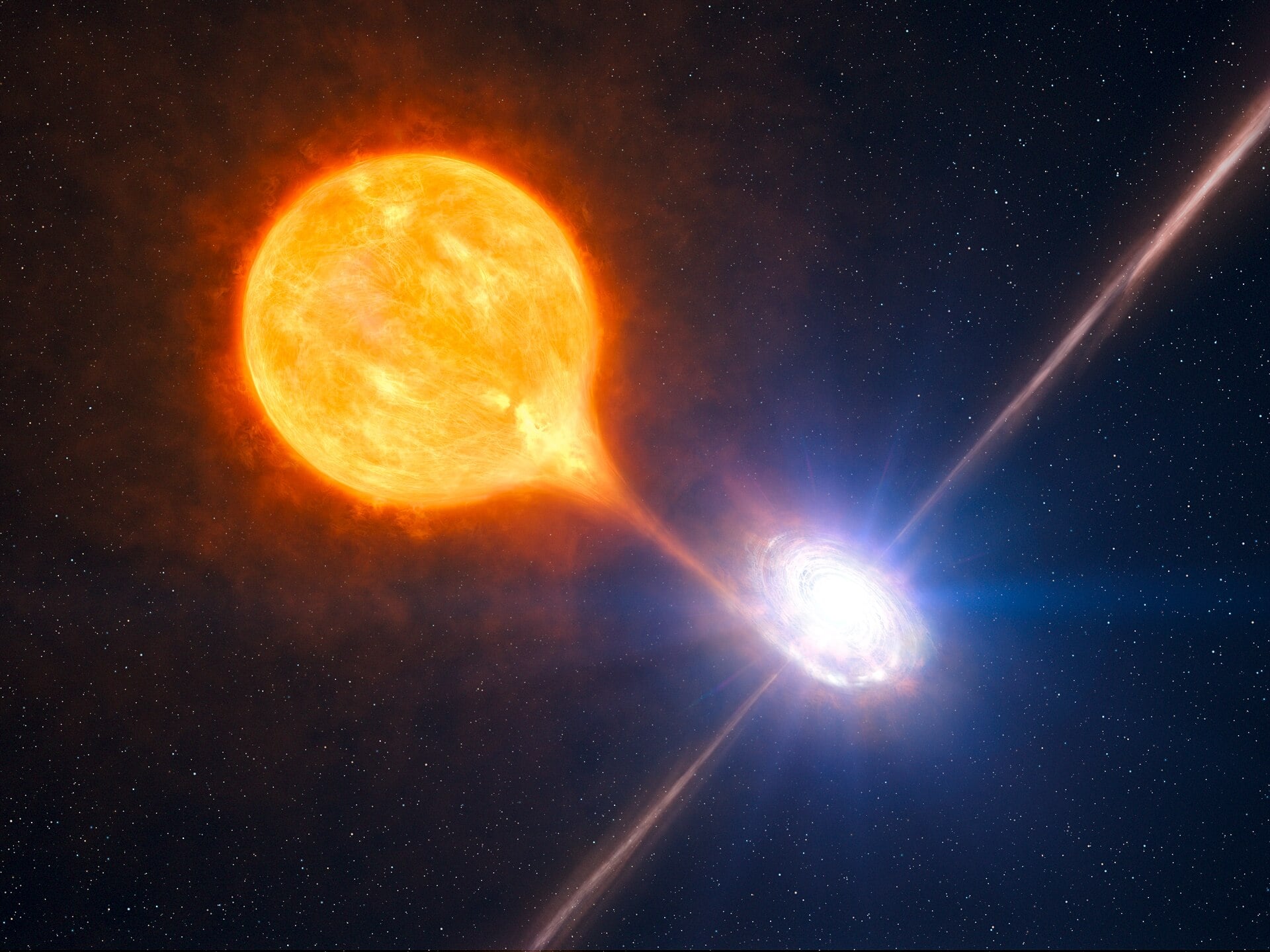
The source text says the nearest known black hole is Gaia BH1, roughly 1,560 light-years away in the constellation Ophiuchus. At that distance, any probe mission is effectively out of reach for present-day engineering. But the preprint’s broader point is statistical: the Milky Way likely contains around 100 million stellar-mass black holes, and about 92% of them are isolated rather than paired with luminous companion stars.
That matters because isolated black holes are hard to see. Without a nearby star feeding them or revealing their gravity through orbital motion, they can remain largely invisible. The source notes that such objects would absorb incoming light rather than emit easily detectable signatures. In practice, that means the galaxy could contain many black holes much closer to Earth than the currently known record holder, but hidden from standard observation.
The preprint described in the source estimates there could be one stellar-mass black hole for roughly every 1,500 cubic parsecs. On that basis, the article says there could plausibly be an undiscovered black hole within 20 to 25 light-years of Earth. That would still be far beyond any routine mission, but it would move the concept from impossible in human terms to at least discussable. A mission to a target a few dozen light-years away is categorically different from one more than a thousand light-years distant.
Crucially, the article says such a nearby object would pose no threat to the solar system at that distance. Its significance would be scientific, not existential.
How researchers think such an object might be detected
The source text points to one possible detection strategy: observing radiation emitted as a black hole passes through local interstellar clouds and accretes surrounding gas. Because isolated stellar black holes do not announce themselves with bright companion stars, researchers would need indirect methods that look for environmental effects rather than the object itself.
According to the article, current multi-wavelength astronomical surveys could likely detect that kind of signal. If that is right, then the first enabling step for any future black hole probe is not propulsion but astronomy. Before engineers can debate payload mass, communications, or flyby trajectory, astronomers would need to identify, confirm, and characterize a sufficiently nearby target.
That framing is useful because it grounds an apparently exotic mission in more familiar scientific work already under way. Sky surveys, transient detection, and multi-band observation campaigns are active fields. The black hole probe concept therefore depends partly on progress that is incremental rather than purely speculative.
Why the probe would have to be tiny
The source text is explicit that rockets are not the answer for this kind of mission. Although the excerpt provided cuts off before laying out the full architecture, its emphasis on a gram-size probe signals the logic clearly. If a spacecraft must cross interstellar distances within a human lifetime, mass becomes the central constraint. Large, power-hungry spacecraft are unrealistic; ultra-light probes become the only concept worth sketching.
This aligns with a broader trend in advanced mission studies that replace heavy spacecraft with minimal payloads, relying on extreme acceleration concepts and lean instrumentation. The advantage is obvious: lower mass reduces propulsion demands. The cost is equally obvious: communications, radiation shielding, attitude control, and data return all become much harder when the probe is measured in grams rather than kilograms or tons.
Even so, the scientific payoff could be enormous. A close pass by a black hole might allow direct measurements of its gravitational environment, tests of relativistic effects under conditions unavailable anywhere else, and better constraints on how matter and radiation behave near an event horizon. The source positions the idea as a route toward learning that cannot be replicated through remote observation alone.
Why this matters now
The value of the preprint is not that it promises a mission, but that it narrows a vague ambition into a sequence of actual requirements. First, find a nearby isolated stellar-mass black hole. Second, confirm that it is close enough to make a lifetime-scale mission meaningful. Third, design an ultra-light probe architecture capable of reaching it. Only after those steps would it make sense to talk seriously about instruments, communications, or trajectory details.
That may sound basic, but it is how ambitious space projects become legible to science and engineering communities. They move from fantasy to roadmap not when they become easy, but when the dependencies become clear enough to evaluate. In that respect, the work described in the source marks a useful transition. It treats the black hole probe not as spectacle, but as a chain of solvable and unsolved problems.
For now, the largest obstacle remains discovery. If no nearby target exists, the mission concept stays academic. If one is found within a few tens of light-years, the discussion changes immediately. The most interesting implication of the article may therefore be observational rather than technological: the galaxy could be hiding scientifically priceless destinations much closer than the catalog currently shows.
That possibility alone is enough to keep the idea alive. Not because humanity is ready to launch a black hole probe, but because astronomy may yet reveal that one of the universe’s most extreme laboratories is nearer than expected.
This article is based on reporting by Universe Today. Read the original article.
Originally published on universetoday.com