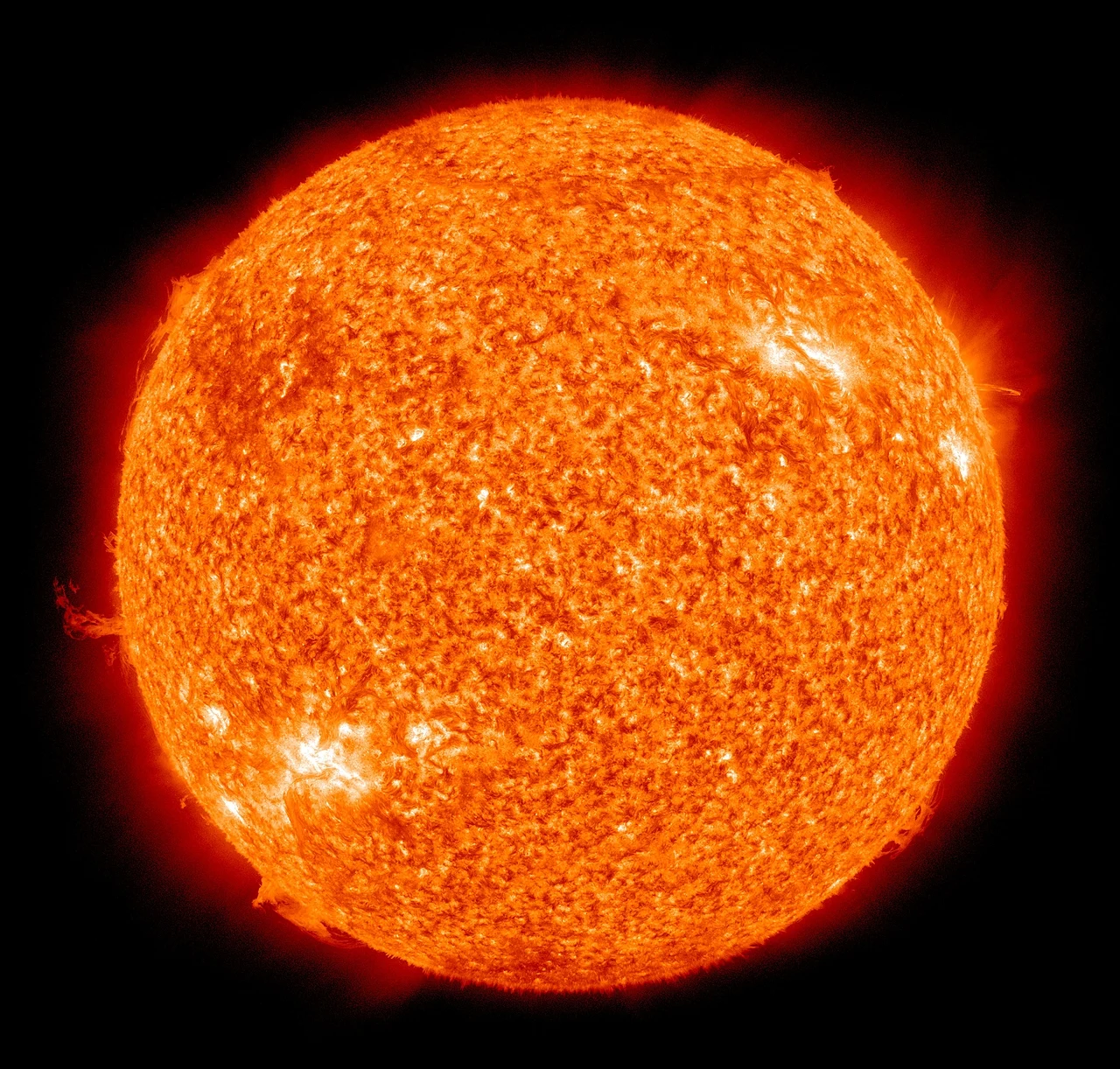
The Sun’s outflow is less steady than its name suggests
The solar wind is often described as a continuous stream of charged particles flowing outward from the Sun. That description is correct, but incomplete. In the supplied source text, new research discussed by Universe Today emphasizes that the wind is not a smooth, featureless current. It is filled with plasma waves that redistribute energy as the flow travels through the Solar System.
That shift in emphasis matters. The solar wind influences geomagnetic storms, satellite conditions, communications systems, and the broader space-weather environment around Earth. Understanding how energy is moved and transformed within that flow is not just a theoretical exercise. It shapes how scientists interpret the Sun’s interaction with planets and spacecraft.
Solar Orbiter is sampling the wind closer to its source
The reporting centers on work by Jordi Boldú of the Swedish Institute of Space Physics and Uppsala University using data from the European Space Agency’s Solar Orbiter mission. The spacecraft can travel closer to the Sun than Mercury’s orbit, allowing researchers to study the solar wind earlier in its journey than observations near Earth usually permit.
That vantage point is important because what scientists see close to the Sun can differ from what reaches Earth after the solar wind has expanded, interacted, and evolved over much greater distances. The supplied article argues that these near-Sun observations reveal a more dynamic picture of the wind’s internal behavior.

Plasma waves are doing active work
The specific focus in the source text is on high-frequency electrostatic waves, including Langmuir waves and ion acoustic waves. Their behavior is governed by resonance, meaning particles moving at the right speed can exchange energy with the passing wave. The article uses an analogy to a wine glass shattering when hit at the right note: very different physics, but the same basic idea of matched frequencies allowing energy transfer.
That mechanism turns plasma waves into active players in the evolution of the solar wind. Rather than simply riding along inside the flow, they help redistribute energy between particles as the wind moves outward. In the account supplied here, the waves are not incidental. They are part of the machinery that shapes the wind over distance.
Why the finding matters for Earth
Space weather is one obvious reason. The source text notes that the solar wind directly influences geomagnetic storms that can disrupt satellites, power grids, and communications. It also affects high-energy particle acceleration and the shock waves that form when the wind interacts with planetary magnetic fields.
Those are practical consequences. Better knowledge of how energy is transferred within the solar wind could improve how researchers model the conditions that eventually reach Earth. That does not mean one study instantly transforms forecasting, but it does show why fundamental plasma physics matters. The connection between basic space science and technological risk is unusually direct in this field.

The result is also conceptually important
There is a second reason this story stands out. It pushes back against the tendency to imagine the solar wind as a simple outward blast. The supplied article presents it instead as a turbulent, evolving medium in which waves and particles are constantly interacting. That is a more complex picture, but also a more realistic one.
In science, some advances come from seeing a familiar system with finer resolution rather than discovering an entirely new object. This appears to be one of those cases. The Sun has been driving the solar wind for the entire history of the Solar System. What changes is the quality of the measurements and the precision of the explanation.
Closer observations are changing the story
Solar Orbiter’s role in this account is central because it allows those explanations to be grounded in earlier-stage observations. If the solar wind is already being shaped by wave-particle interactions much closer to the Sun than previously understood, then some long-standing assumptions about how the flow evolves may need refining.
An inference from the supplied source is that proximity matters as much as sensitivity. Measurements made after the solar wind has traveled all the way to Earth’s orbit can miss part of the story. By then, many interactions have already unfolded. Solar Orbiter is effectively looking upstream.
A more dynamic Sun means a more dynamic neighborhood
The supplied piece ends on the implications for the environments around planets, including Earth. That is the right place to land. The solar wind is not background noise. It is one of the processes that continuously shapes our space environment.
If plasma waves are more influential than many people realized, then the solar wind becomes less like a steady breeze and more like a changing system with internal structure that matters at every scale. That makes the science richer, but it also makes it more useful. Every improvement in understanding helps researchers explain how solar activity becomes technological consequence.
For a field that links the physics of the Sun to the reliability of systems on Earth, that is exactly the kind of progress worth watching.
This article is based on reporting by Universe Today. Read the original article.
Originally published on universetoday.com