A funding round aimed at a long-standing spaceflight problem
Rhea Space Activity has raised $6 million in a Series A round to advance software for spacecraft navigation without GPS, according to the supplied report from SpaceNews. The Washington, D.C.-based company says the funding will accelerate development of a visual-based navigation system called AutoNav, which relies on onboard optical sensors rather than satellite positioning.
At first glance, the amount may look modest by the standards of large aerospace financing. But the target is strategically important. GPS is deeply embedded in modern navigation, yet it is not universally available or reliable for every phase of spaceflight. By focusing on environments where GPS signals are unavailable, degraded, or simply not applicable, Rhea is aiming at a problem that sits directly at the intersection of autonomy, resilience, and mission flexibility.
Why GPS-free navigation matters
The report says Rhea’s software is intended for use in situations including atmospheric reentry and deep space. Those two examples help explain why alternative navigation tools have become more attractive to both government and commercial operators. Spacecraft cannot assume uninterrupted access to satellite-based positioning across every mission profile. When communications are constrained or signals are disrupted, the ability to determine position and trajectory onboard becomes far more valuable.
That is the case Rhea appears to be making with AutoNav. Instead of depending on external positioning infrastructure, the system uses images of moving space objects such as satellites, moons, planets, asteroids, and comets, then compares those images with known positions to calculate movement and location. In practical terms, it is a bid for greater spacecraft autonomy: a way to keep navigating when conventional support is unavailable or undesirable.
The broader appeal goes beyond technical elegance. Space operators increasingly want systems that reduce reliance on vulnerable or contested external services. A navigation approach that functions without GPS aligns with that push, especially as more activity moves into environments where delay, signal limits, or operational risk make independence more important.
NASA heritage gives the technology a stronger starting point
One of the most important details in the supplied report is the system’s origin. AutoNav was originally developed at NASA’s Jet Propulsion Laboratory, where it was intended to help spacecraft determine position and trajectory without continuous guidance from Earth. That is more than a brand-name endorsement. It suggests the underlying idea comes from a mission context in which autonomy is not a convenience but a necessity.
Technology with JPL roots often carries a different level of credibility in the space sector, particularly when the commercial story centers on operational independence. That does not guarantee market success, but it does mean the company is not presenting a purely speculative concept. The report frames AutoNav as an attempt to commercialize and further develop a navigation approach already associated with high-consequence spaceflight needs.
That heritage also helps explain the visual-navigation model itself. Spacecraft are surrounded by reference points. The challenge is not the absence of observable objects, but turning those observations into reliable, onboard calculations. AutoNav’s method, as described in the report, is built around that premise.
A test flight gives the company a near-term milestone
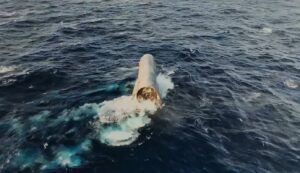
Rhea says the system will be tested on a reentry capsule developed by Varda Space Industries that launched to orbit on March 30. This is a meaningful detail because it moves the story beyond concept development and into operational validation. Investors in space technology increasingly look for evidence that software or hardware can leave the whiteboard and survive real mission conditions.
Reentry is a particularly interesting test environment. The supplied report specifically names atmospheric reentry as one of the conditions in which GPS may be unavailable. If AutoNav can contribute useful navigation performance in that setting, it would strengthen the argument that the system is relevant not only for distant deep-space missions but also for nearer-term commercial operations.
That matters because the market for GPS-independent navigation is likely to emerge in layers. Deep-space capability carries prestige and long-term importance, but more frequent commercial missions can provide earlier proof points and revenue opportunities. A successful test on a reentry capsule would support the idea that the same core approach can serve multiple parts of the space economy.
The timing fits a wider move toward resilient space systems
The report notes that alternatives to GPS have gained attention as governments and commercial operators seek to reduce dependence on navigation systems that can be disrupted or degraded. That wider trend is one reason this financing story matters. It is not just about one startup raising one round. It is part of a larger effort to build space infrastructure that remains functional under stress.
Resilience has become a defining word across both civil and military space. Operators want spacecraft that can do more onboard, depend less on continuous outside direction, and continue operating when links are limited. Optical navigation fits neatly into that agenda. It offers a pathway toward vehicles that are more self-sufficient in contested, communication-limited, or simply distant environments.
For investors, the attraction is straightforward. If navigation without GPS becomes a core requirement for future spacecraft classes, then companies that solve pieces of that problem could become important suppliers. Rhea’s Series A suggests there is enough confidence in that thesis to support scaling the technology further.
What this funding round really signals
The strongest takeaway is not the dollar figure alone. It is that autonomous navigation is moving from a specialized engineering concern toward a clearer commercial category. Rhea is betting that the next generation of spacecraft will need more onboard intelligence about where they are and where they are going, especially when conventional positioning tools fall short.
That is a credible direction based on the supplied report. The company has outside capital, a NASA-derived technology base, and a test opportunity tied to a real flight. In space technology, that combination is often what turns an interesting concept into a company worth tracking.
Why this round matters
- Rhea Space Activity raised $6 million in a Series A round to advance GPS-free navigation software.
- The company’s AutoNav system uses onboard optical sensors and images of celestial or orbital objects rather than satellite-based positioning.
- The technology traces back to NASA JPL and is aimed at use cases including deep space and atmospheric reentry.
- A planned test on a Varda reentry capsule gives the company a near-term validation milestone.
This article is based on reporting by SpaceNews. Read the original article.

Originally published on spacenews.com