Hubble and Webb finally expose one of Omega Centauri’s “missing” black holes
Astronomers have identified the first confirmed stellar-mass black hole in Omega Centauri, a result that addresses a long-running puzzle about one of the Milky Way’s most studied star clusters. The finding, reported in coverage published July 24, comes from a combination of more than two decades of archival observations from NASA’s Hubble Space Telescope and more recent measurements from the James Webb Space Telescope.
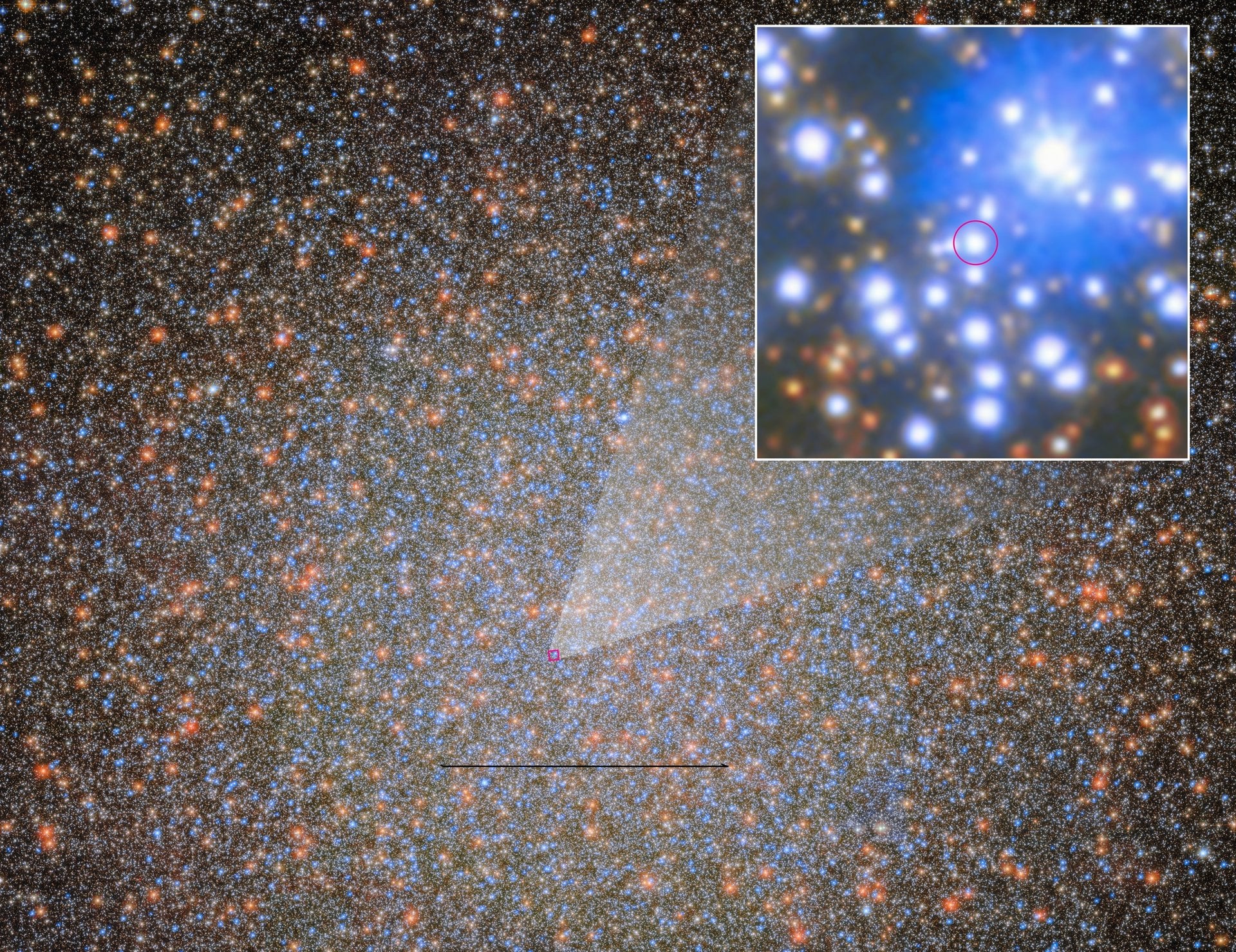
Omega Centauri has occupied a strange place in black hole research for years. The cluster, about 18,000 light-years from Earth in the constellation Centaurus, is the largest known globular cluster in the Milky Way. It contains roughly 10 million stars packed into a region about 150 light-years across. Models have suggested that such an environment should contain many stellar-mass black holes left behind when massive stars ended their lives in supernova explosions. Yet astronomers had not previously found direct evidence for that expected population inside Omega Centauri.
That absence helped turn the cluster into an astrophysical oddity. In 2024, Hubble observations found evidence for an intermediate-mass black hole at the cluster’s center. But theory still indicated that the system should also host a large population of smaller black holes. According to the source report, current models suggest Omega Centauri could contain around 10,000 stellar-mass black holes. The newly identified object does not solve that full count on its own, but it does establish that the “missing” class is present.
A long baseline of data made the difference
The newly identified object is designated oMEGACat BH-2. Rather than relying on bright emissions from infalling matter, the observing team used motion itself as the key signal. Because black holes do not emit visible light on their own, astronomers often have to infer their existence indirectly. One route is to look for X-ray or radio signatures from accreting material. Another is to measure how a hidden massive object perturbs the motion of a visible companion or neighboring stars.
In this case, the team used astrometric measurements, tracking tiny changes in stellar positions over time. By extending the observational baseline from 2002 to 2023 and combining Hubble records with data from Webb’s Near-Infrared Camera, researchers were able to refine the orbit of a star moving around an unseen companion. That invisible object turned out to be massive enough to qualify as a stellar-mass black hole.
The source says an earlier team had interpreted the same binary system as one containing a neutron star. The expanded dataset changed that picture. With a longer time span and more precise position measurements, the Utah-led team could place tighter constraints on the hidden object’s mass and show that a black hole is the better fit.

Why Omega Centauri matters
Globular clusters are dense stellar systems and natural laboratories for testing how compact objects form, interact and survive over time. If large numbers of stellar-mass black holes remain bound inside these environments, they can influence the cluster’s internal dynamics, including how stars move and how binaries evolve. That makes a confirmed black hole in Omega Centauri more than a one-off curiosity. It becomes evidence that the cluster may be retaining at least part of the black hole population that theory expects.
The result is especially significant because Omega Centauri has often been treated as unusual even among globular clusters. Its size and complexity have led to recurring debate about whether it is simply a massive cluster or the remnant core of a disrupted dwarf galaxy. Any direct evidence about its compact-object inventory helps sharpen the physical picture of what the system is and how it evolved.
The discovery also shows the practical value of combining observatories across generations. Hubble’s long archive provided the baseline needed to see slow orbital motion develop over decades, while Webb contributed newer, high-quality measurements that helped refine the solution. That kind of cross-mission astronomy is becoming increasingly important as researchers revisit older targets with more sensitive instruments and different wavelengths.
From one black hole to a larger census
Finding one stellar-mass black hole in Omega Centauri does not mean the broader mystery is finished. If models suggesting thousands of such objects are even roughly correct, astronomers still have a great deal of work ahead. But the new detection changes the status of the problem. Instead of asking whether the cluster somehow lacks stellar-mass black holes altogether, researchers can now ask how many are there, how they are distributed, and why they were so hard to identify.
The answer may depend on technique as much as theory. Quiet black holes in crowded star fields are difficult to isolate, especially when they are not actively feeding and therefore not producing obvious high-energy emission. Precision astrometry offers a way to uncover that hidden population by measuring the gravitational influence of invisible companions on stars that can be seen directly.
If additional detections follow, they could help astronomers test competing models of black hole formation and retention in dense stellar systems. They could also improve understanding of how interactions inside clusters affect the long-term survival of compact binaries. Even a modest sample would provide a stronger empirical anchor than the field has had so far for Omega Centauri.
For now, the discovery of oMEGACat BH-2 stands as a milestone because it turns a theoretical expectation into an observed reality. After years in which Omega Centauri appeared to be missing an entire class of expected remnants, astronomers have now found the first confirmed member of that hidden population. The broader census remains unfinished, but the search has moved from speculation to direct detection.
This article is based on reporting by Universe Today. Read the original article.

Originally published on universetoday.com