Moving beyond single-planet biosignatures
The search for extraterrestrial life has long been dominated by two ideas: look for liquid water and look for biosignatures. That framework has guided decades of planetary science and shaped some of the most anticipated observations from modern observatories, including efforts to study exoplanet atmospheres. But a new research proposal highlighted by Universe Today argues that the field may need a broader strategy, one that searches for life not only on individual planets but in patterns spanning groups of worlds.
The paper, published in The Astrophysical Journal and titled An Agnostic Biosignature Based on Modeling Panspermia and Terraforming, comes from Harrison Smith of the Earth-Life Science Institute at Institute of Science Tokyo and Lana Sinapayen of the National Institute for Basic Biology in Okazaki City, Japan. Their central argument is that conventional biosignatures can be difficult to interpret because many atmospheric or planetary features associated with life on Earth may also arise through non-biological processes elsewhere.
That uncertainty has become one of the core problems in astrobiology. A possible signal in a distant atmosphere can generate excitement, but scientists then have to ask whether chemistry, geology, radiation, or some unfamiliar planetary context could have produced the same reading without life.
The problem with “smoking gun” evidence
Traditional biosignature hunting often assumes that researchers can identify one or more telltale markers on a single exoplanet and then infer biology from them. The difficulty is that no such marker is universally secure. Even on Earth, atmospheric composition reflects a complex interplay of biology, geology, climate, and stellar environment. On worlds very different from Earth, those relationships may look different enough to produce false positives.
The researchers argue that technosignatures suffer from a related weakness. Looking for evidence of technology assumes certain things about how civilizations develop, what tools they use, and what kinds of energy or infrastructure they build. Those assumptions may be too narrow or too anthropocentric to serve as a dependable general method.
Instead, the authors describe an “agnostic” approach. In this context, agnostic does not mean uninterested in life. It means avoiding strong prior assumptions about exactly what alien biology or civilization must look like. The goal is to search for emergent signatures that appear at a larger scale and are less vulnerable to being mimicked by ordinary planetary processes.

Life as a pattern across multiple worlds
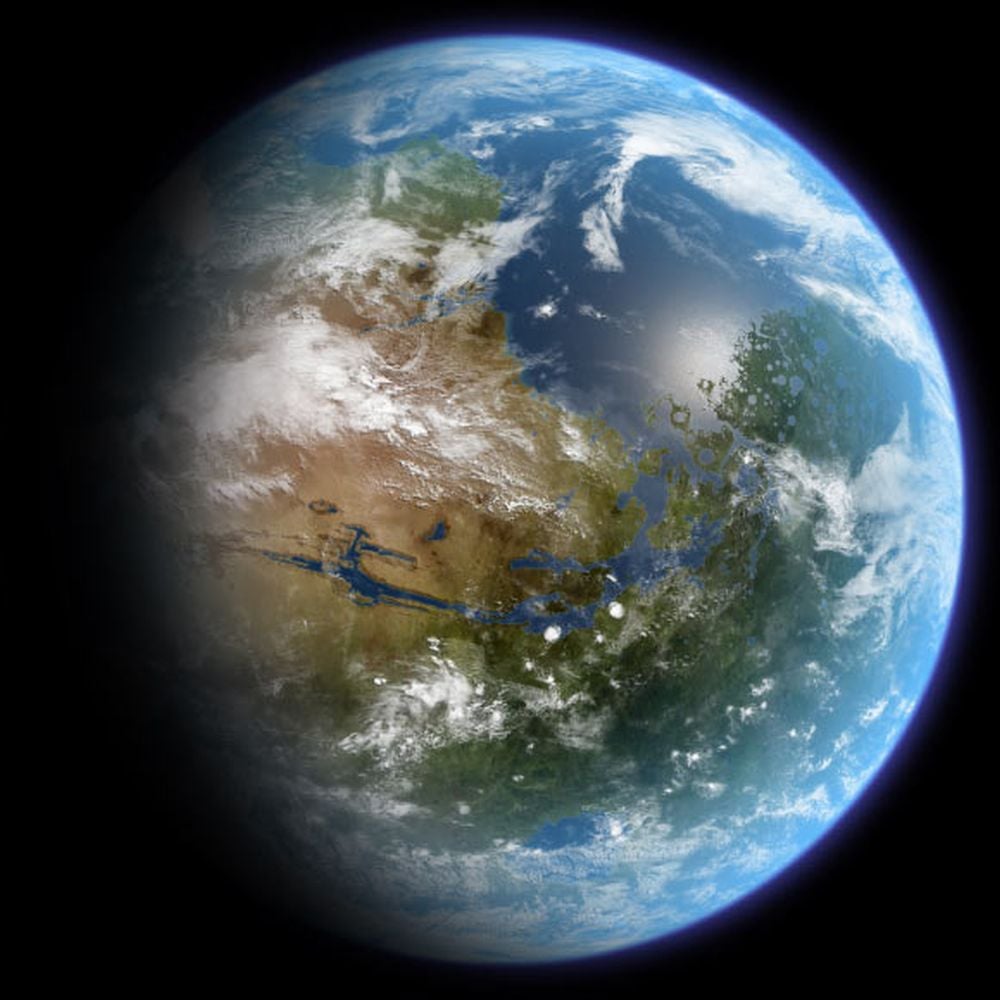
The specific idea explored in the paper is that if life spreads from planet to planet or between star systems, it may alter the observable properties of planets in ways that become visible statistically across a population of worlds. The mechanisms considered include panspermia, in which life spreads naturally, and terraforming, in which intelligent actors intentionally alter planets.
Rather than asking whether one exoplanet contains a decisive atmospheric molecule, the approach asks whether a cluster of planets shows a pattern that is unlikely to arise without life propagating or reshaping environments across multiple locations. According to the article, the researchers argue that this kind of large-scale signature could be more robust and less prone to false positives than conventional single-world biosignatures.
That is an important conceptual shift. It recasts life detection as a systems problem rather than a one-planet forensic puzzle. If successful, it could let scientists infer the presence of biology from correlations and structures across planetary populations, even when none of the individual planets offers a definitive “smoking gun.”
Why the timing matters
The proposal arrives as exoplanet science is entering a more data-rich era. Telescopes are increasingly able to characterize atmospheres, orbital properties, and planetary demographics at scales that would have seemed unrealistic only a generation ago. As those catalogs expand, researchers gain a better chance of comparing worlds within the same systems and across stellar neighborhoods.
That trend makes population-level reasoning more plausible. A method based on groups of planets would have been far harder to imagine when only a small number of exoplanets were known. Today, it fits a field that is moving from simple detection toward comparative exoplanetology.
It also addresses a practical challenge. Outside the solar system, the number of possible targets is vast, but certainty is elusive. Scientists cannot visit these worlds directly, and their observations are often indirect. A framework that improves confidence without demanding an unambiguous single-planet signature could therefore be useful even if it never fully replaces conventional biosignature work.

What this idea changes and what it does not
The proposal does not eliminate the importance of liquid water, atmospheric chemistry, or direct study of candidate habitable planets. Those remain central to the field. Nor does it guarantee that researchers will find a clean statistical pattern proving that life has spread between worlds. The method is still a model-driven concept, not a confirmed detection pipeline.
What it changes is the scope of the question. Instead of asking only, “Does this planet have a biosignature?”, the new approach asks, “Do the relationships among these planets imply the action of life?” That broader framing may help scientists avoid overinterpreting individual signals while still extracting meaning from large datasets.
It also potentially lowers dependence on Earth-centric expectations. If alien life does not produce familiar atmospheric fingerprints, it might still leave traces in how multiple planets within a system or region differ from what non-biological evolution alone would predict.
A more mature search strategy for a difficult problem
Astrobiology has always faced a paradox: life may be common, but proving it remotely is extremely hard. The more scientists learn about planetary diversity, the more cautious they become about declaring simple biosignature solutions. In that sense, the new paper reflects a maturing field. It acknowledges that ambiguity is not a temporary inconvenience but a structural feature of the problem.
The proposed answer is not to give up on biosignatures, but to supplement them with a higher-level lens. Groups of planets may carry information that single planets do not. If life spreads, modifies environments, or clusters in recognizable ways, then the evidence may emerge not from one spectacular target but from a pattern visible only when many worlds are viewed together.
That would be a different kind of discovery narrative than the public often imagines. It might not come as a single dramatic atmospheric reading from one Earth-like world. It might come as an inference assembled from planetary populations, modeled pathways, and unusual system-wide structure.
For a field increasingly defined by complexity, that may be exactly the sort of method it needs.
This article is based on reporting by Universe Today. Read the original article.

Originally published on universetoday.com