Habitability may depend on more than a planet’s parent star
The search for life beyond Earth has long revolved around a familiar concept: the habitable zone around a star, where temperatures may allow liquid water to exist on a planet’s surface. But new research suggests that this local framing is incomplete. Even a planet sitting in the right orbital range could still be rendered hostile by activity taking place much farther away, at the scale of an entire galaxy.
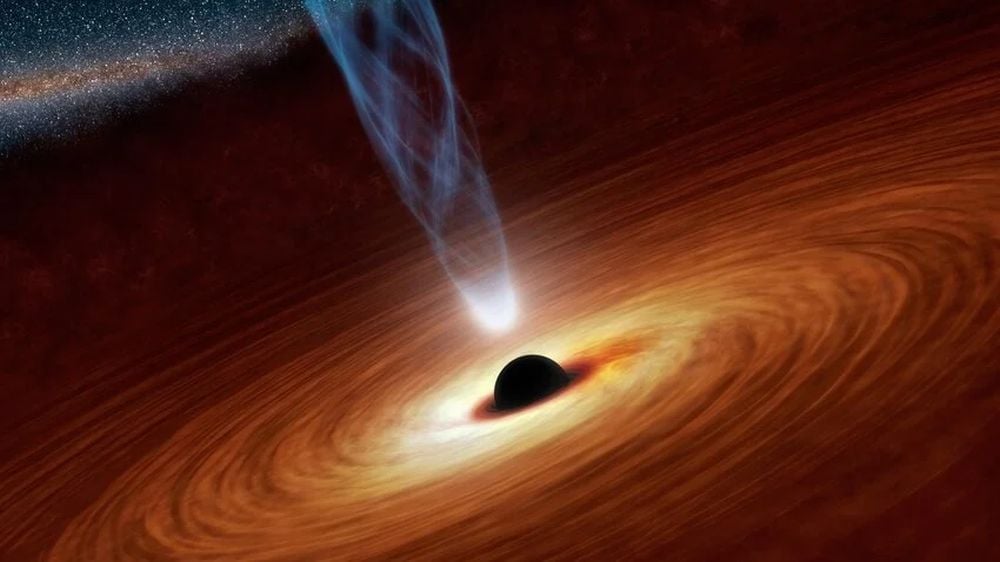
The study, published in The Astrophysical Journal according to the source material, examines how supermassive black holes can shape exoplanet habitability. Specifically, it focuses on the periods when those black holes are actively feeding and become active galactic nuclei, or AGN. In that state, they can emit enormous amounts of high-energy radiation over sustained periods.
The implication is significant: a galaxy’s central engine may influence whether distant planets can retain atmospheres and ozone layers, even when those worlds orbit stars in conventionally favorable locations.
From stellar habitability to galactic habitability
Most popular discussions of habitable planets begin with the Goldilocks zone. Too close to a star and surface water boils away. Too far and it freezes. That framework remains important, but it only captures one level of the problem. The new research asks what happens when a planetary system exists in a harsh galactic environment shaped by a supermassive black hole.
The source explains that the authors place this question in the broader effort to understand galactic habitability. Supernovae have already drawn attention because they can deliver intense radiation, strip atmospheres, or even sterilize planets. Dense regions such as a galactic bulge may face elevated risks because of the higher frequency of these violent events.
Active galactic nuclei may be even more consequential in some cases because, while a supernova is brief, an AGN can remain energetically influential over much longer timescales. That makes it a potentially powerful regulator of habitability across large regions of a galaxy.
How black hole activity could damage worlds
According to the source, the study finds that energy from active supermassive black holes can strip away planetary atmospheres and erode ozone protections at great distances. Those effects matter because atmospheres help stabilize climate and shield surfaces, while ozone can limit biologically damaging radiation reaching the ground.
In practical terms, that means a planet can be in the “right” place relative to its star and still lose conditions favorable to life because of high-energy radiation generated near the galactic center. This expands the idea of habitability from a star-by-star calculation to a nested problem shaped by stellar, planetary, and galactic factors at once.
The work is especially relevant because supermassive black holes are believed to sit at the centers of all large galaxies. They are not unusual outliers. Instead, they are standard features of cosmic architecture, which means their periods of activity may need to be treated as a routine part of long-term planetary risk.
Why the result matters for life searches
The search for biosignatures and habitable exoplanets is accelerating as observational tools improve. But a growing catalog of worlds is only useful if the screening criteria are sophisticated enough. Studies like this one suggest that identifying promising planets will require more than checking orbital distance and star type.
Researchers may also need to account for a system’s location within its galaxy and for the evolutionary history of that galaxy’s central black hole. A world’s atmosphere could reflect not just local conditions, but exposure to ancient or ongoing energetic episodes originating millions of times farther away than its host star.
That does not mean life is rare by default in galaxies with active centers. It means the map is more complicated than once assumed. Some regions may be less hospitable than their stellar properties suggest, while others may remain comparatively protected.
As exoplanet science matures, the concept of the habitable zone is becoming less of a single ring around a star and more of a layered systems problem. This new work adds one of the most dramatic variables yet: whether a supermassive black hole, in an active phase, can quietly reshape the odds of life across vast swaths of a galaxy.
This article is based on reporting by Universe Today. Read the original article.
Originally published on universetoday.com