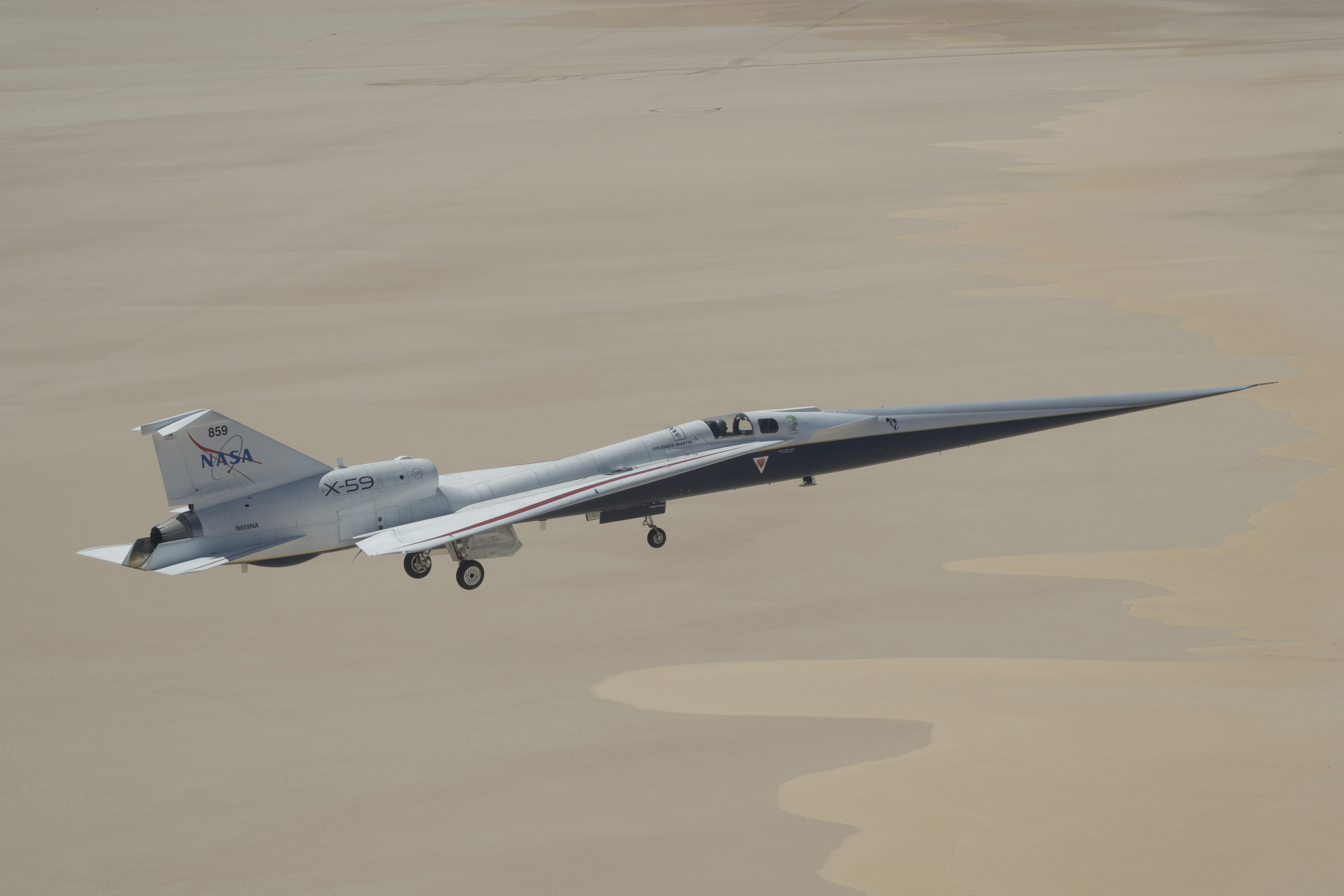
NASA’s quiet-supersonic aircraft is approaching its biggest test yet
NASA’s X-59 research aircraft is moving into a new phase of flight testing that is expected to include the first supersonic flight for the one-of-a-kind X-plane. The agency says the aircraft has completed an initial block of lower-altitude and lower-speed flights and is now preparing for a more demanding series of tests that will push it toward the operating conditions it was built to meet.
The milestone matters because the X-59 is the centerpiece of NASA’s Quesst mission, an effort aimed at gathering real-world data on quiet supersonic flight. The aircraft is designed to fly faster than the speed of sound while softening the disruptive sonic boom into a quieter “thump.” If the concept works in routine operation, it could help support future changes to how supersonic flight over land is evaluated.
What NASA plans next
According to NASA, the X-59 team reviewed its progress in late May and cleared the aircraft for a new block of flights. The next round is expected to include a first supersonic run at roughly 43,000 feet, with speed above 630 miles per hour. After that, the aircraft is slated for a mission-conditions flight at about Mach 1.4, or 925 miles per hour, near 55,000 feet.
Those numbers are not arbitrary. NASA says that altitude and speed represent the performance targets the X-59 will need for later flights over U.S. communities, where the agency hopes to collect public response data to the aircraft’s quieter sonic signature. For now, though, these early supersonic tests are still about aircraft performance, handling, and measurement rather than public demonstration.

Why the first supersonic flights are different from the end goal
NASA is explicit that the coming tests are not yet intended to prove the X-59’s quiet-boom promise. A conventional supersonic chase plane will accompany the aircraft during this phase, and its louder sonic booms will mask whatever quieter pressure signature the X-59 may produce. That makes this stage more about engineering verification than public acoustics.
The chase aircraft will also carry a shock-sensing probe to gather initial measurements of the X-59’s shock waves. That data should give engineers an early look at how the aircraft’s unique shape behaves in supersonic conditions before the program advances to the more public-facing portion of the mission.
What the aircraft has already accomplished
The latest update follows months of expansion flights after the X-59’s first flight in October 2025. NASA says the first block of testing met several objectives and produced data now under review by the program team. Those earlier flights focused on carefully broadening the aircraft’s flight envelope with lower-altitude and slower-speed operations near NASA’s Armstrong Flight Research Center in California.
That deliberate approach reflects the fact that the X-59 is not just another experimental jet. It is a highly specialized aircraft built around a very specific aerodynamic problem: how to reshape the pressure waves produced in supersonic flight so they reach the ground as a softer disturbance instead of a sharp boom.

Why this matters beyond one airplane
The X-59 has become one of NASA’s most closely watched aeronautics programs because it is trying to answer a question that has limited commercial supersonic travel for decades. Faster flight has long been technically possible, but the noise footprint of sonic booms has constrained overland operations. If quieter supersonic signatures can be demonstrated and measured with enough confidence, regulators would have better evidence to assess future aircraft designs and operating rules.
That does not mean the upcoming flights will settle the issue by themselves. But first supersonic flight is a crucial threshold. It takes the program from initial envelope expansion into the regime where the airplane’s core purpose can start to be tested directly.
What to watch
- NASA expects the first supersonic test flights in early June.
- The aircraft’s first mission-conditions run is planned at Mach 1.4 and about 55,000 feet.
- Quiet-thump validation over communities comes later, after performance and shock-wave measurements are complete.
For NASA, this next block is the point where the X-59 starts moving from preparation toward proof. The aircraft has already shown it can fly. The question now is whether it can do the job it was designed for when the speed needle passes Mach 1.
This article is based on reporting by NASA. Read the original article.
Originally published on nasa.gov