Light From an Ancient Explosion, Revisited
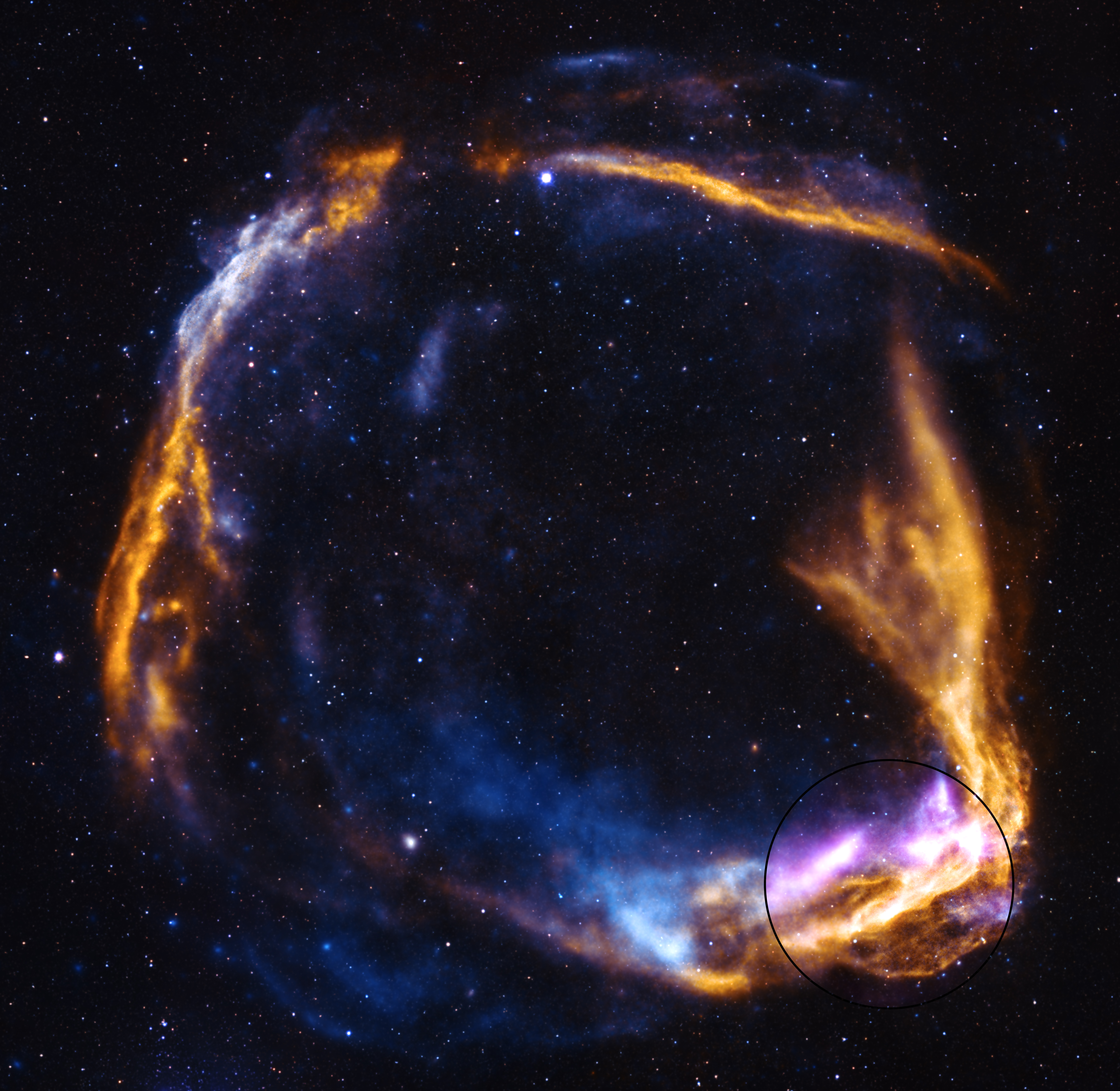
Somewhere in the southern constellation Circinus, light from a stellar explosion first reached Earth approximately 2,000 years ago. Chinese astronomers recorded the event in 185 CE, making it the earliest documented supernova in history. The remnant of that explosion, designated RCW 86, has been studied with every major X-ray observatory since the dawn of space astronomy, and it has repeatedly confounded expectations. A new observation by NASA's Imaging X-ray Polarimetry Explorer (IXPE) has now revealed the physical mechanism behind one of the remnant's most puzzling behaviors.
The finding, announced this week by NASA, identifies what researchers call a "reflected shock effect" at the outer rim of RCW 86. The phenomenon appears in the IXPE data as a distinctive polarization signature at the precise location where the remnant's rapid outward expansion appears to have stopped.
The Cavity That Made RCW 86 Unusual
To understand what IXPE found, it helps to understand what made RCW 86 anomalous to begin with. When a massive star ends its life in a supernova explosion, it blasts material outward in a shock wave that expands into the surrounding interstellar medium. The speed of that expansion depends on the density of the material the shock wave encounters — denser material slows it down, lower-density material allows it to expand faster.
The Chandra X-ray Observatory had previously identified an unusual feature around RCW 86: the remnant is surrounded by a large cavity of relatively low-density gas, thought to have been carved out by the stellar winds of the progenitor star in the thousands of years before it exploded. That cavity allowed the shock wave to expand far faster than it would have in normal interstellar conditions, explaining why RCW 86 appears unexpectedly large for a 2,000-year-old remnant and why its shape is irregular rather than the roughly spherical form typical of young supernova remnants.
What IXPE Detected at the Edge
The question that remained after Chandra's observations was what happened when the expanding shock wave reached the edge of that cavity. IXPE's X-ray polarimetry capability — the ability to measure not just the intensity of X-rays but the orientation of their electric field — provides a tool for answering that question that previous X-ray missions lacked.
Polarized X-ray emission from supernova remnants is produced when high-energy electrons spiral around magnetic field lines, a process called synchrotron radiation. The polarization pattern encodes information about the geometry of the magnetic field and the direction of the shock. When a shock wave hits a wall of denser material — the edge of the cavity — the geometry changes in a characteristic way that IXPE can detect.
The team's analysis of the new IXPE observations shows exactly that signature at the outer rim of RCW 86: a region where the polarization pattern is consistent with a reflected shock — one that has bounced back from the cavity wall and is now propagating inward as well as outward. This reflected component explains the observed halting of the outward expansion and fills in a gap in the physical picture that Chandra's observations left open.
Building a Complete Picture Across Observatories
The composite image released alongside the finding illustrates the power of combining data from multiple observatories operating at different wavelengths and with different detection capabilities. IXPE contributes the polarized X-ray map that reveals the shock geometry. Chandra and ESA's XMM-Newton contribute high-energy X-ray data showing the distribution of the hottest shock-heated gas. Lower-energy X-ray data traces the cooler circumstellar material. An optical starfield from NSF's NOIRLab provides spatial context against the background sky.
Each dataset reveals a different aspect of the same physical system, and the combination produces a more complete physical account than any single observatory could provide. This multi-wavelength approach has become standard practice in high-energy astrophysics, and IXPE's unique polarimetric capability has consistently added information about magnetic field geometry that was simply inaccessible before the mission launched in 2021.
Why Supernova Remnants Matter
Beyond the intrinsic interest of solving a decades-old astrophysical puzzle, RCW 86 and remnants like it matter because supernovae are how the galaxy distributes the heavy elements forged in stellar cores. Every atom of calcium in human bones, iron in blood, and oxygen in the atmosphere was created inside a star and distributed by an explosion of this kind. Understanding the physics of supernova shock waves — how they expand, what happens at density transitions, how they accelerate cosmic rays — connects directly to questions about the chemical evolution of galaxies and the origin of life's raw materials.
RCW 86 is also an unusually well-constrained case study because the historical record dates its explosion to within a few decades. Most supernova remnants are identified without a firm date, making age-based analyses uncertain. The 185 CE record from Chinese court astronomers provides a chronological anchor that lets researchers test models against a known timeline rather than inferring it from the remnant's appearance.
IXPE's Ongoing Mission
IXPE is a joint mission between NASA and the Italian Space Agency (ASI), with scientific participation from 12 countries. It launched in December 2021 from NASA's Kennedy Space Center aboard a SpaceX Falcon 9 rocket and is operated from NASA's Marshall Space Flight Center in Huntsville, Alabama. The observatory has now observed more than 100 X-ray sources, including supernova remnants, black hole systems, neutron stars, and magnetars. Its polarimetric data have resolved long-standing questions about particle acceleration mechanisms in several of these systems, and the RCW 86 result continues a track record of findings that require this specific measurement capability to achieve.
This article is based on reporting by NASA. Read the original article.
Originally published on nasa.gov