A half-century comparison reveals a moving landscape
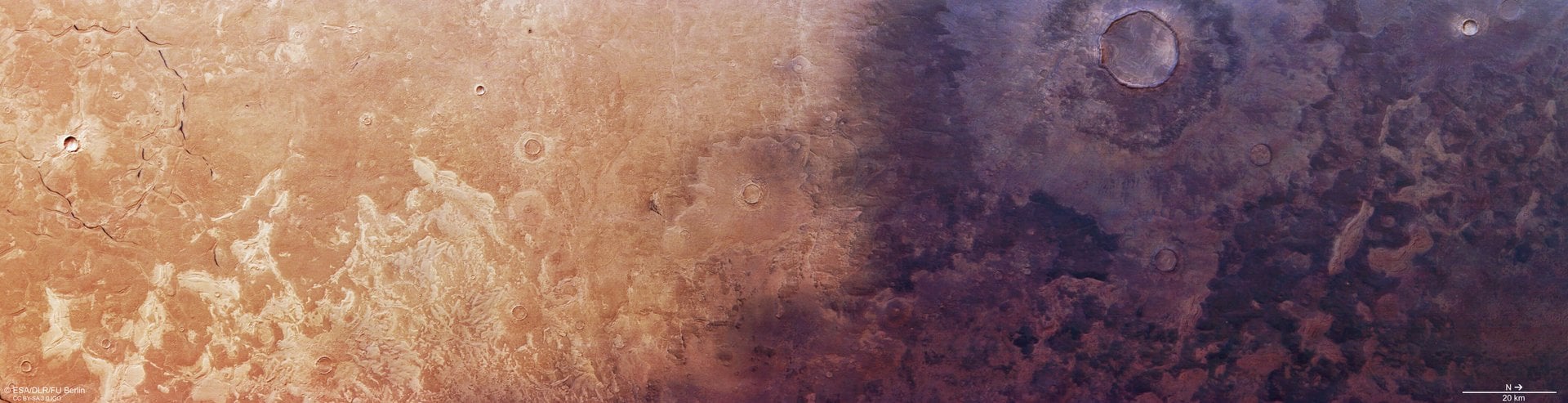
Mars is often described as a frozen world where meaningful change unfolds too slowly for human observers to notice. New imagery highlighted by the European Space Agency complicates that picture. By comparing views of Utopia Planitia taken by Viking orbiters in 1976 with a much more recent image from the Mars Express orbiter’s High Resolution Stereo Camera, scientists can now point to a dark deposit that has visibly spread across the region in just under 50 years.
In planetary terms, that is almost no time at all. Yet the change is unmistakable enough to make the result compelling: a blanket of dark material now stretches across bright reddish terrain where it was previously less extensive. The contrast between the old and new images offers an unusually intuitive glimpse of Mars as an active environmental system rather than a motionless relic.
The deposit is believed to be volcanic ash composed of mafic material such as olivine and pyroxene, minerals associated with the planet’s ancient volcanic history. The ash itself likely originated billions of years ago, when massive volcanoes including Olympus Mons were still erupting. What appears to be changing now is not the creation of fresh volcanic material, but its exposure, redistribution, or both.
Wind is the leading explanation
The most likely driver is aeolian activity: Mars’ wind. Researchers suggest two broad possibilities. The first is that wind is physically moving dark ash across the surface. The second is that wind is stripping away the lighter rust-colored dust that had covered darker layers underneath, making the ash appear to spread even if the underlying deposit was already present.
With image comparisons alone, the source text says it is difficult to determine which mechanism dominates. Both remain plausible. Either way, the interpretation points to the same conclusion: Mars’ surface is being actively reshaped by atmospheric processes on timescales humans can document.
That is important because public imagination often reserves planetary change for dramatic events such as dust storms, impacts, or volcanic eruptions. The Utopia Planitia sequence instead emphasizes a quieter kind of activity. Even without liquid water, plate tectonics, or ongoing volcanism on the scale seen in Earth’s recent geologic history, Mars still evolves through persistent environmental forcing.
Why the mineral story matters
The ash is thought to contain olivine, a mineral with broader scientific significance. Olivine tends to degrade relatively quickly in the presence of water. Its apparent preservation in this region therefore supports the idea that Mars has remained dry since these deposits were laid down. That does not settle the full history of water on Mars, but it adds another piece to the larger puzzle of where and when wet conditions persisted on the planet.
In other words, the images are not just visually striking. They also connect present-day surface change to deep-time climate interpretation. If the dark material really does preserve water-sensitive minerals, then every new exposure created by wind may reveal more about ancient Martian conditions and how long aridity has dominated the region.
That makes the moving ash doubly interesting. It is both an active phenomenon in today’s Mars environment and a mechanism for uncovering evidence about the distant past.
Scalloped depressions add another layer
The newly highlighted images also show rounded pits with wavy edges known as scalloped depressions. These features form when climate shifts or erosion expose subsurface ice, which then sublimates. As the ice turns directly to vapor, the ground above can lose support and collapse, leaving the distinctive scalloped shapes behind.
The presence of those depressions reinforces the idea that Utopia Planitia is not merely being dusted by surface winds. It is a region where the boundary between atmosphere, soil, and buried ice can still produce detectable landscape evolution. That makes it especially useful for scientists trying to reconstruct how modern Martian climate processes interact with older geological materials.
Subsurface ice is also strategically important for future exploration. Regions that preserve accessible ice are of interest not only for climate science, but also because water resources could matter for eventual human missions. The source text does not claim this specific site is a planned landing zone, but it does underline why seemingly subtle geomorphic changes can attract outsized attention.
A lesson in patience and planetary observation
One reason this story resonates is methodological. Space science often depends on returning to the same place years or decades apart. The Viking orbiters provided a historical baseline in 1976. Mars Express, operating nearly five decades later, supplied the modern comparison. Without that archival continuity, the change might have remained anecdotal or invisible.
This is one of the strengths of long-lived planetary observation programs. They turn worlds that feel static into environments with observable histories. On Mars, where human presence is absent and in-situ monitoring is sparse, orbiters play the role of long-term witnesses. Each additional pass becomes more valuable as the timeline grows.
That is why this comparison feels larger than one image pair. It demonstrates how patient observation can reveal active Mars without requiring sensationalism. The planet does not need ongoing eruptions or rivers to be geologically alive in an environmental sense. It only needs processes that continue to reshape its surface, and the ash at Utopia Planitia appears to be one of them.
What this means for Mars science now
The immediate takeaway is that scientists have another concrete example of visible change over a human timescale. That helps refine models of sediment transport, dust removal, and landscape evolution under Martian conditions. It may also guide future targeting decisions for imaging campaigns that look for similarly dynamic boundary zones between bright dust and darker underlying materials.
More broadly, the result nudges Mars away from the stereotype of complete stasis. The planet remains cold and dry, but not inert. Its winds can expose mineral history, alter regional appearance, and interact with buried ice in ways that become measurable over decades. For a world so often treated as a monument to ancient processes, that is a useful corrective.
Mars is still a planet of long timescales. But the new imagery from Utopia Planitia shows those timescales are not always beyond our reach. Sometimes all that is needed to see change is a good camera, a useful archive, and the willingness to wait long enough for a dark stain to creep across the red planet.
Key takeaways
- ESA imagery shows a dark ash deposit spreading across Utopia Planitia compared with Viking images from 1976.
- Scientists think wind is either moving volcanic ash or removing lighter dust to expose darker material beneath.
- The ash may contain olivine, supporting the view that the region has remained dry since the deposits formed.
- Nearby scalloped depressions point to processes involving subsurface ice and sublimation.
This article is based on reporting by Universe Today. Read the original article.

Originally published on universetoday.com