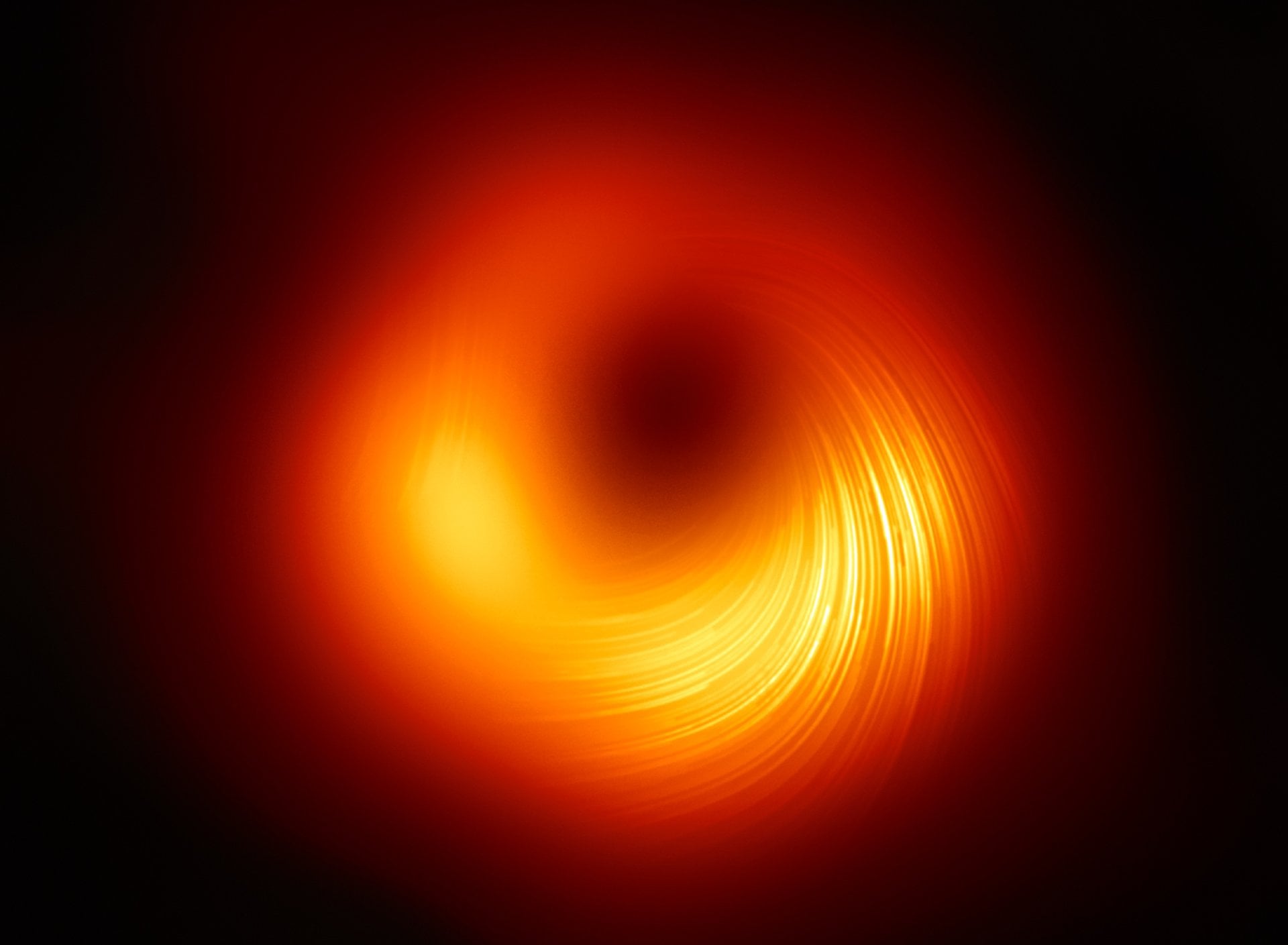
A new look at M87 moves beyond the first black hole image
The first image of a black hole, released in 2019 by the Event Horizon Telescope collaboration, became an instant landmark in modern astronomy. That image showed the supermassive black hole at the center of the galaxy M87, a giant elliptical galaxy about 53.5 million light-years from Earth in the constellation Virgo. Now, researchers have pushed the science further by looking not just at the shape of the emission around the black hole, but at how that emission changes with distance from the center.
According to the supplied source text, an international team led by researchers at the Shanghai Astronomical Observatory carried out the first spatially resolved dual-frequency spectral study of the M87 black hole. By combining horizon-scale images from multiple observatories, the team produced what the report describes as the first spatially resolved map of how the object’s spectral signature varies with radius. The work was published in The Astrophysical Journal Letters on July 20.
That is an important step because the first black hole image was never just a picture in the ordinary sense. It was a measurement of extreme physics near one of the most hostile environments in the universe. This new study adds another layer by examining how radiation properties differ from one region to another, offering a more detailed probe of the plasma and processes around the black hole.
How the team built the map
The study drew on observations obtained in 2018 by the Event Horizon Telescope and the Global Millimeter VLBI Array. The researchers combined images made at two wavelengths, 1.3 millimeters and 3.5 millimeters, spanning the extremely high frequency radio range and the high-frequency edge of microwaves. Using those two frequencies allowed the team to derive a spectral index across the observed structure.
In practical terms, that index tells astronomers how the strength of radiation changes with frequency at different locations around the black hole. Instead of treating the region as a single unresolved glow, the new approach breaks it into a spatially varying pattern. That makes it possible to infer where different physical regimes dominate.
The result, based on the source text, is a radius-dependent picture of the emission environment around the M87 black hole. The innermost zone shows a positive spectral index that increases slightly with radius. Farther outward, the index decreases and becomes negative. That shift is not merely descriptive. It points to a change in the underlying radiation conditions around the black hole.

What the changing spectral index means
The source explains that the positive index in the inner region suggests strong influence from synchrotron self-absorption. In that process, electrons moving through magnetic fields at nearly the speed of light emit radiation and then reabsorb some of the photons they have produced. A region dominated by that effect behaves differently from one where photons escape more freely.
Farther from the center, the new map shows a transition toward an optically thin regime, where emitted photons can get out without being absorbed, scattered, or re-emitted to the same degree. The source text places that transition at about 30 microarcseconds from the black hole.
That distance scale is tiny on the sky but physically revealing. It marks a boundary between inner conditions shaped strongly by self-absorption and outer conditions where the radiation can travel more directly to observers. For astronomers trying to understand how matter behaves near the event horizon of a supermassive black hole, identifying that transition matters because it constrains models of plasma structure, magnetic fields, and energy transport.
Why this matters for black hole physics
Black holes cannot be observed directly in visible terms because even light cannot escape from within the event horizon. What astronomers can observe is the behavior of matter and radiation in the surrounding environment. That makes every improvement in measurement technique valuable. The significance of the new M87 study is that it goes beyond a static image and toward a diagnostic method.
The supplied source text explicitly says the work provides a new way to characterize the extreme physics and conditions present around the black hole. That phrase is doing real work. The spectral map can help distinguish among competing interpretations of what is happening in the plasma near the central engine, including how energy is distributed and where emission becomes transparent enough to reveal different layers of the structure.
M87 is an especially important target for this kind of work because it has already become the reference case for horizon-scale black hole imaging. Improvements made there can shape methods used on other systems and in future observing campaigns. The same object that gave the world the first black hole image is now helping define how black holes may be studied in richer physical detail.

A collaborative milestone built on global observatories
The project also reflects the international and multi-instrument nature of frontier astronomy. The source text identifies collaborators from the Chinese Academy of Sciences’ Key Laboratory of Radio Astronomy and Technology, the University of Tsukuba, the INAF Institute of Radio Astronomy, the CSIS Andalusian Institute of Astrophysics, and the Max Planck Institute for Radio Astronomy, among others. That breadth is typical for very long baseline interferometry, where observatories separated by vast distances act together as a single Earth-sized instrument.
The technical achievement lies not only in gathering data, but in combining observations from different facilities and frequencies into a coherent, spatially resolved analysis. Black hole research has increasingly moved in this direction: not just making sharper images, but extracting more physical meaning from them.
From iconic image to sharper physical insight
The first image of M87’s black hole changed public perception of astronomy because it made a famously invisible object suddenly concrete. This new result is less visually dramatic, but scientifically it may be just as telling. It suggests astronomers are entering a phase where horizon-scale observations can map changing physical conditions instead of merely confirming the presence of a shadow-like structure.
That shift matters. The more precisely researchers can trace where self-absorption dominates, where emission becomes optically thin, and how these conditions vary with distance, the more tightly they can test theories of black hole environments. M87 remains too distant and extreme to be understood through a single snapshot. But with spectral mapping at horizon scales, astronomers are getting closer to turning a historic image into a more complete physical portrait.
This article is based on reporting by Universe Today. Read the original article.

Originally published on universetoday.com