Artificial Stars in the Atacama
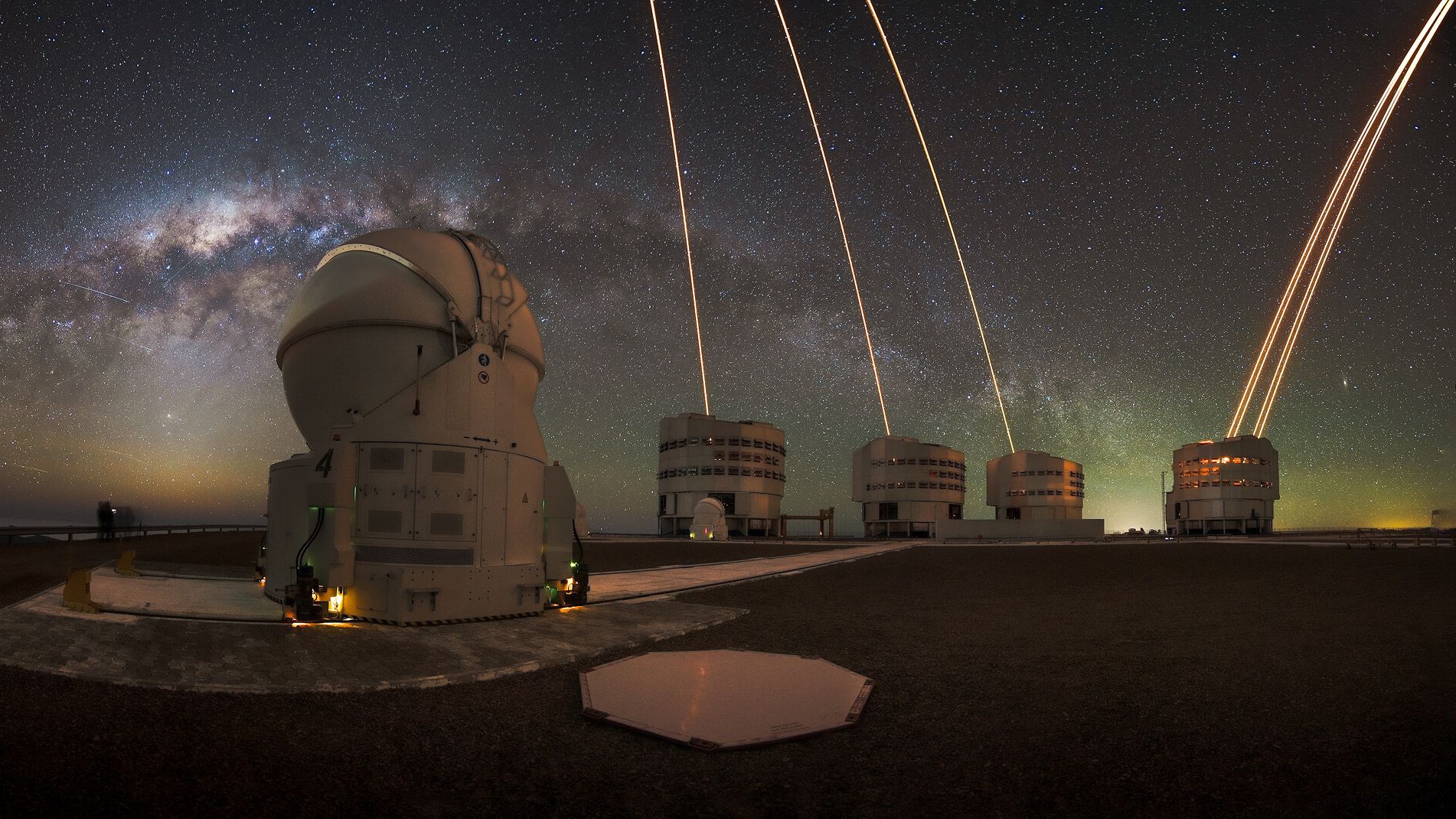
A striking new photograph released by the European Southern Observatory captures one of modern astronomy's most visually arresting technologies in action: powerful laser beams lancing upward from the Very Large Telescope at the Paranal Observatory in Chile, creating glowing artificial stars in the upper atmosphere against the sweeping backdrop of the Milky Way. The image, captured by Chilean astrophotographer Alexis Trigo, has been selected as Space Photo of the Day for February 17, 2026, and it offers a vivid illustration of how ground-based observatories are overcoming the fundamental limitation that has challenged astronomers since Galileo first turned a telescope skyward.
The photograph shows multiple orange-yellow laser beams projecting from the telescope units into the clear desert sky, each one terminating in a tiny bright point high in the atmosphere. These artificial guide stars, created by exciting sodium atoms in a layer of the atmosphere roughly 90 kilometers above the Earth's surface, serve as reference points for an adaptive optics system that corrects for the constant blurring caused by atmospheric turbulence.
How Laser Guide Stars Work
The principle behind laser guide stars is elegant in its conception if technically demanding in its execution. Earth's atmosphere, while essential for life, is a persistent nuisance for astronomers. Pockets of air at different temperatures and densities constantly shift and swirl above any telescope, bending light rays in slightly different directions from moment to moment. This atmospheric turbulence is what makes stars appear to twinkle to the naked eye, a phenomenon that is charming for casual stargazers but devastating for precise astronomical imaging.
To counteract this effect, the Very Large Telescope projects sodium laser beams into the sky, targeting a thin layer of sodium atoms that exists at an altitude of approximately 90 kilometers. These sodium atoms are remnants of meteors that have burned up in the atmosphere, leaving behind a persistent metallic layer. When the laser light hits these atoms, they fluoresce, creating a bright point source that functions as an artificial star.
The adaptive optics system then monitors this artificial star hundreds of times per second, measuring exactly how the atmosphere is distorting its light at any given instant. A computer processes these measurements in real-time and sends commands to a deformable mirror, a flexible mirror that can change its shape many times per second to compensate for the atmospheric distortion. The result is images with a level of sharpness that approaches what could be achieved from space, effectively removing the atmosphere from the equation.
- The photograph was captured by astrophotographer Alexis Trigo at the Paranal Observatory in Chile's Atacama Desert
- Laser guide stars work by exciting sodium atoms at approximately 90 kilometers altitude, remnants of burned-up meteors
- Adaptive optics systems measure atmospheric distortion hundreds of times per second and correct it in real-time
- Three additional Unit Telescopes received laser upgrades in December 2025 to support the VLTI and GRAVITY+ instruments
- The technology allows ground-based telescopes to achieve image clarity approaching that of space-based observatories

The Very Large Telescope
The Paranal Observatory is home to the European Southern Observatory's flagship facility, the Very Large Telescope, which consists of four Unit Telescopes each housing an 8.2-meter primary mirror. Operating individually or in concert as an interferometer, these telescopes are among the most productive astronomical instruments ever built, contributing to discoveries ranging from the first direct image of an exoplanet to the detection of the supermassive black hole at the center of the Milky Way.
Each Unit Telescope looms in the background of Trigo's photograph, their distinctive cylindrical enclosures silhouetted against the star-filled sky. The telescopes sit atop Cerro Paranal, a 2,635-meter mountain in Chile's Atacama Desert, one of the driest and most astronomically pristine locations on Earth. The combination of high altitude, minimal light pollution, dry air, and stable atmospheric conditions makes the Atacama an ideal site for optical and infrared astronomy.
Recent Laser Upgrades
The photograph is particularly timely because the VLT recently completed a significant expansion of its laser guide star capabilities. In December 2025, three additional Unit Telescopes were equipped with their own laser systems, joining the fourth Unit Telescope, known as Melipal, which had been the only one with laser guide star capability. The upgrades were undertaken to support the Very Large Telescope Interferometer and the advanced GRAVITY+ instrument, which requires adaptive optics correction on all four telescopes to achieve its full scientific potential.
With all four Unit Telescopes now equipped with laser guide stars, the observatory can correct for atmospheric distortion more effectively than ever before, particularly when the telescopes are used in interferometric mode. Interferometry combines the light from multiple telescopes to achieve the angular resolution of a telescope as large as the distance between them, an extraordinarily powerful technique that has enabled some of the most precise measurements in all of astronomy.
The Atacama: Astronomy's Prime Real Estate
The Atacama Desert has become the global center of ground-based astronomical observation, hosting not only the VLT at Paranal but also the Atacama Large Millimeter Array, the La Silla Observatory, and the under-construction Extremely Large Telescope, which will feature a 39-meter primary mirror when it begins operations later this decade. The concentration of world-class observatories in this single region reflects the Atacama's unmatched combination of atmospheric conditions, geographic advantages, and supportive institutional frameworks.
The region's extraordinary dryness is a critical factor. Water vapor in the atmosphere absorbs infrared light, which carries crucial information about distant stars, galaxies, and planetary systems. The Atacama receives less than a millimeter of rainfall per year in some areas, making its atmosphere among the most transparent on Earth for infrared observations. The high altitude further reduces the amount of atmosphere that telescope light must pass through, and the desert's remoteness ensures minimal light pollution from human activity.
Art and Science Converge
Photographs like Trigo's serve a dual purpose in the world of astronomy. They are simultaneously scientific documentation of cutting-edge technology and works of art that convey the beauty and grandeur of humanity's effort to understand the universe. The contrast between the ancient light of the Milky Way and the precisely engineered laser beams reaching toward it encapsulates something essential about the human relationship with the cosmos: we have always looked up in wonder, and we are now reaching upward with ever more sophisticated tools to see more clearly.
As the VLT continues its work with enhanced adaptive optics capabilities, the artificial stars created by its lasers will enable discoveries that are difficult to predict. From characterizing the atmospheres of exoplanets to mapping the dynamics of gas clouds around the Milky Way's central black hole, the technology captured in this photograph is not merely visually spectacular but scientifically transformative. The lasers may be artificial, but the stars they help us study are very real.
This article is based on reporting by Space.com. Read the original article.
Originally published on space.com