A Visitor From Beyond
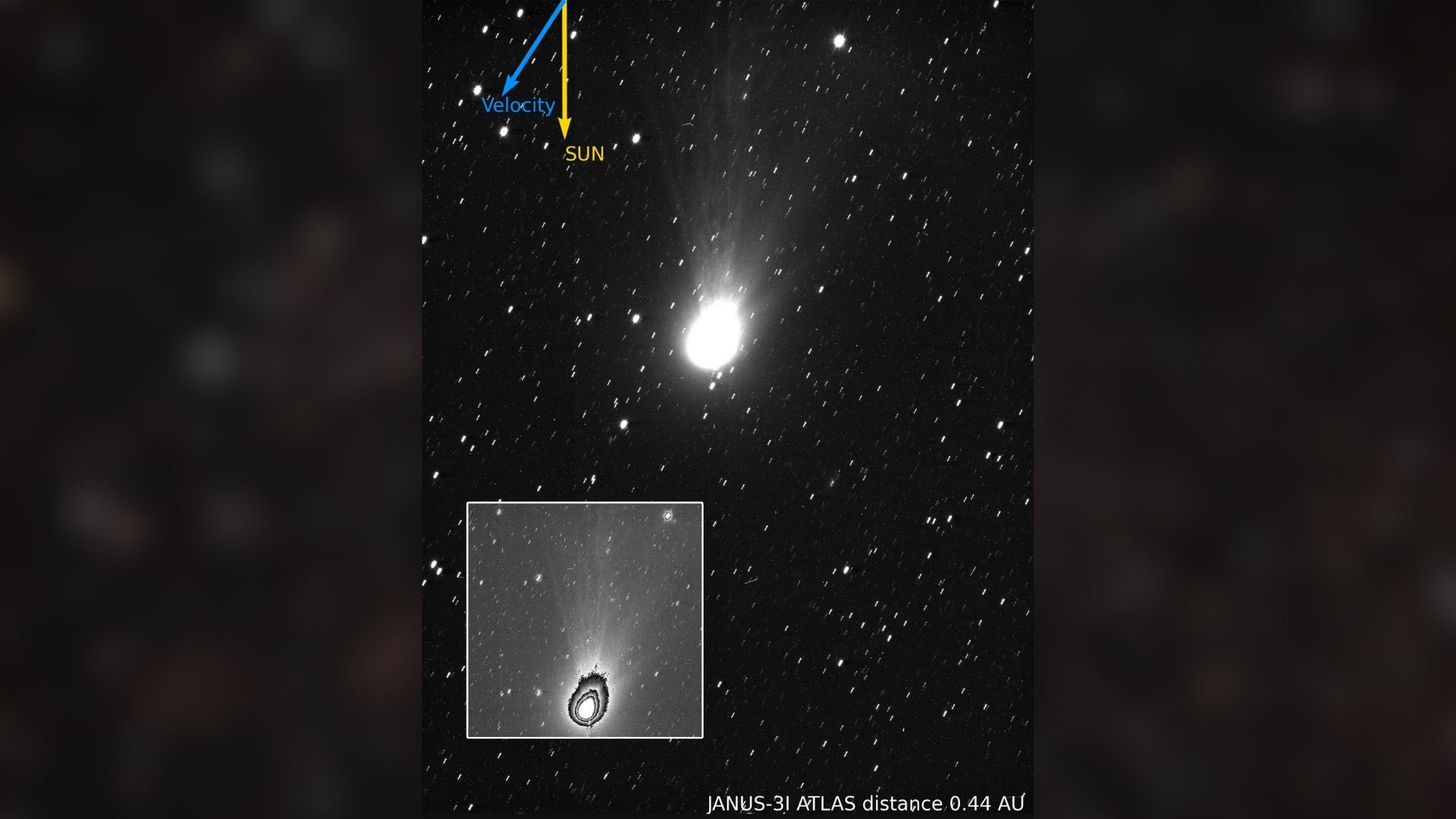
The European Space Agency's JUICE spacecraft has captured its first detailed image of interstellar comet 3I/ATLAS, revealing a luminous coma and an elegant sweeping tail as the object continues its journey through our solar system. The image marks a significant observational achievement — the third confirmed interstellar object ever detected passing through our cosmic neighborhood, photographed by a spacecraft designed to study Jupiter's icy moons.
The black-and-white photograph shows an egg-shaped glowing object set against a field of background stars, with directional indicators marking the sun's position and the comet's velocity vector. Inset details reveal the internal structure of the coma through concentric brightness patterns, providing scientists with data about the composition and activity of this extrasolar visitor.
What Makes It Interstellar
The designation 3I/ATLAS identifies this as the third interstellar object recognized by astronomers, following 1I/'Oumuamua in 2017 and 2I/Borisov in 2019. The I prefix denotes its interstellar origin — an object traveling on a hyperbolic trajectory that indicates it was not captured by the sun's gravity but is merely passing through.
Unlike 'Oumuamua, which appeared as a point of light and generated intense debate about its nature, 3I/ATLAS is unmistakably a comet. The glowing coma — an envelope of gas and dust surrounding the nucleus — and the distinctive tail confirm that the object contains volatile materials that are sublimating as it approaches the sun's warmth. This is consistent with a body that formed in the outer regions of another star system, where water ice and other frozen compounds accumulate.
The discovery of a third interstellar visitor in less than a decade suggests these objects may be far more common than astronomers initially believed. Statistical models now estimate that interstellar objects pass through the inner solar system regularly, but most are too small and fast to detect with current survey capabilities.
JUICE's Unexpected Role
JUICE — the Jupiter Icy Moons Explorer — launched in April 2023 on an eight-year journey to study Ganymede, Callisto, and Europa. The spacecraft was never designed for comet observation, but its suite of cameras and spectrometers proved capable of capturing useful data on the unexpected interstellar visitor.
The opportunistic observation demonstrates the versatility of modern space instruments and the value of having capable observatories distributed throughout the inner solar system. While ground-based telescopes discovered and have been tracking 3I/ATLAS since its detection, a space-based perspective eliminates atmospheric interference and provides viewing angles unavailable from Earth.
What Scientists Hope to Learn
Every interstellar object that passes through our solar system carries information about the conditions in which it formed — potentially billions of years ago, around a star that may be hundreds or thousands of light-years away. The composition of the coma gas, the size and structure of the dust tail, and the comet's response to solar heating all encode clues about its origin environment.
With 2I/Borisov, scientists were able to detect carbon monoxide and water in the coma, establishing that the basic building blocks of comets are similar across different star systems. Observations of 3I/ATLAS will add another data point to this emerging picture of interstellar chemistry, potentially revealing whether the volatile composition of comets is universal or varies significantly depending on the conditions in which they form.
The comet's trajectory will also be precisely measured, allowing astronomers to trace its path backward and potentially identify the star system from which it originated. This backward trajectory calculation was inconclusive for 'Oumuamua but more successful for Borisov, and 3I/ATLAS offers another opportunity to connect an interstellar visitor to its home.
The Growing Census
The detection of three interstellar objects in less than a decade reflects both improved survey capabilities and a fundamental shift in how astronomers think about the space between stars. The interstellar medium was once considered essentially empty — vast stretches of near-vacuum separating isolated star systems. The reality appears to be a space populated by countless small bodies ejected from their home systems by gravitational interactions with giant planets.
The Vera Rubin Observatory, scheduled to begin its full survey operations in the coming years, is expected to dramatically increase the detection rate of interstellar objects. Its wide-field, high-cadence survey strategy is specifically optimized for detecting transient and fast-moving objects, including those on hyperbolic trajectories indicating interstellar origin.
If the current detection rate scales with improved survey capabilities as models predict, astronomers may soon be cataloging interstellar visitors on a regular basis, transforming what was once a once-in-a-lifetime discovery into a routine field of observational science.
A Cosmic Laboratory
For now, 3I/ATLAS continues its passage through the inner solar system, offering a finite observational window before it swings past the sun and accelerates back into interstellar space, never to return. Every telescope capable of tracking it — on the ground and in space — will be gathering data while the opportunity exists.
The JUICE image represents a small but meaningful contribution to this effort, adding a space-based perspective to the ground-based observations that form the bulk of the scientific campaign. It is a reminder that the solar system is not a closed environment but a way station through which the debris of other stellar systems occasionally passes, offering glimpses of worlds we may never visit.
This article is based on reporting by Space.com. Read the original article.

Originally published on space.com