DART's Lasting Scientific Legacy
When NASA's DART spacecraft slammed into the asteroid Dimorphos in September 2022, the primary goal was to test whether a kinetic impactor could alter an asteroid's orbit. That mission succeeded spectacularly. But scientists poring over the detailed images captured during DART's final approach have now discovered something unexpected: direct evidence that the binary asteroid system had been exchanging surface material long before the spacecraft arrived.
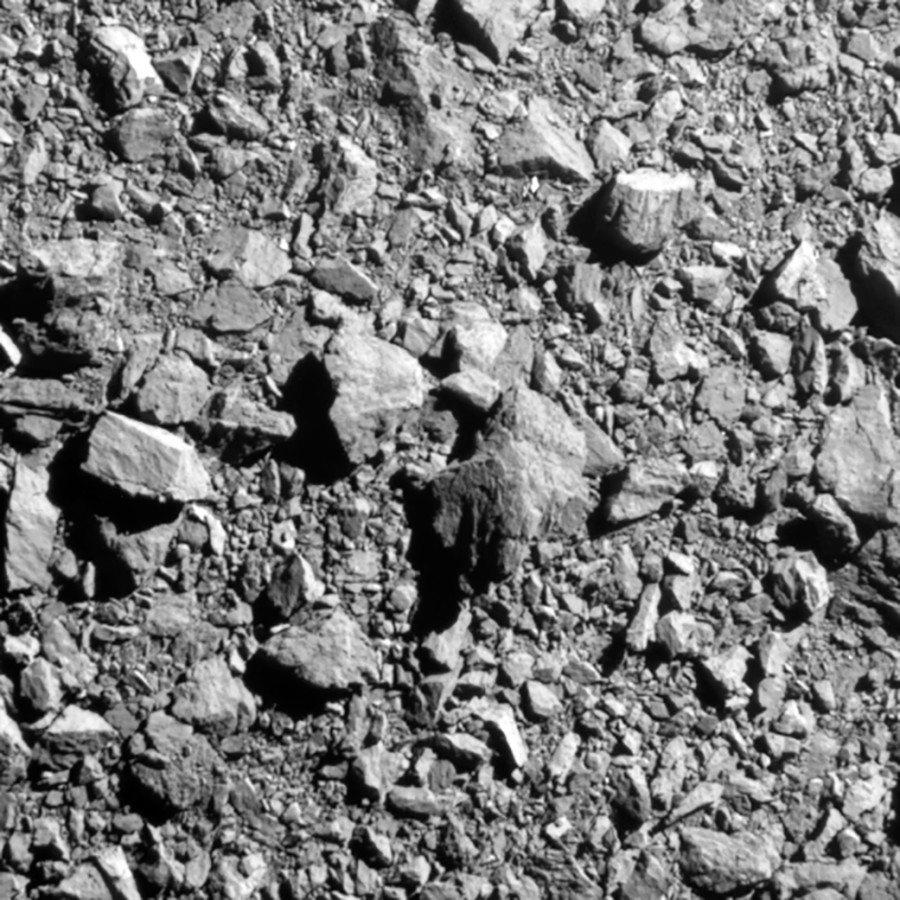
A new study published in The Planetary Science Journal by Jessica Sunshine and colleagues at the University of Maryland describes fan-shaped patterns of material spread across the surface of Dimorphos. These patterns, initially suspected to be imaging artifacts, have been confirmed as real geological features — and they tell a story of material flowing between Dimorphos and its larger companion, Didymos.
Deciphering the Fan Patterns
The fan-like features appear as streaks of material radiating across Dimorphos's rubble-pile surface. Their orientation and distribution are consistent with debris ejected from Didymos landing on the smaller moon, carried there by the weak but persistent gravitational interactions between the two bodies.
Binary asteroid systems — where two asteroids orbit each other — are surprisingly common, comprising an estimated 15 percent of near-Earth asteroids. Theoretical models have long predicted that these systems should exchange surface material through various mechanisms, including tidal forces, impacts on one body that loft debris onto the other, and the gradual migration of loose regolith driven by the YORP effect, a process where uneven absorption and re-emission of sunlight creates tiny but cumulative torques.
Despite these predictions, direct observational evidence of material transfer had remained elusive until now. The DART mission's close-approach images provided the resolution needed to identify these features for the first time.

How Material Migrates Between Bodies
The dynamics of material transfer in a binary asteroid system are governed by the complex gravitational environment created by two irregularly shaped, rotating bodies in close proximity. The gravitational field between Didymos and Dimorphos includes regions where material can be lofted from one surface and gently deposited on the other.
Small impacts on Didymos could eject debris at low velocities — just centimeters or meters per second — sufficient to escape Didymos's weak gravity but slow enough to be captured by Dimorphos orbiting just about a kilometer away. Over millions of years, this process would accumulate the fan-shaped deposits now observed on Dimorphos's surface.
The patterns also suggest that material transfer is not uniform. Certain regions of Dimorphos appear to receive more deposited material than others, likely reflecting the geometry of the binary orbit and the rotation states of both bodies. This asymmetry provides additional constraints for models of binary asteroid dynamics.
Implications for Planetary Defense
Understanding how binary asteroids behave and evolve is directly relevant to planetary defense. Binary systems present unique challenges for deflection missions because the two-body dynamics complicate trajectory predictions and impact outcomes. DART's success in changing Dimorphos's orbit demonstrated that kinetic impact works, but the discovery of pre-existing material exchange adds new complexity to modeling how such systems respond to perturbations.
If material is routinely transferred between binary asteroid components, then the surface properties of the target body may differ from what would be expected for an isolated asteroid. Surface composition, density, and cohesion all affect how a kinetic impactor transfers momentum, and these properties could vary across the surface depending on the history of material deposition.

A Window Into Asteroid Evolution
Beyond planetary defense, the discovery offers insights into how asteroids age and evolve. Most asteroids are not static rocks but dynamic bodies whose surfaces are constantly being modified by impacts, thermal cycling, and radiation. In binary systems, material exchange adds another dimension to this evolution, creating mixed surfaces that blend material from two distinct bodies.
The European Space Agency's Hera mission, currently en route to the Didymos-Dimorphos system with an expected arrival in late 2026, will provide detailed follow-up observations. Hera will map the crater left by DART, measure the physical properties of both asteroids, and may be able to characterize the fan-shaped deposits in greater detail. Those observations could determine whether the transferred material differs in composition from native surface material, revealing the geological history of this small but scientifically significant binary system.
This article is based on reporting by Universe Today. Read the original article.
Originally published on universetoday.com