A possible answer to one of JWST’s biggest early-universe puzzles
The James Webb Space Telescope has forced astronomers to rethink how quickly galaxies and black holes matured in the early universe. It has revealed that many very ancient galaxies already hosted supermassive black holes, and it has also found more “red and dead” galaxies than expected only around 1 to 2 billion years after the Big Bang. A new study argues that those two surprises may be tightly linked.
According to research published in Nature, luminous early quasars frequently produced extreme galaxy-scale outflows capable of driving away the cool gas needed to form new stars. If that mechanism was common, it could help explain how some galaxies shut down star formation so quickly in cosmic history.
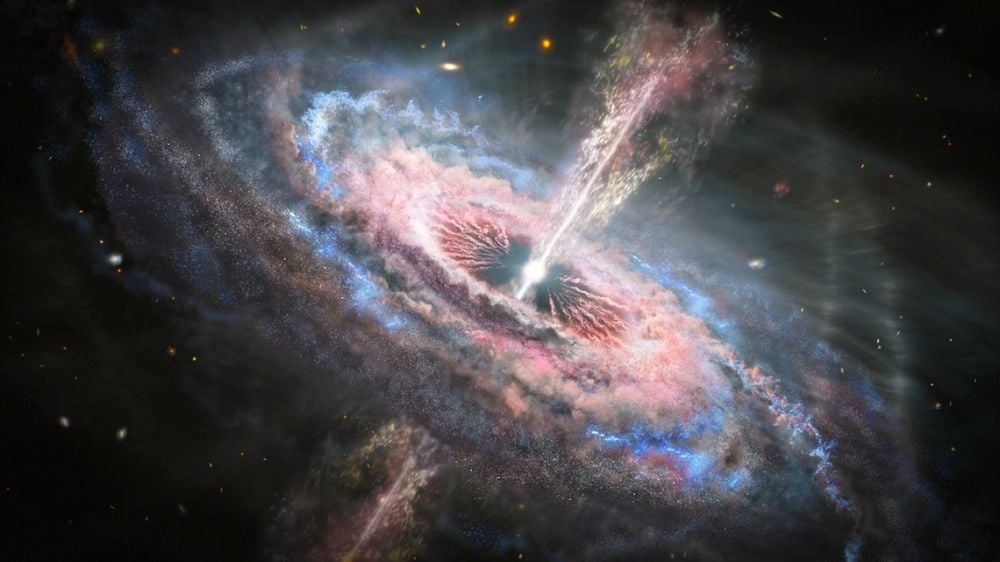
The idea is not that quasars merely coexisted with rapidly aging galaxies, but that they actively helped create them. When a supermassive black hole is accreting matter, it becomes an active galactic nucleus. The most energetic examples are quasars, which can outshine entire galaxies. The new work suggests that in the early universe, these objects were often powerful enough to quench their host galaxies on short timescales.
Why JWST made the question urgent
Before JWST, the standard picture of galaxy evolution had less pressure to account for large numbers of mature, quenched galaxies so soon after the Big Bang. Webb’s observations complicated that view. Some galaxies appear to have stopped forming stars surprisingly early, and many ancient systems seem to host central supermassive black holes despite the short time available for both galaxies and black holes to grow.
That combination has left astrophysicists searching for a mechanism fast and forceful enough to reshape galaxies early. Quasar feedback has long been a candidate in simulations, but the new study strengthens the case by reporting that extreme outflows are frequent among luminous early quasars rather than being rare exceptions.
The source text highlights JADES-GS-z7-01-QU, an ancient “red and dead” galaxy discovered by JWST that stopped creating new stars shortly after formation. Objects like that have become emblematic of the challenge. Something seems to have removed or heated their star-forming fuel before standard models would comfortably predict.
How quasars can shut a galaxy down
Star formation requires cool hydrogen gas that can collapse under gravity. If that gas is heated, disrupted, or expelled, the galaxy’s star-making machinery slows or stops. The new research says early quasars often generated outflows more like vast galactic winds than narrow jets, pushing material out across the host galaxy.
That process is known as quenching. As the supply of new stars dries up, a galaxy’s population becomes increasingly dominated by older, cooler, redder stars. Over time it takes on the appearance JWST has been finding in unexpected numbers: systems that already look aged despite existing in a very young universe.
The important claim here is frequency. Quasars have always been known as energetic objects, but the new work suggests that powerful, galaxy-wide outflows were common among luminous early examples. That makes quasar feedback a more plausible explanation for the abundance of quiescent galaxies Webb has observed.
Rethinking black holes as drivers of galaxy evolution
The findings also sharpen the broader question of how supermassive black holes and galaxies grow together. JWST’s early results suggested a close relationship, but the direction of cause and effect has been hard to pin down. If powerful quasars routinely expelled star-forming gas, then black-hole activity was not just a byproduct of galaxy evolution. It was one of its governing forces.
That would align with the growing view that active galactic nuclei can regulate the life cycle of galaxies, helping determine when growth accelerates and when it ends. In the early universe, the effect may have been even stronger than in later cosmic eras because quasars themselves appear to have been more powerful.
Universe Today frames this as a potential explanation for several of JWST’s puzzling discoveries at once. Galaxies that formed rapidly, hosted very large black holes early, and then quenched quickly are difficult to reconcile under a slower, more orderly growth story. Quasar-driven outflows offer a route to that compressed timeline.
What this does and does not resolve
The new study does not erase every mystery raised by JWST. Not all ancient galaxies appear to host supermassive black holes, and the exact relationship between black-hole growth, gas inflow, and stellar shutdown remains an active research problem. But the findings do give astronomers a stronger physical mechanism for one of the central anomalies: why the young universe contains so many systems that already look old.
That matters because galaxy evolution models are built from these causal links. If feedback from early quasars was both frequent and extreme, simulations may need to assign a larger role to black-hole-driven outflows in shaping the first generations of large galaxies.
The result is a more dynamic picture of the early cosmos. Rather than galaxies simply assembling stars until they gradually exhaust their fuel, some may have been rapidly transformed by the activity of the black holes at their centers. In those cases, the object helping illuminate the universe most intensely may also have been responsible for dimming its future star formation.
A stronger case for violent early evolution
JWST has made one thing clear: the early universe was not as simple as many astronomers hoped. Massive galaxies, mature stellar populations, and giant black holes all seem to appear earlier and more often than expected. The new quasar study does not just add another oddity to that list. It offers a route toward integrating several of them.
If luminous early quasars frequently launched galaxy-scale outflows, then the telescope’s “red and dead” galaxies may not be evidence that the universe broke the rules. They may be evidence that the rules always included more violent, black-hole-driven shutdowns than previous models fully captured.
That would make quasars more than spectacular beacons from the distant cosmos. It would make them among the chief architects of how the first mature galaxies came to look the way JWST now sees them.
This article is based on reporting by Universe Today. Read the original article.
Originally published on universetoday.com