A familiar fluid phenomenon in an unfamiliar world
One of the strangest atmospheric features in the solar system may now have an unexpectedly domestic explanation. Researchers led by Professor Takeshi Imamura at the University of Tokyo say the enormous recurring disturbance seen in Venus’s cloud layers can be understood as a hydraulic jump, the same abrupt transition that appears when water from a tap strikes a sink and suddenly thickens as it spreads outward.
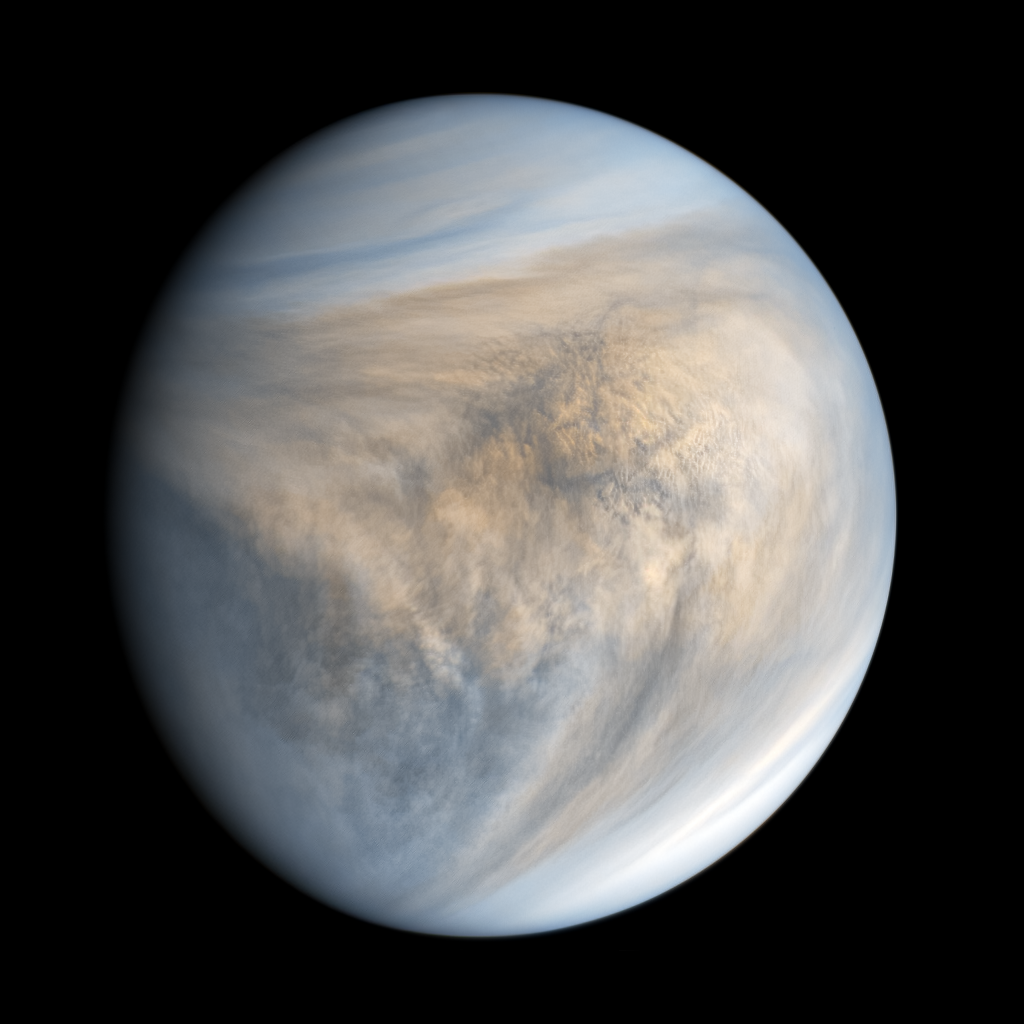
The comparison sounds playful, but the underlying result is serious planetary science. In 2016, Japan’s Akatsuki probe returned images of a puzzling atmospheric disturbance sweeping repeatedly around Venus’s equator. The feature was sometimes measured at around 6,000 kilometers wide and left a dark band of denser cloud behind it. Scientists could observe it clearly, yet for years lacked a convincing mechanism for how it formed.
The mystery of Venus’s recurring wall of cloud
Venus is already an extreme atmospheric laboratory. Its clouds super-rotate, racing around the planet at roughly 60 times the speed of the planet’s own rotation. Within that circulation sit multiple cloud layers, including lower regions that remain poorly understood. The long-standing puzzle was how such a vast and coherent disturbance could emerge repeatedly within this already turbulent system.
The new explanation centers on a fast-moving wave in the lower cloud layer known as a Kelvin wave. Using fluid dynamics models and atmospheric simulations, the team concluded that the wave periodically becomes unstable. When that happens, wind speed drops suddenly, material piles up, and the atmosphere undergoes a sharp transition analogous to the thickening ring of water in a hydraulic jump.
That transition then drives a strong upward current of air. Sulfuric acid vapor is pushed higher into the atmosphere, where it condenses and forms the sweeping wall of denser cloud observed by Akatsuki. In effect, a fluid-dynamics process familiar from everyday life appears to be operating on a planetary scale in one of the most hostile atmospheres in the solar system.
Why the explanation matters
The result is notable not just because it solves a visual mystery, but because it links horizontal and vertical behavior in a way that classical fluid dynamics would not necessarily lead scientists to expect. Large-scale horizontal flow and strongly localized vertical effects are often treated as more separate than this finding implies. On Venus, however, the new model suggests that a destabilized wave can abruptly reorganize the local structure of the atmosphere and generate a dramatic visible signature.
That matters for more than planetary weather. Understanding how energy and momentum move through Venus’s atmosphere is central to broader questions about circulation, cloud chemistry, and climate dynamics on worlds very different from Earth. Venus is often invoked as a cautionary example of runaway greenhouse conditions, but its atmosphere also provides a test bed for extreme fluid behavior that can challenge existing assumptions.
A clue that may travel beyond Venus
The researchers also suggest the same general conditions could exist elsewhere. Mars, they note, may harbor something similar. That possibility hints at a wider payoff. Planetary atmospheres can differ radically in composition, temperature and density, yet some of the governing physics may still repeat across worlds in recognizable forms. Finding a hydraulic jump on Venus does not mean planets are simple. It means that even exotic environments may sometimes be decoded through robust physical principles that show up close to home.
The idea carries a second implication for future missions. Remote observations can reveal unusual structures, but explaining them often requires a combination of simulation, theory and repeated imaging. Akatsuki supplied the mystery; the new modeling effort supplied the mechanism. As more missions probe Venus and other planets, scientists will likely encounter additional phenomena that look alien at first glance but turn out to be extreme expressions of familiar rules.
Venus remains strange, but perhaps a little less opaque
The appeal of the new work lies in its simplicity without triviality. It does not make Venus ordinary. A planet with crushing pressure, sulfuric acid clouds and super-rotating winds remains anything but ordinary. What it does show is that a baffling atmospheric feature can emerge from a clean and testable physical process, one that people can watch for themselves every time water splashes into a basin.
Professor Imamura said the phenomenon was identified years ago but resisted explanation. The new model finally supplies one. That is often how planetary science advances: not by a single dramatic image alone, but by the slower work of finding the right mechanism beneath it. In this case, the solution connects a kitchen sink to a planet next door, and in doing so turns an everyday fluid effect into the key to one of Venus’s biggest atmospheric riddles.
This article is based on reporting by Universe Today. Read the original article.
Originally published on universetoday.com