Blue Origin moves toward routine reusability
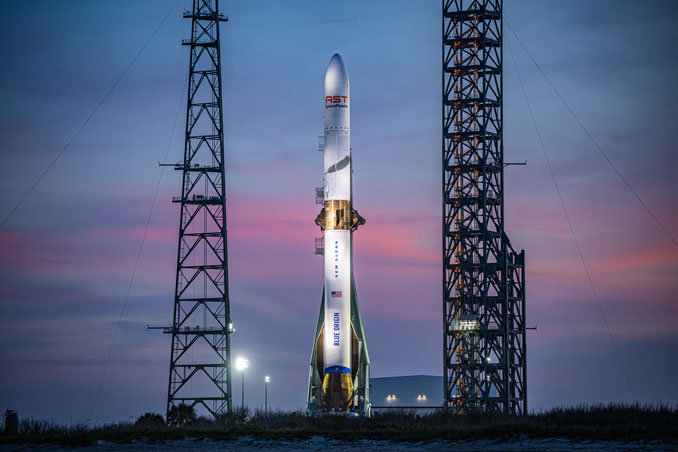
Blue Origin is preparing a consequential test of its heavy-lift launch system with the third flight of New Glenn, a mission scheduled for Sunday, April 19, 2026, from Cape Canaveral Space Force Station. The launch window opens at 6:45 a.m. EDT, and the rocket is set to carry AST SpaceMobile’s BlueBird 7 satellite into low Earth orbit.
The mission matters for more than its payload. Blue Origin says this flight will feature the first reuse of a New Glenn booster, marking a transition point for a rocket program that has so far focused on proving baseline performance. Reusability has become central to launch economics and cadence, and this mission is Blue Origin’s clearest attempt yet to show that New Glenn can begin operating on that model.
The booster assigned to the flight, named Never Tell Me the Odds, previously launched in November 2025 and successfully landed on the company’s ocean-going platform, Jacklyn. That earlier recovery established that Blue Origin could bring an orbital-class booster back intact. The next step is proving that the hardware can be turned around and flown again in a way that supports a scalable business.
What is actually being reused
Blue Origin is not presenting this mission as a fully untouched reflown stage. CEO Dave Limp said the company chose to replace all seven engines on this refurbished booster and to test upgrades, including a thermal protection system on one engine nozzle. He added that the engines used on New Glenn’s second flight are expected to be used on future missions.
That distinction is important. Reusability is not a single switch that flips from expendable to airline-like operations. It emerges in steps: recovery, inspection, refurbishment, selective replacement, then eventually repeatable low-touch reuse. By flying a booster structure again while swapping engines and introducing upgrades, Blue Origin is using this launch to gather operational data rather than claiming a fully mature reuse model before it exists.
The company has said New Glenn boosters are being designed to support up to 25 flights each. What remains unclear is whether that target applies to the same integrated vehicle configuration over time or primarily to the tank and structural elements, with engines and some subsystems rotating on different schedules. Sunday’s mission will not answer every question, but it should provide the strongest evidence yet of how Blue Origin intends to approach fleet durability and maintenance cycles.

Why this flight matters competitively
Blue Origin became only the second company after SpaceX to land an orbital-class booster vertically. That achievement was notable on its own, but the strategic question has always been what follows recovery. Launch providers are judged less by demonstrations than by whether those demonstrations evolve into repeatable operations.
For Blue Origin, New Glenn is expected to serve commercial, civil, and national security missions. To compete seriously in those markets, the company needs more than lift capacity. It needs confidence in schedule, refurbishment, manufacturing throughput, and the ability to spread hardware costs across multiple missions. A successful reused-booster flight would not complete that process, but it would meaningfully strengthen Blue Origin’s case that New Glenn is entering a more operational phase.
The timing also matters because the launch market increasingly rewards providers that can pair heavy-lift performance with predictable cadence. Reuse is part of that equation because it can reduce dependence on building every major element from scratch for each mission. Even where refurbishment remains substantial, the ability to re-fly core hardware can change launch planning and long-term margins.
BlueBird 7 adds commercial weight to the mission
The payload is also significant. BlueBird 7 is the second satellite in AST SpaceMobile’s next-generation constellation, which the company says is designed to support space-based cellular broadband for commercial and government customers. The satellite is described as a Block 2 spacecraft, and future New Glenn missions may be able to carry as many as eight of them at a time.
That detail highlights a second reason this launch matters. New Glenn is not just attempting reuse; it is doing so while supporting an emerging satellite architecture aimed at direct connectivity. AST SpaceMobile has said it remains on track to deploy 45 to 60 satellites into low Earth orbit by the end of this year. If that schedule holds, launch capacity and vehicle availability will become increasingly important.
The large scale of the BlueBird design also underscores why heavy-lift systems are useful in the growing broadband and communications market. Spacecraft with expansive antenna and solar array structures can impose packaging and deployment constraints that favor bigger rockets with larger fairings and meaningful mass margin.

Conditions look favorable, but execution is the real test
U.S. Space Force meteorologists forecast a 90 percent chance of acceptable weather for the launch. That reduces one source of uncertainty, but operational complexity remains high. The rocket uses liquid methane and liquid hydrogen propellants, will fly on a southeasterly trajectory, and must perform both mission delivery and the reuse demonstration under real flight conditions.
Even if the launch and payload deployment succeed, observers will be watching for what Blue Origin says afterward about booster condition, inspection findings, and refurbishment lessons. Those details will help reveal whether the company is moving toward rapid reuse or taking a more incremental path built around cautious iteration.
What to watch after liftoff
- Whether the reused booster performs nominally through ascent.
- How Blue Origin characterizes the value of reflown structure versus replaced engines.
- Any new details on refurbishment workload, upgrades, or turnaround expectations.
- What the mission signals for future launches of AST SpaceMobile satellites.
New Glenn’s third flight is therefore more than another launch on the calendar. It is a test of whether Blue Origin can start converting recovery into repeatable capability. If the mission succeeds, the company will still have much to prove. But it will have crossed a threshold that matters: showing that New Glenn is not only recoverable, but reusable in practice.
This article is based on reporting by Spaceflight Now. Read the original article.

Originally published on spaceflightnow.com