Black Holes Grew Faster in the Young Universe
Astronomers have spent years trying to understand why supermassive black holes no longer grow at anything like their earlier pace. A report highlighted by Universe Today points to a compelling answer from new research: the modern universe simply does not offer the same supply of cold gas that fueled rapid growth billions of years ago.
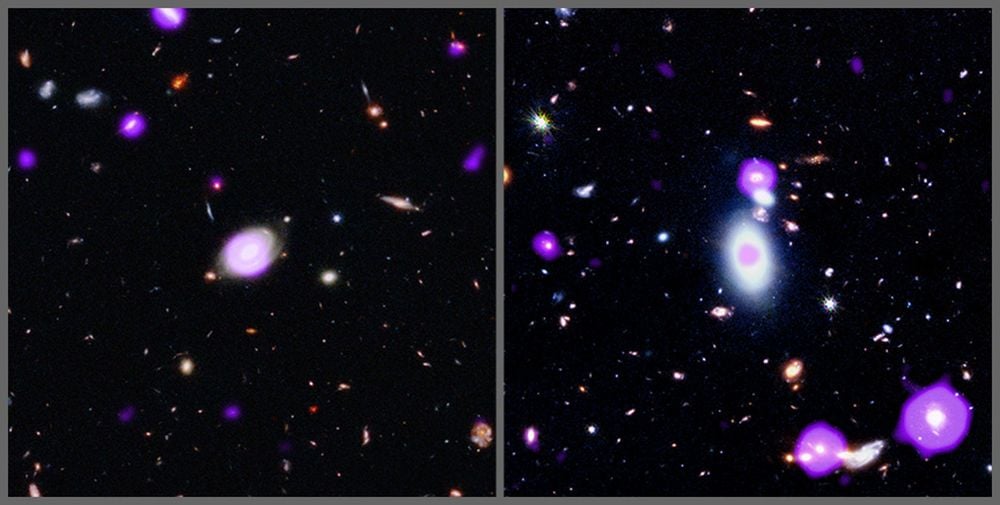
The study, published in The Astrophysical Journal, examined more than 1 million galaxies and more than 8,000 growing supermassive black holes across cosmic time. Its focus was a major transition in the history of galaxy evolution. During the period known as Cosmic Noon, black holes and star formation both surged. After that era, black hole growth slowed dramatically.
What Changed After Cosmic Noon
Universe Today says the peak in supermassive black hole growth occurred around redshift z ≈ 1.5 to 2, corresponding to roughly 9.5 to 10.5 billion years ago. That places the turning point in an epoch when the universe was much younger and galaxies were more actively forming stars.
The new work argues that one of the main reasons growth later weakened is that black holes lost access to enough cold gas, which is the kind of material they most effectively accrete. In other words, the slowdown may not require an exotic new mechanism. It may reflect a changing fuel supply.
This matters because supermassive black holes do not evolve in isolation. The report notes that astronomers have found tight relationships between black hole mass and properties of the host galaxy, including the mass of the bulge and its velocity dispersion. Researchers also see correlations between average accretion rates and galaxy stellar mass as well as star formation in the bulge. Those patterns suggest that galaxies and their central black holes grow in a coordinated way.

A Window Into Galaxy Coevolution
If black hole growth and galaxy growth are linked, then explaining the decline in one may help explain the evolution of the other. Universe Today summarizes the researchers’ conclusion that tracing black hole growth can provide insight into galaxy-black-hole coevolution. That is one reason the result reaches beyond black hole specialists. It helps clarify how the broader cosmic ecosystem changed after its most productive era.
The slowdown has sometimes been described as “AGN downsizing,” referring to the declining activity of active galactic nuclei over time. The new research gives that idea a more concrete physical basis. Rather than suggesting that black holes somehow lost the ability to accrete efficiently, the study indicates that the environment changed around them. The preferred fuel became less available.
That conclusion also fits the larger story of the universe’s maturing structure. The conditions that supported intense star formation and rapid black hole feeding were not permanent. As those conditions faded, both processes eased. In that sense, the growth history of supermassive black holes may be one more sign that the universe’s most dramatic building phase lies deep in the past.
Big Samples, Long Timescales
One of the strengths of the study is scale. By looking across more than a million galaxies and thousands of actively growing black holes, the researchers could test long-term trends rather than rely on a handful of extreme objects. That broad sample makes the result more persuasive because it connects individual accreting black holes to population-level changes over billions of years.
The work also reflects how modern astronomy increasingly depends on large surveys and cross-era comparisons. Powerful infrared instruments have made it easier to see deeper into the universe’s past, and those views have sharpened a puzzle that once seemed less urgent: if giant black holes were so active earlier on, why are they relatively subdued today?
The answer offered here is almost austere in its simplicity. Growth slowed because the food supply changed. Cold gas became harder to come by, and without it the engines at galactic centers lost much of their momentum.

Why This Matters
Supermassive black holes remain among the most extreme objects in the universe, but their significance is not limited to spectacle. Their activity influences surrounding galaxies through radiation, jets, and feedback processes that can shape star formation and the movement of gas. Understanding when and why black hole growth declined therefore helps astronomers build a more complete picture of how galaxies became what they are today.
The new study does not suggest the mystery is entirely closed. Cosmic evolution is rarely driven by one variable alone. But the research summarized by Universe Today points strongly toward fuel availability as a leading explanation. That makes the modern quietness of many supermassive black holes less puzzling. The universe they inhabit is no longer the same one that fed their ancestors during Cosmic Noon.
This article is based on reporting by Universe Today. Read the original article.
Originally published on universetoday.com