A familiar planet, seen from an uncommon place
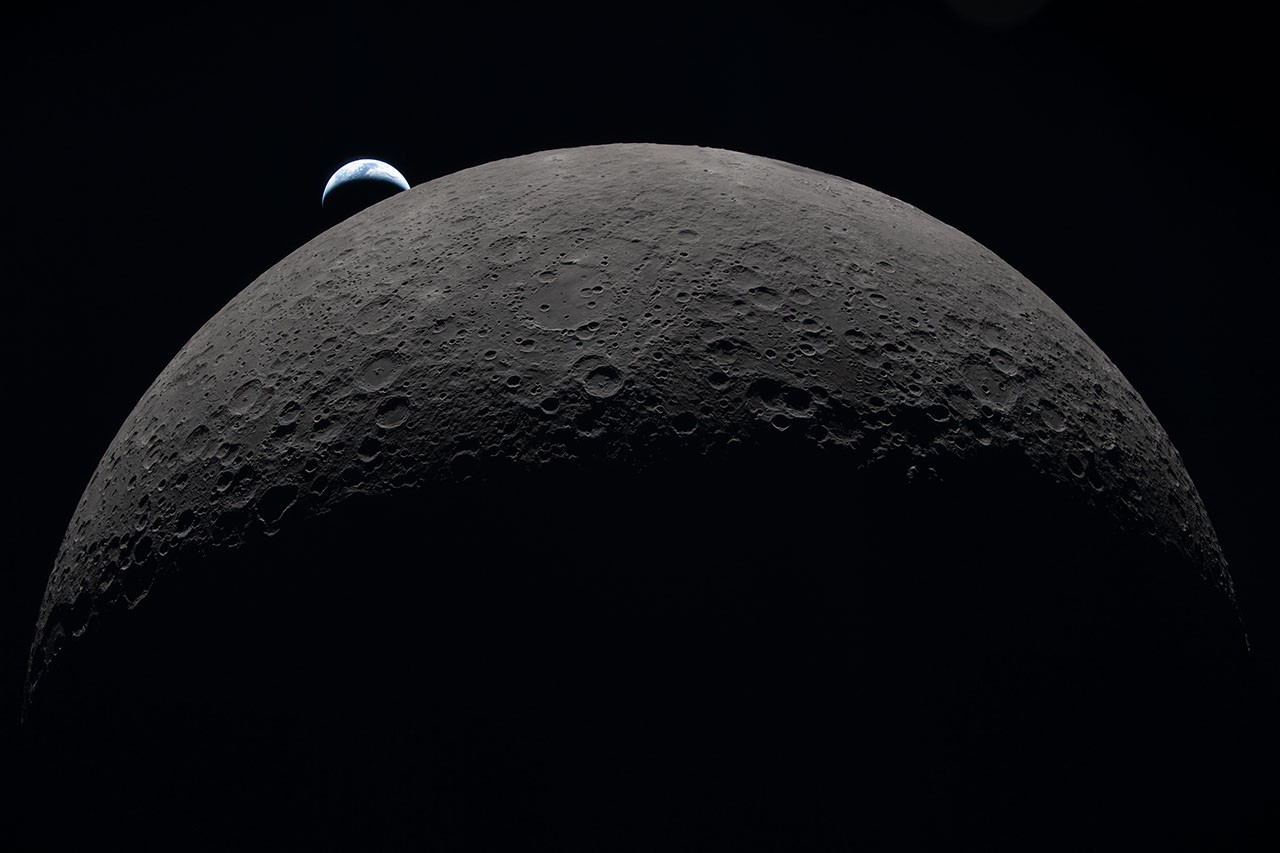
NASA’s Artemis II mission has delivered one of its defining images before the crew’s return to Earth: a view of “Earthset” captured from the far side of the Moon. Published by NASA Earth Observatory as its April 10, 2026 Image of the Day, the photograph shows a partially lit crescent Earth appearing to sink below the lunar horizon, a visual echo of the Earthrise imagery made famous by Apollo 8 in 1968.
The timing adds to the weight of the image. NASA said Artemis II would conclude its 10-day journey around the Moon on April 10, 2026, with splashdown off the California coast. Although additional mission imagery will continue to be processed after the astronauts return, the crew has already sent back what NASA describes as a remarkable collection of photographs. Among them, the Earthset frame stands out not only as a beautiful scene, but as a marker of how the Artemis program is beginning to build its own visual identity.
NASA says the image was taken at 6:41 p.m. Eastern Daylight Time on April 6, 2026, as the astronauts passed behind the Moon’s far side. In the picture, the sunlit edge of Earth reveals clouds and blue water over the Oceania region, while darker portions of the globe lie in nighttime. The Moon in the foreground is sharply textured, with overlapping craters and basins that emphasize the roughness of the lunar surface and the depth of the scene.
A mirror to Apollo, but not a remake
Comparisons with Apollo 8 are unavoidable, and NASA itself invokes them. Yet the significance of this photograph is not that it recreates an older mission. It is that it shows a new generation of astronauts reaching the same distant perspective and returning with imagery that can define a new era of lunar exploration. Earthrise became iconic because it compressed science, exploration, and planetary perspective into a single frame. Earthset performs a similar function, but in the context of Artemis, a program meant to extend human activity deeper into cislunar space.
The image also captures a subtle shift in viewpoint. Earthrise is remembered as a revelation: our planet emerging above the Moon’s horizon. Earthset carries a different emotional register. Here, Earth appears to descend, as though the crew is watching home slip out of sight while traveling through one of the most remote and visually dramatic sections of the mission. The effect is cinematic, but it is also operationally grounded. This was not a symbolic detour. The shot came during a real far-side passage on a seven-hour flyby that NASA says included images of a total solar eclipse, light from several planetary neighbors, and long shadows along the terminator where lunar day meets night.
That matters because great exploration photography is rarely just decoration. It is often a byproduct of capability. To capture this scene, the spacecraft, crew, trajectory, lighting conditions, and mission timeline all had to align. The result is a public-facing artifact of a much larger technical achievement: a crewed lunar flyby that generated not only telemetry and operations experience, but a visual record strong enough to shape public memory.

Why mission imagery still matters
In an era saturated with space visuals, it can be tempting to treat a striking image as a side note to the mission rather than part of its substance. That would undersell what NASA is doing here. Images like this one help translate a complex mission into something legible beyond aerospace circles. They make distance comprehensible. They remind viewers that lunar exploration is not an abstract engineering exercise but a human encounter with new vantage points.
NASA’s own description highlights how much more remains to be seen. The agency says additional imagery will continue to be processed after splashdown, and it points viewers to a lunar flyby gallery and a broader multimedia collection. That suggests the Earthset image may become the flagship frame from a much larger archive, not a one-off. The existence of that archive is itself important. Artemis II is not only flying around the Moon; it is documenting the journey in a way designed for science communication, public engagement, and historical record.
The picture also reinforces one of the oldest lessons of spaceflight: leaving Earth often clarifies Earth. The visible crescent, the weather systems, the blue oceans, and the stark line between day and night all make the planet feel both vivid and fragile. NASA Earth Observatory has long specialized in connecting planetary imagery to environmental understanding, so it is fitting that the agency presented this lunar view not merely as space spectacle, but as part of a broader Earth-observation tradition.
The first enduring image of Artemis II
Every major mission eventually acquires a handful of pictures that stand in for the whole undertaking. For Artemis II, this Earthset image looks like an early candidate to join that class. It contains scale, motion, geography, and narrative in a single frame. It also arrives at a moment when Artemis needs images that are more than promotional. It needs proof, in visual form, that the program is producing distinct experiences and not simply revisiting Apollo’s achievements with updated hardware.
NASA’s publication of the photo as Image of the Day is therefore more than routine curation. It is an editorial decision that signals what the agency believes this mission has already accomplished. Artemis II has not just completed a 10-day lunar journey. It has given the public a new way to picture Earth from deep space and a new emblem for the long campaign to return humans to the Moon.
Long after the splashdown timeline, mission briefings, and operational milestones fade from daily headlines, this is the kind of frame likely to remain. A crescent Earth sinking behind the Moon is at once scientifically precise and emotionally immediate. That is rare. It is why Earthset deserves to be remembered not only as an impressive photograph, but as one of the first truly lasting images of the Artemis era.
This article is based on reporting by science.nasa.gov. Read the original article.
Originally published on science.nasa.gov