A Historic Lunar Return
For the first time in more than 50 years, humans are again traveling through lunar space. On April 6, NASA’s Artemis 2 crew entered the moon’s sphere of influence, reaching the region where lunar gravity becomes the dominant pull over Earth’s. It is a technical milestone, but also a symbolic one: people have not been in the moon’s vicinity since the Apollo era ended in 1972.
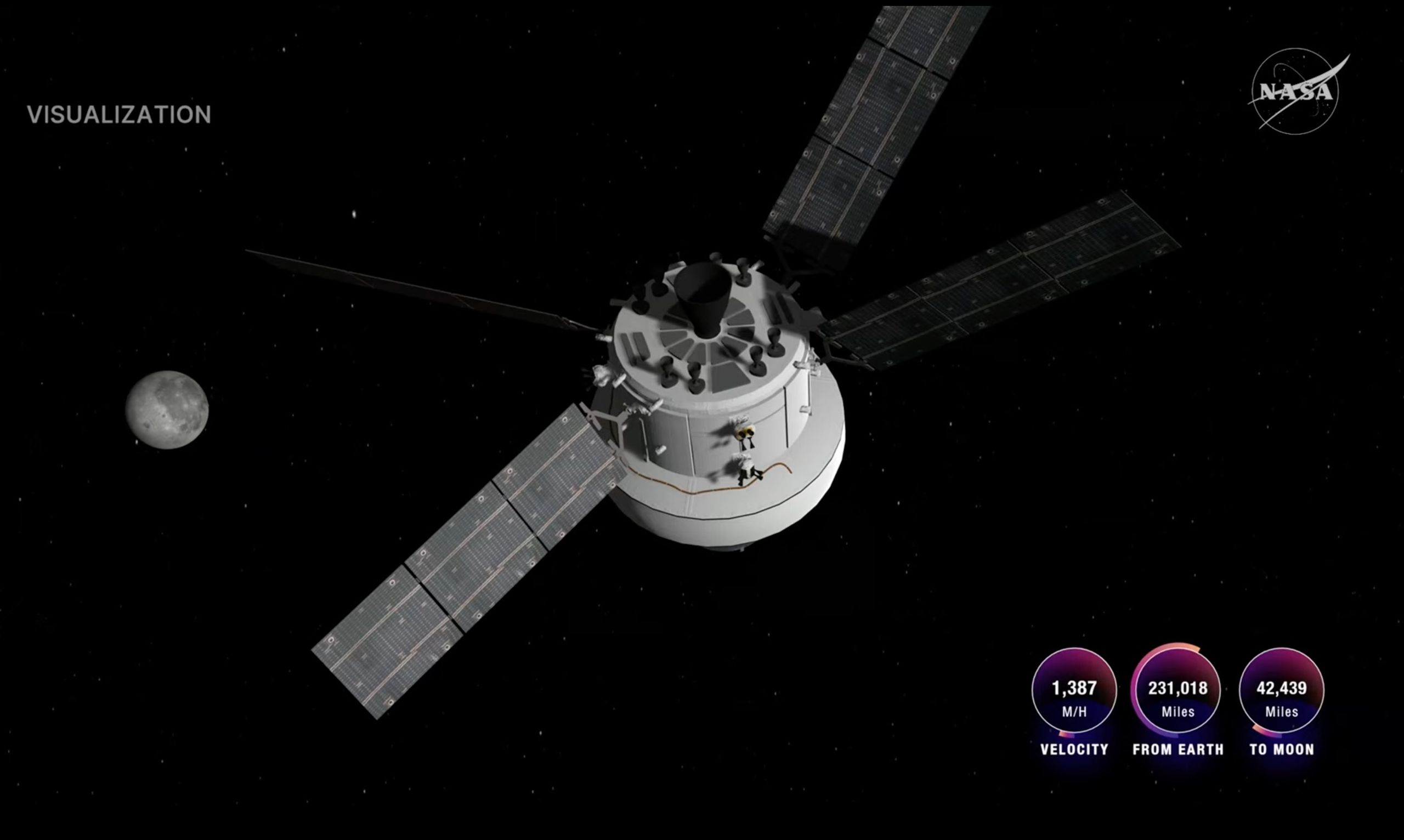
According to Space.com’s report, the milestone occurred at 12:37 a.m. EDT, when the Orion spacecraft was about 39,000 miles from the moon and roughly 232,000 miles from Earth. The crew of Artemis 2 consists of NASA astronauts Reid Wiseman, Victor Glover, and Christina Koch, along with Canadian Space Agency astronaut Jeremy Hansen.
The event marks a major step in NASA’s Artemis program, which is intended to reestablish human operations beyond low Earth orbit and build a path back to the lunar surface. Artemis 2 is not a landing mission, but its progress matters precisely because it demonstrates that a crewed spacecraft can once again travel safely to the moon’s neighborhood.
Why the Sphere of Influence Matters
The phrase “sphere of influence” can sound abstract, but it has real operational meaning. It refers to the point at which the moon’s gravity exerts a stronger pull on the spacecraft than Earth’s does. Crossing into that region is not the same thing as entering lunar orbit or attempting a descent, but it confirms that the mission has progressed into a genuine deep-space and lunar-navigation phase.
That matters for mission control, for spacecraft systems, and for the broader credibility of the Artemis architecture. A modern crewed lunar mission is not simply a replay of Apollo. It involves different spacecraft, updated life-support and communications systems, new mission planning assumptions, and a program structure designed to support repeat operations rather than isolated flags-and-footprints moments.
Every milestone on Artemis 2 therefore serves two roles. It is a success in its own right, and it is also a validation step for the missions that follow. The deeper Orion moves into the lunar environment, the more confidence NASA can build in the procedures and hardware that future crews will depend on.

The Human Meaning of the Mission
There is a reason this mission has drawn attention beyond the usual spaceflight audience. Artemis 2 reconnects human space exploration with a destination that has existed mostly as memory, archive footage, and long-range planning for half a century. The moon has remained close in astronomical terms, but distant in operational reality. Crossing back into lunar space changes that.
The crew composition also reflects a different era of exploration. Artemis 2 brings together astronauts from NASA and the Canadian Space Agency, underscoring that deep-space missions are now being framed as long-term international projects rather than purely national demonstrations.
That shift matters because the Artemis campaign is meant to support sustained activity. The objective is not only to reach the moon again, but to make lunar operations normal enough to support science, technology testing, and eventually the infrastructure needed for more ambitious missions beyond the moon.
What Comes Next
Space.com’s report focuses on the arrival in lunar space, and that milestone alone is enough to establish the mission’s significance. The next phases will be watched just as closely, because public confidence in Artemis depends on the whole mission profile, not on a single moment. Even so, entering the lunar sphere of influence is one of the clearest markers that the mission is achieving what it set out to do.
The importance of Artemis 2 also extends to the political and industrial side of spaceflight. Human exploration programs require sustained funding, stable institutional backing, and broad public legitimacy. Highly visible milestones help secure all three. When a crewed spacecraft returns to lunar space after decades away, it becomes easier to argue that the broader program is not hypothetical. It is underway.
That, in turn, affects suppliers, launch providers, mission planners, partner agencies, and the scientific community that hopes to use future lunar missions for research and fieldwork. A functioning crewed lunar program creates expectations that ripple far beyond a single flight.
For now, the headline is simple and historically resonant. Artemis 2 has carried people back into the moon’s gravitational domain. Humanity is not yet back on the lunar surface, but it is back in lunar space, and after more than five decades, that alone is a consequential return.
This article is based on reporting by Space.com. Read the original article.
Originally published on space.com