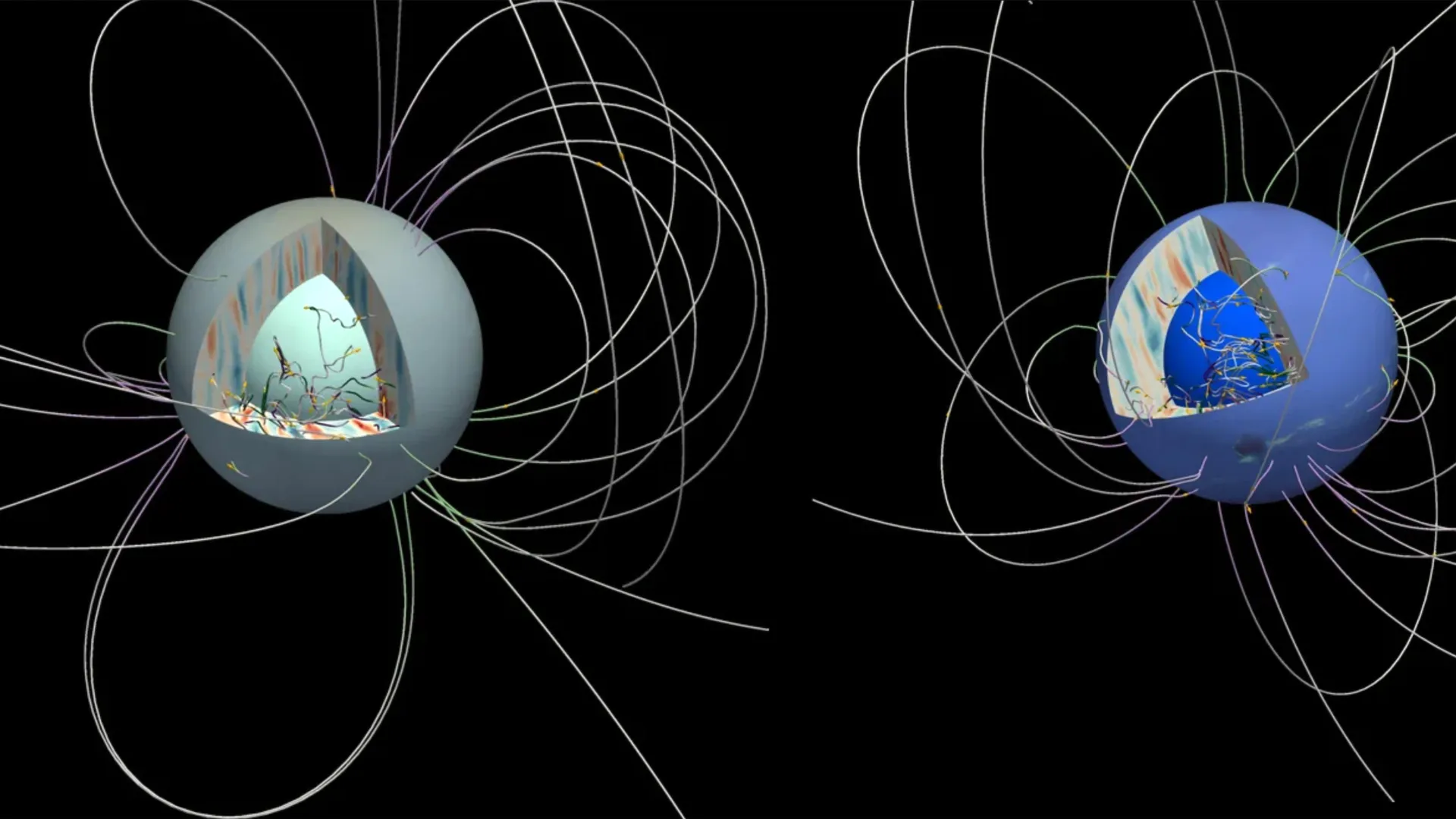
Uranus and Neptune have long been two of the solar system’s magnetic oddities. When NASA’s Voyager 2 spacecraft visited the ice giants in the 1980s, it found magnetic fields that looked markedly different from Earth’s comparatively orderly field. Rather than being closely aligned with the planets’ rotation axes, the fields are strongly tilted and distorted.
New simulations described in a study published in Communications Physics point to an explanation rooted in the extreme conditions deep inside the two planets. The work, led by researchers at the University of Texas at Austin with collaborators at UCLA, Imperial College London and Northumbria University, examines how changes in electrical conductivity could shape the dynamos that generate planetary magnetic fields.
A different kind of planetary dynamo
Magnetic fields arise when electrically conducting fluids move inside a planet. On Earth, circulating liquid iron in the outer core works with the planet’s rotation to create a magnetic field broadly resembling a bar magnet. Earth’s primary magnetic axis is tilted by about 11 degrees from its rotation axis, helping produce the familiar north and south magnetic poles.
The situation at Uranus and Neptune is much less regular. Uranus has a magnetic dipole tilted by 59 degrees, while Neptune’s is tilted by 47 degrees. The Voyager 2 observations also showed fields with shapes that depart substantially from a simple dipole. Those characteristics have made it difficult to explain the two planets using a straightforward Earth-like dynamo model.
The new research focuses on the fact that an ice giant’s deep interior is not expected to behave like Earth’s metallic outer core. Under enormous pressure and temperature, materials in Uranus and Neptune can have electrical properties that change significantly with depth. The simulations suggest those shifts in conductivity can alter where and how efficiently magnetic fields are generated.

Conductivity may reorganize the field
In the proposed models, extreme interior conditions produce layers with differing ability to conduct electricity. That structure changes the behavior of the moving conductive material responsible for the dynamo. Instead of consistently favoring a stable, bar-magnet-like field, the modeled dynamos can produce magnetic geometries more like the asymmetric and highly tilted fields seen at Uranus and Neptune.
This offers a route to reconciling the planets’ unusual magnetism with the same broad physical principle that operates in Earth’s core: the conversion of fluid motion and electrical conductivity into a magnetic field. The difference is not that Uranus and Neptune lack dynamos, but that their dynamos may work in interiors where the relevant electrical properties vary dramatically.
That distinction matters for planetary science. Magnetic fields are an indirect probe of conditions far beneath a planet’s clouds, where direct observations are impossible. If conductivity changes are central to the ice giants’ magnetism, magnetic measurements can help constrain the composition and physical state of their deep interiors.
Fields that may change on human timescales
The study’s simulations also raise the possibility that the magnetic poles of Uranus and Neptune could move by tens of degrees in only a few decades. That would be much faster than the changes generally associated with Earth’s main magnetic field.
Such behavior would make a single flyby-era measurement an incomplete picture of either planet. Voyager 2 remains the only spacecraft to have visited Uranus and Neptune, so scientists have had limited direct magnetic observations from which to reconstruct long-term change. If the models are borne out, the distinctive fields measured in the 1980s may represent only one phase in a much more dynamic process.
The finding does not mean the simulations have supplied a final answer for every feature of the two planets. But it identifies a specific mechanism that can generate the kind of irregular, tilted fields that have puzzled researchers for decades. It also creates a testable expectation: future measurements could reveal substantial evolution in the planets’ magnetic configurations.

Why future missions could matter
Uranus and Neptune are often grouped as ice giants, yet they remain far less explored than the solar system’s gas giants. Better measurements of their magnetic fields, gravity, atmospheres and internal structures would help determine whether the conductivity-driven dynamo scenario reflects conditions in the real planets.
The new work underscores why revisiting the outer solar system would be scientifically valuable. A mission capable of sustained observations could do more than refine a map of magnetic poles. It could examine whether the fields change over time, test models of conductive layers inside the planets and improve understanding of a planet type that may be common beyond the solar system.
For now, the research shifts the mystery from an apparently anomalous magnetic result toward a physically motivated explanation. Uranus and Neptune may not be failed versions of Earth’s dynamo. Their fields may instead be the natural outcome of interiors operating under conditions that are fundamentally different from those found inside rocky planets.
This article is based on reporting by Science Daily. Read the original article.
Originally published on sciencedaily.com