A Long-Promised Chemistry, Still Waiting on Durability
Lithium metal has been the great unfinished project of battery research for more than a generation. Swapping the graphite anode used in conventional lithium-ion cells for a layer of pure lithium metal would allow far more energy to be packed into the same volume and mass, a prospect that has drawn sustained investment from automakers, aerospace firms, and national laboratories. The obstacle has never been whether the chemistry can store energy. It is whether it can do so repeatedly without falling apart. A newly published paper in Science, Volume 393, Issue 6818, dated September 2026, takes direct aim at that question. Its title, "Unlocking cycle life of lithium metal batteries," frames the work around the single metric that has kept the technology out of the mainstream.
That framing is telling. In battery research, the announcement of a high-capacity electrode material is routine; the announcement of one that survives hundreds or thousands of charge and discharge cycles is not. By placing cycle life at the center of the title, the paper signals that its contribution belongs to the durability side of the ledger rather than the energy-density side — the harder and more consequential half of the problem.
What Cycle Life Actually Measures
Cycle life is the number of complete charge-discharge cycles a cell can undergo before its usable capacity falls below a defined threshold, typically a percentage of its original value. It sounds like a simple number, but it is the product of a punishing set of variables: how fast the cell is charged, how deeply it is discharged, at what temperature, and under what mechanical pressure. A chemistry that performs beautifully in a single laboratory test can fail quickly once those conditions are varied.
For lithium metal, the gap between a promising first cycle and a commercially viable thousandth cycle is where most research programs stall. Cells that look exceptional in early testing often show accelerating capacity fade, meaning the losses compound rather than level off. Understanding whether fade is linear, accelerating, or reaches a plateau is therefore as important as measuring the total number of cycles achieved.

The Science of Why Lithium Metal Fades
The reasons lithium metal anodes degrade are well established in the literature, and any serious attempt to extend cycle life has to confront several of them at once.
Dendrites and Inactive Lithium
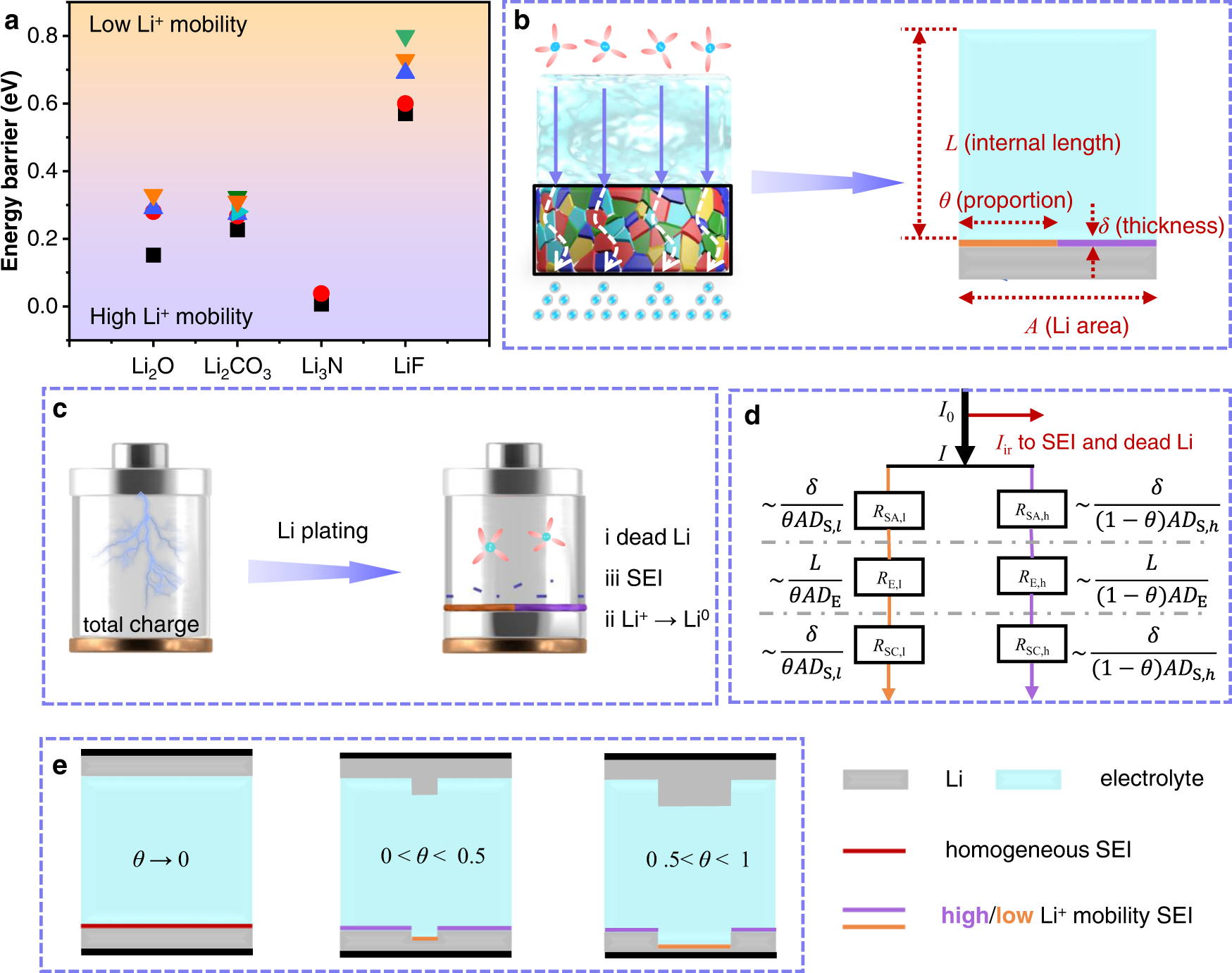
When lithium is plated onto the anode during charging, it does not always deposit as a smooth, uniform film. It can grow into needle-like structures known as dendrites, which can puncture the separator between electrodes, create short circuits, and in the worst case drive safety failures. Even when dendrites do not cause a short, irregular plating leaves behind isolated pockets of lithium that lose electrical contact with the electrode. This so-called dead lithium no longer participates in the reaction, so capacity quietly disappears with every cycle.
The Electrolyte Interface
Lithium metal is highly reactive, and it reacts continuously with the liquid electrolyte around it. The resulting surface layer — the solid electrolyte interphase — is essential for stable operation, but it is also consumed and reformed as the anode expands and contracts during cycling. Electrolyte is a finite resource inside a sealed cell, so its gradual depletion sets a hard ceiling on longevity. Much of the modern effort in the field involves designing electrolyte formulations and additives that produce a more stable, longer-lasting interface.
Pressure, Stacking, and Cell Design
Cycle life is not purely a chemistry question. Mechanical stack pressure, the choice of separator, the ratio of electrolyte to electrode, and the way cells are assembled all influence how evenly lithium plates and strips. Research groups increasingly treat the anode, electrolyte, and cell architecture as a single coupled system rather than separable components, because improvements in one area are frequently neutralized by weaknesses in another.
Why Publication in Science Matters
Science is one of the most selective venues in the physical sciences, and its battery coverage tends to favor work that either resolves a long-standing mechanistic dispute or demonstrates a step change in performance. A paper appearing there under a title about unlocking cycle life suggests that the reviewers saw something more than an incremental formulation tweak — most likely a mechanism, a design principle, or a measurement approach that others in the field can build on.
That distinction matters for how the result should be read. Papers that identify a mechanism often influence research direction even when the specific device they describe is not ready for manufacturing. The durable contribution is the explanation, not the prototype.

Where Longer Cycle Life Would Matter Most
The applications that would benefit from a lithium metal anode with genuinely long cycle life span nearly every corner of the energy economy:
- Electric vehicles. Automakers have pursued lithium metal and related anode-free designs because they promise greater driving range from a battery of the same weight, but warranty periods measured in years demand thousands of cycles.
- Electric aviation. Weight is everything in aircraft, and the energy density advantage of a lithium metal anode is one of the few plausible routes to regional electric flight.
- Grid storage. Stationary batteries must tolerate frequent cycling over a decade or more, and replacement costs dominate their economics.
- Consumer electronics. Phones, laptops, and wearables would gain from thinner cells with higher capacity, provided the battery does not degrade faster than the device it powers.
- Space and defense. Missions that cannot service hardware place an especially high premium on predictable, long-lived energy storage.
Reading the Result in Context
A single journal paper does not settle a decade-old engineering problem, and the transition from a laboratory cell to a production line is where most battery breakthroughs quietly expire. Manufacturing a lithium metal anode at scale requires handling a material that reacts with moisture and air, and every process step adds cost. Researchers and analysts will therefore be watching for the details behind the headline: the cycling conditions used, whether the result holds under fast charging, how the cell behaves at realistic temperatures, and whether the approach can be reproduced with commercially available materials.
It is also worth noting that this result arrives into a crowded field. Solid-state electrolytes, anode-free cell architectures, and lithium-rich cathode chemistries are all competing for the same performance territory, and progress in any one of them reshapes the benchmark the others must beat.

The Bottom Line
Lithium metal batteries have spent years being described as a few breakthroughs away from commercialization. The Science paper's focus on cycle life is a reminder of where the real difficulty lies: not in storing more energy, but in storing it again and again without losing ground. If the work delivers a durable mechanism for extending that lifetime, it will be a meaningful data point in a long-running effort — one that the battery industry will measure not in cycles on a laboratory bench, but in years of service in the field.
This article is based on reporting by Science (AAAS). Read the original article.
Originally published on science.org


