The Promise and Challenge of Perovskite Solar Cells
Perovskite solar cells have captured the attention of the photovoltaic community due to their remarkable efficiency gains over the past decade. These devices, based on a class of materials with a distinctive crystal structure, offer the prospect of low-cost, high-performance solar energy. Yet for all their promise, perovskite photovoltaics face a persistent obstacle: operational stability. The very lattice that enables efficient light absorption and charge transport also permits the movement of ions within the material, a phenomenon that can degrade performance over time.
A new paper published in Science, titled "Prussian blue regulates ion dynamics in perovskite solar cells," addresses this challenge directly. The article appears in Volume 393, Issue 6818, on pages 1329–1334 of the September 2026 issue. The work focuses on a specific material—Prussian blue—as a means to manage the migration of ions, a process that has long complicated efforts to commercialize perovskite technology.
Understanding Ion Migration in Perovskite Materials
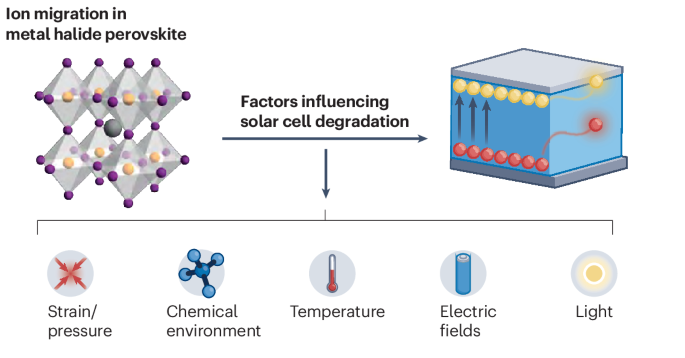
Ion migration refers to the movement of charged species—such as halide ions, organic cations, and metal cations—within the perovskite crystal lattice. Unlike electrons and holes, which are the desired charge carriers in a solar cell, ions are relatively heavy and slow. Their motion, however, can have outsized effects on device behavior. When ions migrate, they can accumulate at interfaces, create internal electric fields, and distort the built-in potential that drives charge extraction.
This migration is linked to several well-known problems in perovskite solar cells:
- Current-voltage hysteresis: The performance of a perovskite cell can depend on the direction and history of the voltage scan, a sign of slow ionic redistribution.
- Degradation: Ion movement can trigger chemical reactions that break down the perovskite layer or corrode adjacent contact materials.
- Phase instability: Mobile ions can contribute to the transformation of the photoactive perovskite phase into inactive phases.
Because ion dynamics influence both efficiency and lifetime, researchers have explored numerous strategies to control them. These include compositional engineering, additive molecules, interfacial layers, and low-dimensional capping layers. The new study introduces a different approach: using Prussian blue, a classic coordination compound, as a regulator of ionic motion.

What Is Prussian Blue?
Prussian blue is a deep blue pigment with the chemical formula Fe4[Fe(CN)6]3. It has been known since the early 18th century and is widely used in inks and paints. More recently, it has attracted interest in materials science because of its open framework structure. The compound consists of iron centers linked by cyanide bridges, forming a rigid, porous lattice with channels that can accommodate guest ions.
This open framework gives Prussian blue several useful properties. It can undergo reversible redox reactions, intercalate small ions such as lithium, sodium, and potassium, and maintain structural integrity during cycling. These characteristics have made it a candidate for batteries, electrochromic devices, and sensors. In the context of perovskite solar cells, the same ion-insertion chemistry may offer a way to buffer or redirect mobile ions that would otherwise disrupt the device.
The Study: Prussian Blue as an Ion Dynamics Regulator
The paper published in Science investigates how Prussian blue can regulate ion dynamics within perovskite solar cells. According to its title, the compound is used to influence the movement of ions—presumably by interacting with them through its framework or surface chemistry. The study is part of a broader effort to improve the operational stability of perovskite photovoltaics without sacrificing their high power conversion efficiencies.
While the full details of the experimental methods and results are available in the journal article, the title alone signals a novel direction. Rather than simply blocking ion migration with a barrier layer, the approach may involve a dynamic regulation mechanism. Prussian blue's ability to host ions could allow it to act as a reservoir or sink, moderating the concentration of mobile species at critical interfaces. Alternatively, the compound might influence the energy landscape for ion hopping, making migration less favorable. These possibilities align with the known chemistry of Prussian blue and its analogues.

Potential Mechanisms and Implications
If Prussian blue can effectively regulate ion dynamics, the implications for perovskite solar cells could be significant. Reduced ion migration would likely lead to:
- Lower hysteresis in current-voltage measurements, making device performance more predictable.
- Improved long-term stability under illumination and thermal stress.
- Better interface integrity, as fewer ions would accumulate at charge-transport layers.
These improvements would address some of the most pressing concerns for the commercialization of perovskite photovoltaics. The technology has already demonstrated efficiencies above 25% in laboratory settings, but modules must survive decades of outdoor operation. Any strategy that enhances stability while being compatible with existing fabrication processes is therefore highly valuable.
The use of Prussian blue also raises interesting questions for further research. How does the compound interact with different perovskite compositions? Does it remain stable under prolonged illumination? Can it be incorporated into large-area devices? The Science paper provides a foundation for exploring these questions, and its publication in a high-impact journal suggests the findings are of broad interest to the materials and energy communities.
Broader Context: Materials Innovation in Photovoltaics
The work fits into a larger trend of using multifunctional materials to solve device-level problems. In recent years, researchers have introduced polymers, small molecules, metal oxides, and 2D materials into perovskite solar cells to passivate defects, improve charge extraction, and enhance stability. Prussian blue adds a new entry to this toolbox, one with a rich and tunable chemistry.
Analogues of Prussian blue, known as Prussian blue analogues, allow for substitution of different metal ions, which can tailor the framework's properties. This versatility could enable fine-tuning of ion regulation for specific perovskite formulations. It also connects perovskite research to other fields, such as battery science and electrochemistry, where Prussian blue has been extensively studied. Such cross-pollination often leads to unexpected advances.

Conclusion
"Prussian blue regulates ion dynamics in perovskite solar cells," published in Science (Volume 393, Issue 6818, pages 1329–1334, September 2026), represents a promising step toward more stable perovskite photovoltaics. By targeting ion migration—a fundamental challenge—the research offers a potential pathway to devices that combine high efficiency with long operational lifetimes. While further work is needed to translate the findings into commercial products, the study highlights the power of materials chemistry in addressing the complex failure modes of emerging solar technologies. As the world seeks affordable, scalable renewable energy, innovations like this will be essential to moving perovskite solar cells from the laboratory to the rooftop.
This article is based on reporting by Science (AAAS). Read the original article.
Originally published on science.org