A new route around a classic thermal limit
Researchers have proposed a material system that could let engineers control heat in a far more selective way than conventional physics usually allows. The design, described in a June 25 study in Laser & Photonics Reviews, aims to independently tune how a surface absorbs and emits heat radiation, then preserve that setting even after power is removed.
If realized in practice, that would mark a significant advance for thermal engineering. Heat management sits at the center of modern technology, from industrial energy systems and electronics cooling to infrared devices and advanced sensors. Yet one of the field’s long-standing constraints has been reciprocity: under ordinary conditions, a material that is effective at absorbing heat from a given direction is also effective at emitting it in that same direction.
That principle traces back to 19th-century physicist Gustav Kirchhoff, and it has shaped how engineers think about thermal design for roughly 160 years. The newly described device does not simply offer a better insulator or radiator. Instead, it proposes a way to break the usual symmetry and make incoming and outgoing thermal radiation behave differently depending on direction.
How the proposed device works
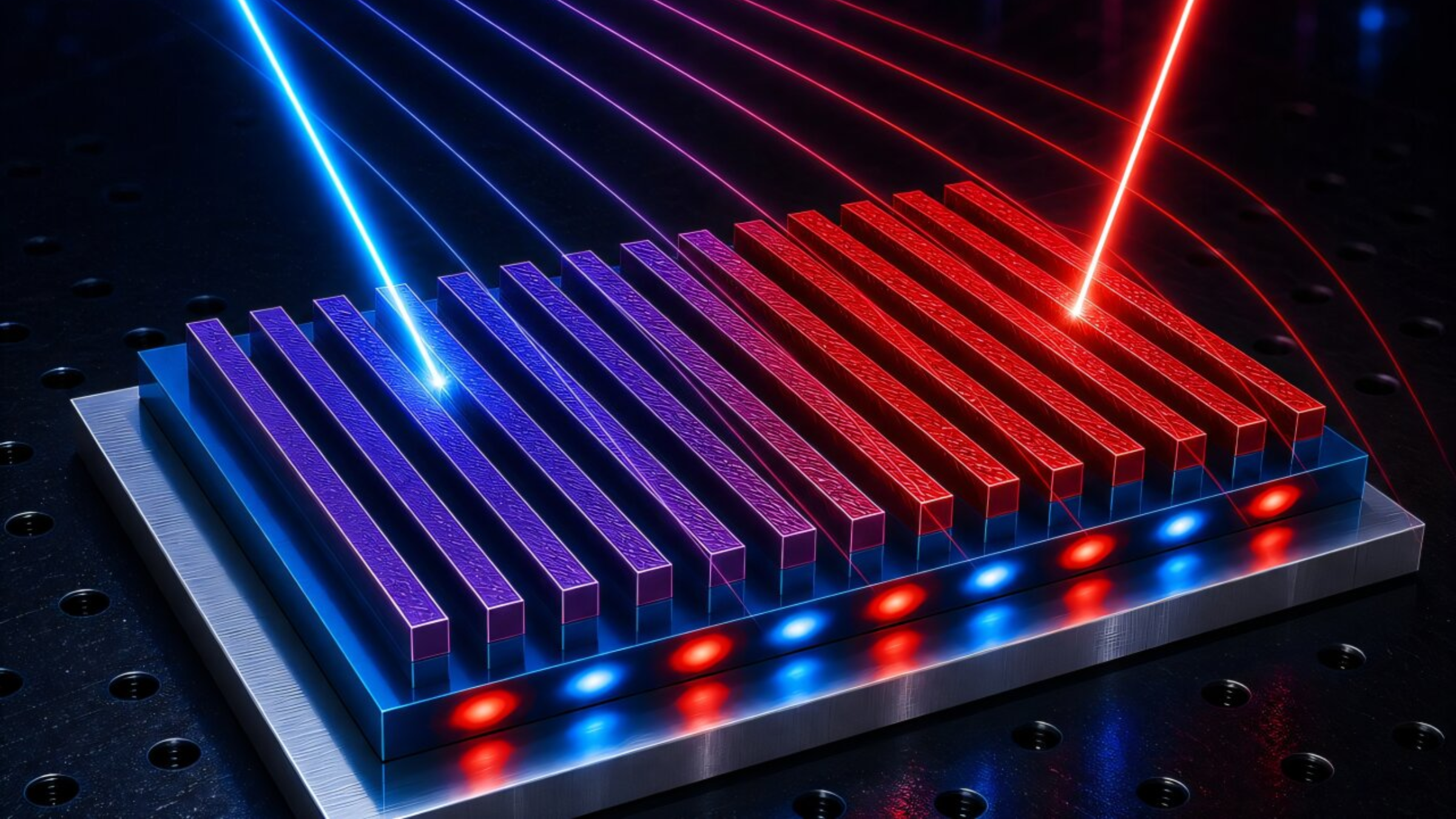
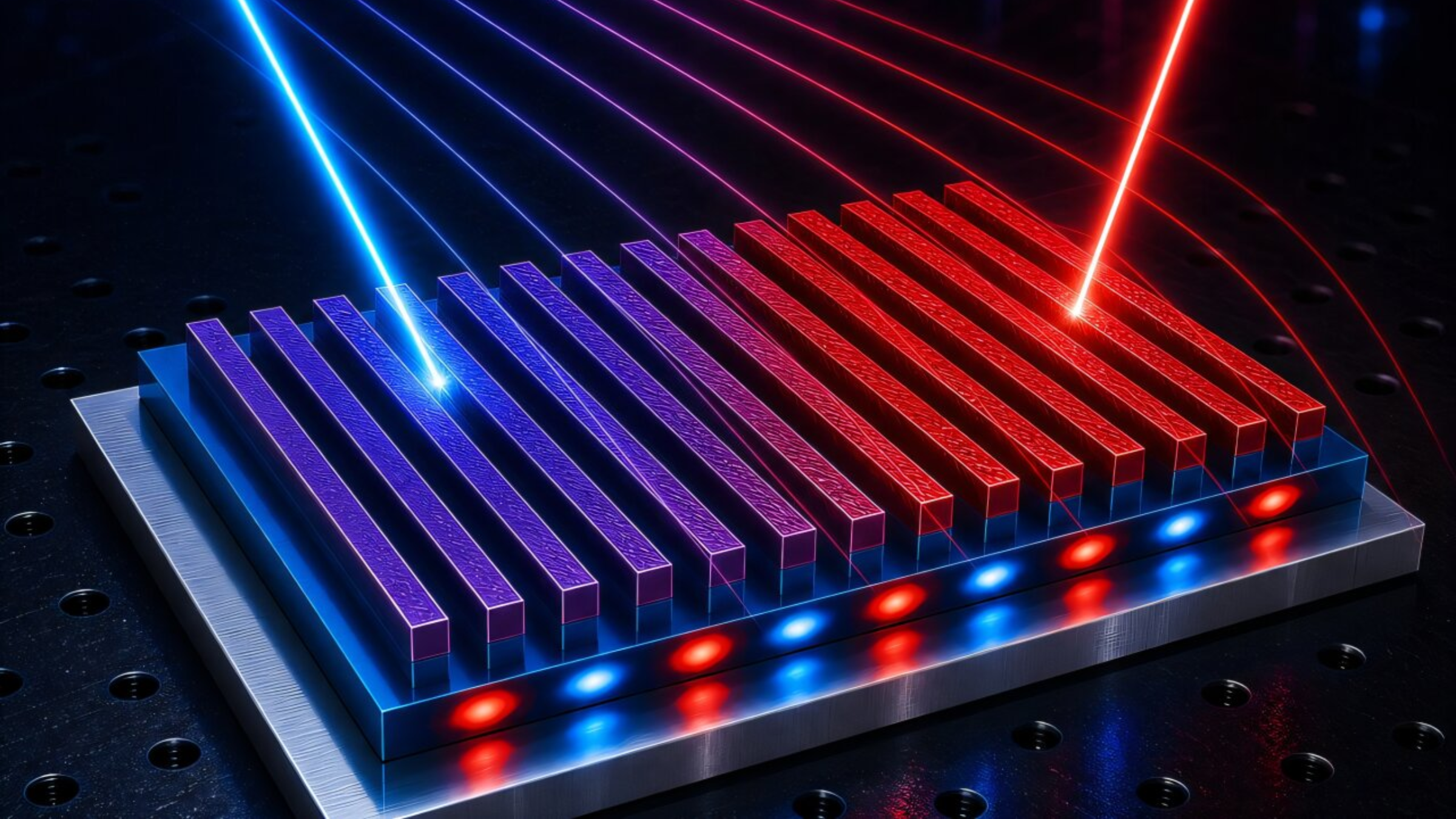
The design combines two materials with different roles. One is indium arsenide, which interacts with infrared light and heat radiation. The researchers propose applying a magnetic field to this layer to break its natural symmetry, so that radiation traveling one way behaves differently from radiation traveling the other way.
On top of that sits a grating made from germanium-antimony-tellurium, or GST, a phase-change material already known for its ability to switch between two distinct structural states. The key feature of GST is persistence: once it is switched into one state, it remains there until deliberately changed again.
That persistence is what makes the design especially notable. In the proposed architecture, GST does more than assist the directional thermal effect. It effectively locks the heat-handling behavior into place, allowing the system to retain its programmed state without requiring continuous power.
In other words, the material would not just modulate heat while an external control is active. It could store a thermal setting. That opens the door to thermal components that behave more like memory devices, preserving a configuration rather than constantly needing energy to maintain it.

Why reciprocity matters
Reciprocity is one of those background rules that rarely gets public attention but deeply influences design. In thermal systems, it means engineers often cannot optimize heat intake and heat release separately. A surface that is good at taking in radiation from a direction tends to be good at sending radiation back out in that same directional pattern.
That linkage can be limiting. Energy systems, spacecraft thermal controls, buildings, and electronics often have competing needs: absorb little heat in one context, emit a lot in another, or handle directional heat flows in a selective way. A material system that loosens that connection could give designers far more flexibility.
The reported concept targets exactly that problem. By combining magnetic-field-induced asymmetry with a nonvolatile phase-change layer, the researchers outline a way to create directional thermal behavior that is both controllable and persistent.
Potential applications
The research remains at the design stage, but the possible use cases are broad if the concept can be fabricated and scaled. More precise control over thermal radiation could matter in several areas:
- Energy systems that need to minimize waste heat or direct thermal flows more efficiently.
- Infrared devices and thermal management hardware that benefit from directional heat control.
- Low-power thermal components because the programmed state can remain in place after power is switched off.
- Experimental computing architectures that encode information through heat behavior instead of electrical charge alone.
The prospect of storing information using heat rather than electricity is particularly intriguing. The source text frames this as a potential long-term application rather than an immediate product path, but it highlights how thermal physics and information technology may increasingly overlap.
What the study does and does not show
The most important qualifier is that the work describes a proposed device design rather than a commercial technology or field-ready platform. The article says the researchers designed a theoretical device, not that they demonstrated a mass-manufacturable system operating in deployed conditions.
That distinction matters. Materials breakthroughs often look strongest at the concept or laboratory stage, while practical deployment depends on fabrication tolerances, durability, cost, switching reliability, and compatibility with existing systems. Those questions are not resolved simply because a new physical pathway has been identified.
Even so, concept papers can be highly consequential when they challenge assumptions that have constrained an entire field. If engineers can independently govern absorption and emission in a programmable, nonvolatile way, thermal design rules could begin to change in the same way that tunable optical and electronic materials opened new device classes in earlier decades.
The study’s importance, then, lies less in an immediate consumer or industrial product and more in the possibility that a core thermal limitation may be more negotiable than previously thought.
Why this matters now
Thermal control is becoming more important, not less. Data centers, high-performance computing, electrified systems, advanced manufacturing, and space technologies all face mounting pressure to manage heat with greater precision and lower energy overhead. Materials that can direct, store, or selectively release thermal energy could become foundational tools in that effort.
The proposed device also fits a wider trend in materials science: the move from passive substances to programmable ones. Instead of accepting fixed thermal properties, researchers are increasingly trying to build materials whose behavior can be set, changed, and retained depending on system needs.
That shift has strategic implications. Programmable thermal materials could eventually influence energy efficiency, sensing, communications, and computing. The study does not claim those outcomes have been achieved. What it does suggest is that a route may exist toward them, built from a combination of symmetry-breaking physics and a memory-like phase-change layer.
For now, the work stands as a compelling demonstration of where thermal materials research is heading: away from static surfaces and toward configurable systems that can treat heat as something to be directed with intent rather than merely endured as a byproduct.
This article is based on reporting by Live Science. Read the original article.
Originally published on livescience.com