A Cambrian Fossil Rewrites the Early History of Spider Fangs
A fossilized marine animal no longer than a few centimeters is giving researchers a rare look at how one of the most recognizable anatomical tools in the animal kingdom first emerged. In a study reported by researchers from Yunnan University and the University of Leicester, a 518-million-year-old creature called Urokodia preserves the earliest known evidence of structures that later evolved into the fang-bearing appendages seen in modern spiders.
The finding matters because spider fangs are part of a much older evolutionary story than spiders themselves. Those fangs are modified versions of chelicerae, a pair of specialized appendages that define a broader group of animals known as chelicerates. Today that group includes spiders, scorpions, and ticks, but its roots reach back into the Cambrian, a period when many major animal body plans were first diversifying.
By identifying pincer-like appendages in Urokodia, the researchers argue that the basic anatomical foundations of later spider and scorpion feeding structures were already in place more than half a billion years ago. That does not mean the animal had spider fangs in the modern sense. It does mean that the evolutionary building blocks behind those predatory tools appeared much earlier than the later terrestrial species that made them famous.
What the Fossil Shows
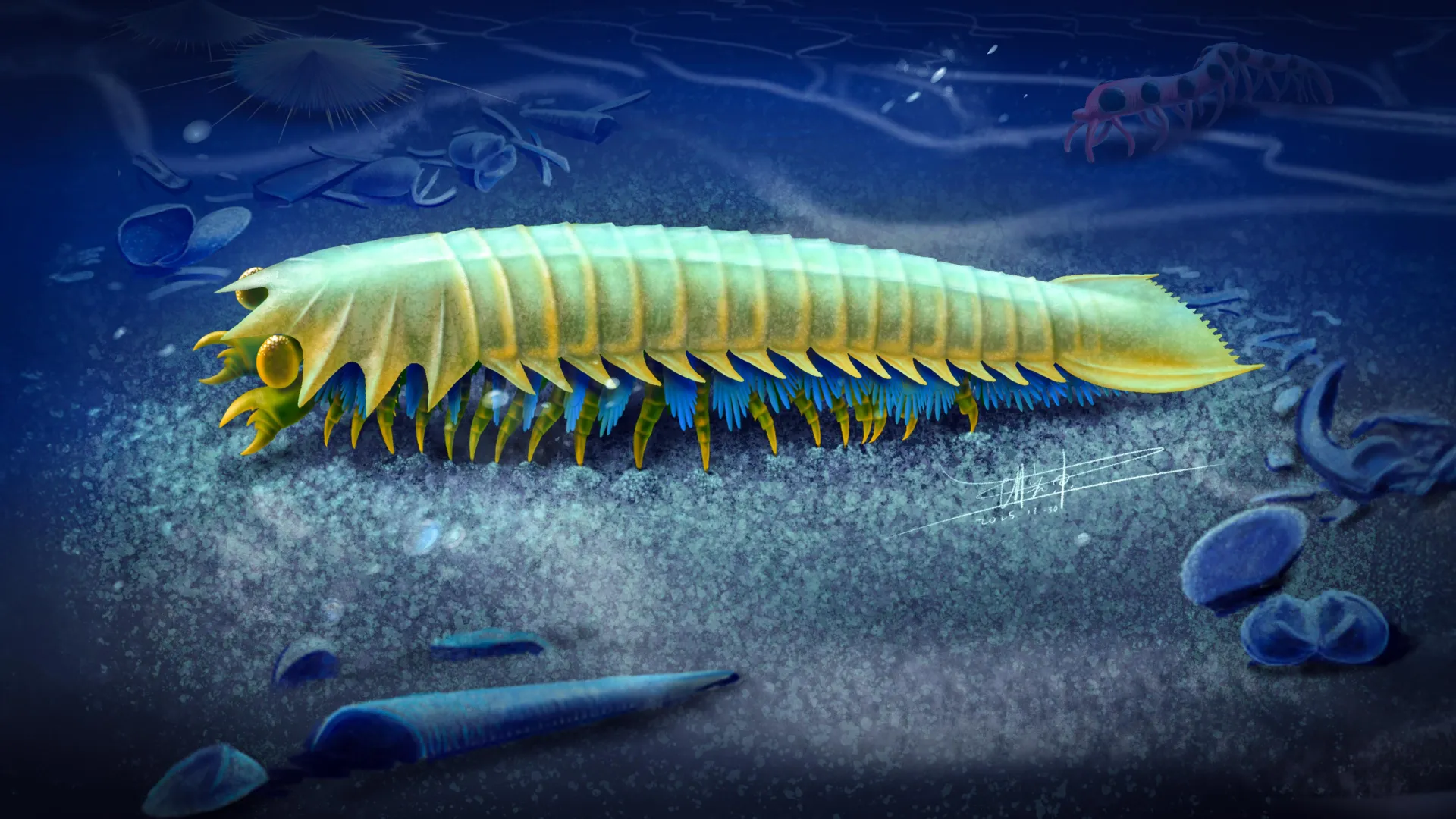
The fossil was recovered from the Chengjiang site in Yunnan Province, one of the world’s best-known deposits for exceptionally preserved early Cambrian life. According to the source material, Urokodia measured roughly 2 to 3 centimeters long and had a narrow segmented body, jointed limbs beneath it, and prominent eyes on stalks projecting from the front.
On the surface, that body plan does not immediately resemble a modern spider. The importance of the specimen comes from what researchers could see inside the surrounding rock. Using X-ray methods, the team examined preserved soft anatomy that survived in what the report describes as a mummified state. That level of preservation is unusual and especially valuable in fossils this old, because soft tissues are normally lost long before burial can lock them into the rock record.
The key observation was a pair of pincer-like appendages positioned just behind the eyes. Researchers interpret these as early chelicerae, the same basic anatomical structure that would later diversify into the grasping or piercing mouthparts of many modern chelicerates. In present-day species, chelicerae can function in different ways depending on lineage. In spiders they became fangs capable of piercing prey, while in other groups they can operate more like pincers.
That makes Urokodia important not because it looks like a spider, but because it helps anchor a deeper branch in the family tree. The fossil preserves a stage at which the lineage had not yet acquired the full form of later arachnids, but had already evolved a defining anatomical innovation.

Why Evolutionary Timing Matters
For paleontologists, the timing of when major structures first appear can reshape how broader evolutionary transitions are understood. Chelicerates are a large and successful branch of invertebrate life, with more than 100,000 described species according to the source text. Yet deep questions remain about how their hallmark body structures arose and how early marine forms connect to later land-dwelling predators.
This discovery offers a concrete fossil data point. Instead of inferring the origin of chelicerae only from living animals and younger fossils, researchers can now point to a Cambrian organism preserving an early version of the structure. That helps narrow the window in which the trait must have evolved and gives scientists a more detailed starting point for reconstructing how later predatory specializations emerged.
The result also reinforces the scientific value of exceptionally preserved fossil sites. Without the Chengjiang deposit and the ability to image hidden anatomy, Urokodia might have remained just another small segmented marine animal. Advanced imaging turned it into evidence for a major evolutionary milestone.
How the Discovery Fits Into the Bigger Picture
The Cambrian Period is often described as a time of evolutionary experimentation, when animal lineages were diversifying rapidly and ecological roles were becoming more complex. Predation was a major part of that shift. Specialized appendages for grasping, piercing, and processing prey became central to how many groups competed and survived.
Seen in that context, the appendages in Urokodia are more than a curiosity. They point to the early assembly of a body plan that would later produce some of the most effective terrestrial predators among invertebrates. Spiders and scorpions are separated from Cambrian marine ecosystems by immense spans of time, but the fossil suggests their defining weaponry grew out of much older anatomical experiments in the oceans.
The study does not answer every question about how spider fangs evolved. The source material notes that the fossil reveals the earliest known evidence of the structures that eventually became those fangs, not the final stage itself. Evolution works through modification, and what appears in Urokodia is an ancestral form whose descendants would continue changing across many later branches.
Even so, the fossil helps explain how a familiar modern structure can emerge through a long series of transformations rather than appearing abruptly. It is a reminder that some of the traits most associated with present-day animals began in creatures that looked nothing like their descendants.

What Researchers Can Do Next
The next step is not simply to find older fossils, though that would be valuable. It is also to compare Urokodia more closely with other early arthropod-like organisms and refine where it sits in the chelicerate family tree. Better imaging, new specimens, and more detailed anatomical comparisons could show whether the appendages seen here were already performing a specialized feeding role or represent an intermediate stage in a broader structural transition.
For now, the finding gives paleontology something it rarely gets at this depth in time: a fossil that connects a famous modern trait to a specific early anatomical precursor. In practical terms, that makes Urokodia a small animal with an outsized role in explaining how the evolutionary roots of spider fangs first took shape in Cambrian seas.
Key Points
- The fossil animal Urokodia lived about 518 million years ago during the early Cambrian.
- Researchers identified pincer-like appendages interpreted as early chelicerae.
- Chelicerae are the structures that later diversified into spider fangs and related mouthparts.
- The specimen was studied using X-ray methods that revealed preserved soft anatomy.
- The discovery provides the earliest known evidence for the origins of these hallmark chelicerate structures.
This article is based on reporting by Science Daily. Read the original article.
Originally published on sciencedaily.com


