Why Nacre Still Sets the Standard for Tough Ceramics
The iridescent lining of an oyster shell may look delicate, but it is one of the most mechanically ingenious materials in nature. Nacre — mother-of-pearl — is composed almost entirely of aragonite, a brittle crystalline form of calcium carbonate that on its own offers little resistance to fracture. Bound together by only a few percent of organic protein and polysaccharide, however, the mineral is reorganised into a layered composite that absorbs energy on a scale pure ceramic cannot match. The performance comes not from the ingredients but from the architecture.
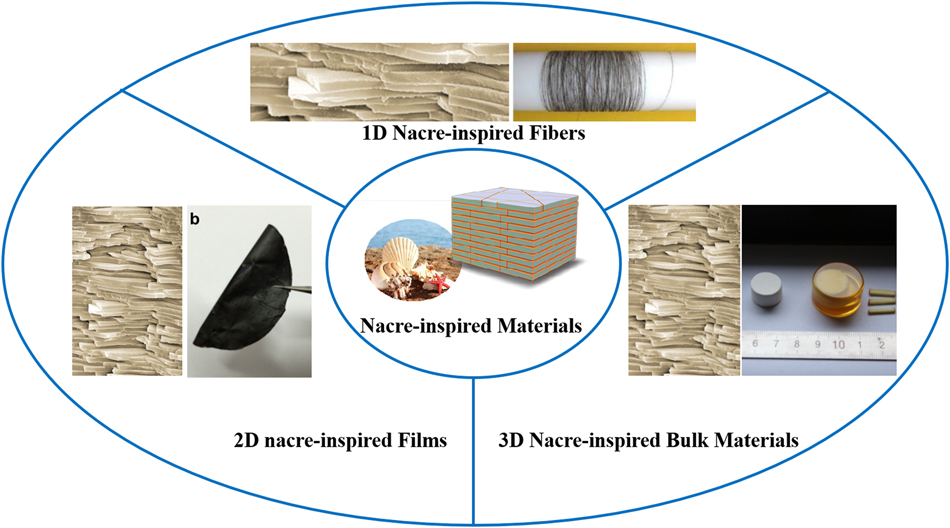
That architecture repeats itself across several length scales. Microscopic polygonal tablets of aragonite are stacked in aligned sheets and separated by nanometre-thin organic films. The tablets are themselves mosaics of smaller crystalline domains rather than single crystals, and mineral bridges occasionally thread through the organic layers to link one tablet to the next. When a crack attempts to move through this structure, it is deflected and twisted along a far more circuitous route than it would follow in a monolithic ceramic. Tablets slide against one another, the organic glue stretches, and energy that would otherwise drive fracture is dissipated instead.
What the New Paper Adds
That biological blueprint is the backdrop for a study now published in Science. The paper, which appears in Volume 394, Issue 6819, on pages 81–86 in October 2026, is titled “Hierarchical crystalline organic-inorganic framework enabling high-modulus toughening in nacre.” Its framing places it squarely within the long-running effort to reproduce nacre's combination of stiffness and damage tolerance using synthetic chemistry rather than shellfish.
The title points to a specific strategy: a hierarchical, crystalline framework that integrates organic and inorganic components and, according to the paper's framing, delivers toughening while preserving a high modulus — the measure of a material's resistance to elastic deformation. In practical terms, that is the combination engineers have chased for decades, because the two properties usually pull in opposite directions. The work arrives in one of the world's most selective scientific journals, which means its claims have passed peer review and its underlying data have been examined by specialist referees.

The Stiffness–Toughness Trade-Off
Materials science has a persistent problem. Stiff, strong materials — ceramics, glasses, many metals — tend to be brittle: they carry load efficiently until, suddenly, they do not. Tough materials such as polymers and elastomers deform gracefully and soak up impact energy, but they are compliant and easily dented. Getting both properties in a single material is difficult because they arise from different mechanisms. Stiffness comes from strong atomic bonds and rigid crystal lattices; toughness comes from mechanisms that dissipate energy, and those mechanisms generally require the material to yield, slide, or crack in controlled ways.
Engineers have developed a toolbox of partial answers:
- Crack deflection, in which layered or fibrous second phases force a crack to change direction and consume more energy.
- Fiber bridging, where reinforcing fibres hold crack faces together behind the advancing tip.
- Transformation toughening, used in zirconia-based ceramics, where a stress-induced phase change absorbs energy.
- Layered and laminated architectures, including glass laminates and engineered composites, that spread damage rather than let it run.
Nacre achieves all of this simultaneously, using cheap mineral and a tiny organic fraction, at ambient temperature and pressure. That efficiency is why it remains such an attractive target.
Decoding “Hierarchical Crystalline Organic–Inorganic Framework”
The phrase in the title packs three ideas together. “Organic–inorganic” describes a hybrid: inorganic crystalline matter — the mineral-like component that supplies stiffness — combined with organic molecules that supply compliance and can mediate how the mineral grows and how it fails. “Crystalline” signals that the inorganic phase retains ordered atomic structure rather than acting as an amorphous filler; crystallinity is generally what gives a material its modulus. “Hierarchical” indicates the structure is organised at more than one scale, from molecular or nanoscale ordering up through the microscopic architectures that control crack behaviour.
It is the coupling of those levels that matters. A framework organised only at the molecular scale might be stiff but brittle; one organised only at the macroscopic scale might be tough but weak. Nacre's advantage is that its hierarchy is continuous — each level of structure influences the next. A synthetic framework described as hierarchical in this sense is therefore attempting to reproduce not just a single trick, but the layered logic of the biological original.

Where Such Materials Could Matter
If the approach proves robust and manufacturable, the applications are broad:
- Lightweight protective systems, where a material must resist impact without adding mass.
- Aerospace and automotive structures, where stiffness governs performance and toughness governs safety.
- Biomedical devices, including dental restorations and bone-repair scaffolds that need to match the mechanical behaviour of hard tissue.
- Impact-resistant coatings and transparent armour, where layered architectures are already used.
- Consumer electronics and energy hardware, where stiff but damage-tolerant substrates and separators are valuable.
Questions That Remain
Several obstacles stand between a laboratory demonstration and a product. Manufacturing a hierarchical organic–inorganic framework at scale is often the hardest step, since precise control at several length scales does not translate easily into high-volume production. Cost matters too: a process that relies on specialised precursors or slow self-assembly may be difficult to justify commercially. Long-term stability is another concern — organic components can degrade under heat, humidity, ultraviolet light, or repeated loading, and a material that loses its organic phase may lose the very toughness it was designed for.
Fatigue behaviour, resistance to environmental ageing, and performance under multi-axial or repeated impact will all require thorough characterisation before adoption in safety-critical roles. Questions about recyclability and the environmental footprint of new hybrid chemistries will also shape how quickly industry takes an interest.

The Bigger Picture
Work of this kind sits within a wider wave of biomimetic materials research, in which the strategies evolved by organisms over hundreds of millions of years serve as design specifications for synthetic systems. Shells, bone, teeth, wood, and silk all combine modest ingredients into structures that outperform most engineered alternatives at comparable cost and weight. Each advance in understanding those biological architectures — and in rebuilding them in the laboratory — expands the palette available to designers facing the perennial demand for materials that are lighter, stronger, and harder to break.
The nacre-inspired framework described in Science is one more entry in that catalogue. Whether it becomes a platform technology or a valuable piece of fundamental insight depends on the work that follows: replication, scaling, and the unglamorous engineering that turns a promising structure into a dependable material.
This article is based on reporting by Science (AAAS). Read the original article.
Originally published on science.org